
Age, Time Cards and Time Arithmetic: How the Counting Works
Why an exact age is counted by anniversaries, what to do with a 29 February birthday, how to turn punches into decimal payroll hours, and why 7.45 hours is not 7:45.
· 9 min read
Ages, timesheets and durations look like the easiest arithmetic there is, and yet they produce a steady supply of wrong answers: a birthday counted a day early, a paycheck short by twenty minutes a day, 7.45 hours typed into payroll when the worker meant 7:45. The cause is the same every time. Calendars and clocks are not decimal, and the shortcuts that work for ordinary numbers quietly break on them. This guide explains how the Age Calculator, the Time Card Calculator and the Time Calculator do the counting, and the judgment calls behind each rule, so you can check any result by hand.
Counting an exact age
The everyday question "how old am I?" has a precise answer: the number of birthdays you have had. Everything finer than that follows the same anniversary logic.
- Whole years are the birthdays that have happened on or before the date you are asking about.
- Whole months are counted from the most recent birthday, each one complete on the same day number of the following month.
- Days are whatever is left over.
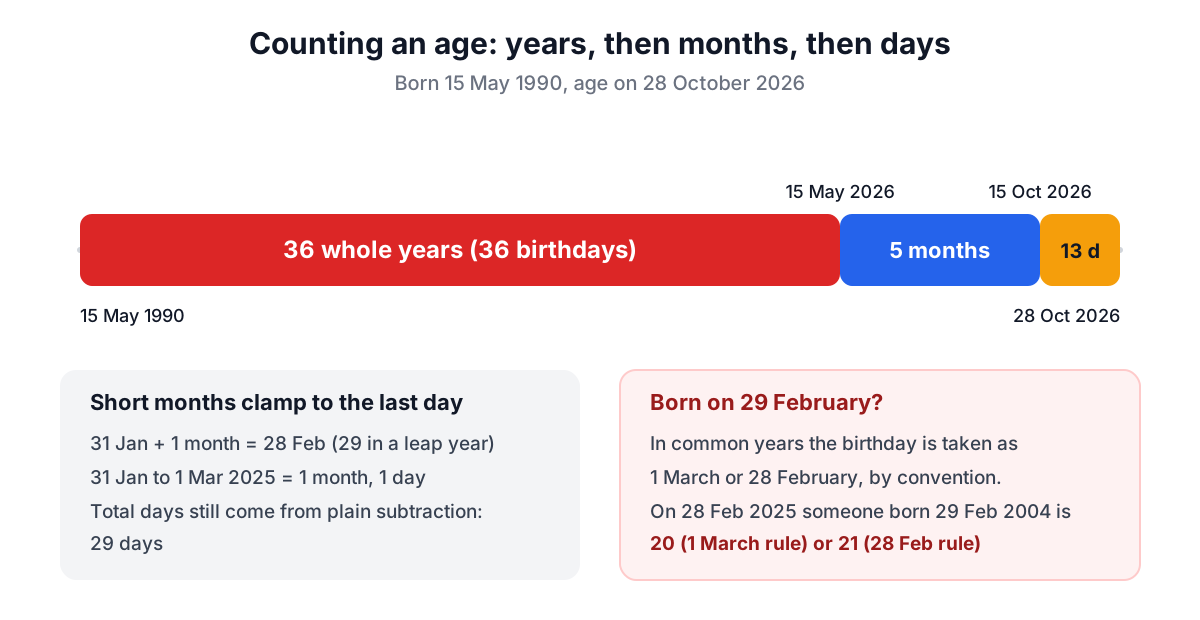
Take someone born on 15 May 1990, asked on 28 October 2026. Their 36th birthday was 15 May 2026. Counting on, 15 June, July, August, September and October make five whole months. From 15 October to 28 October is 13 days. The age is 36 years, 5 months and 13 days.
Why not divide the number of days by 365.25? Because the result drifts. The same 13,315 days divided by 365.25 gives 36.45 years, and turning 0.45 of a year back into months and days depends on which months you mean. The anniversary method is the one that matches a paper calendar, legal age limits and how people actually celebrate.
When the day does not exist
Months have 28 to 31 days, so "the same day number next month" is sometimes missing. The usual rule, and the one the calculator uses, is to clamp to the last day of the shorter month. A baby born on 31 January is one month old on 28 February, or 29 February in a leap year. Someone born on 31 January 2025 and asked on 1 March 2025 is 1 month and 1 day old, even though only 29 days have passed. Totals in days, weeks and hours are not affected by this, because they come from simple subtraction of the two dates.
Birthdays on 29 February
About one person in 1,461 is born on a leap day, and in three years out of four their birthday does not exist. There is no single rule for when they get older. Some laws, such as Maryland's code, say the age is reached on 1 March in a common year; many families and some agencies use 28 February. The difference matters only on 28 February itself: someone born on 29 February 2004 is 20 under the 1 March rule and 21 under the 28 February rule on that day. The calculator makes you choose rather than hiding the decision, and both rules agree again every fourth year.
What the extra numbers mean
Next to the exact age the calculator lists the age as total months, weeks, days, hours and minutes, the weekday you were born on, a countdown to the next birthday and the generation for your birth year. Two judgment calls sit behind these:
- Hours and minutes are whole days times 24 or 1,440. Dates are treated as calendar days, never as moments in a time zone, which is what keeps daylight-saving changes from moving a birthday. The price is that birth times are ignored.
- Generations follow Pew Research Center: Silent 1928 to 1945, Boomers 1946 to 1964, Generation X 1965 to 1980, Millennials 1981 to 1996, and Generation Z from 1997 (Pew's reports have run it to 2012). These are research conventions, not official categories, and other organisations shift them by a year or two.
If you need the gap between two arbitrary dates, or business days only, the Date Difference tool is the right one, and Date Arithmetic adds days to a date.
From punches to payroll hours
A time card turns clock readings into hours you can be paid for. Each day is clock-out minus clock-in minus any unpaid break. Simple enough, until you have a full week of them.
Minutes are sixtieths
Payroll software works in decimal hours, and this is where most hand calculations go wrong. A minute is one sixtieth of an hour, so:
- 15 minutes = 0.25 h, 30 minutes = 0.5 h, 45 minutes = 0.75 h
- 6 minutes = 0.1 h, which is why some employers record time in tenths
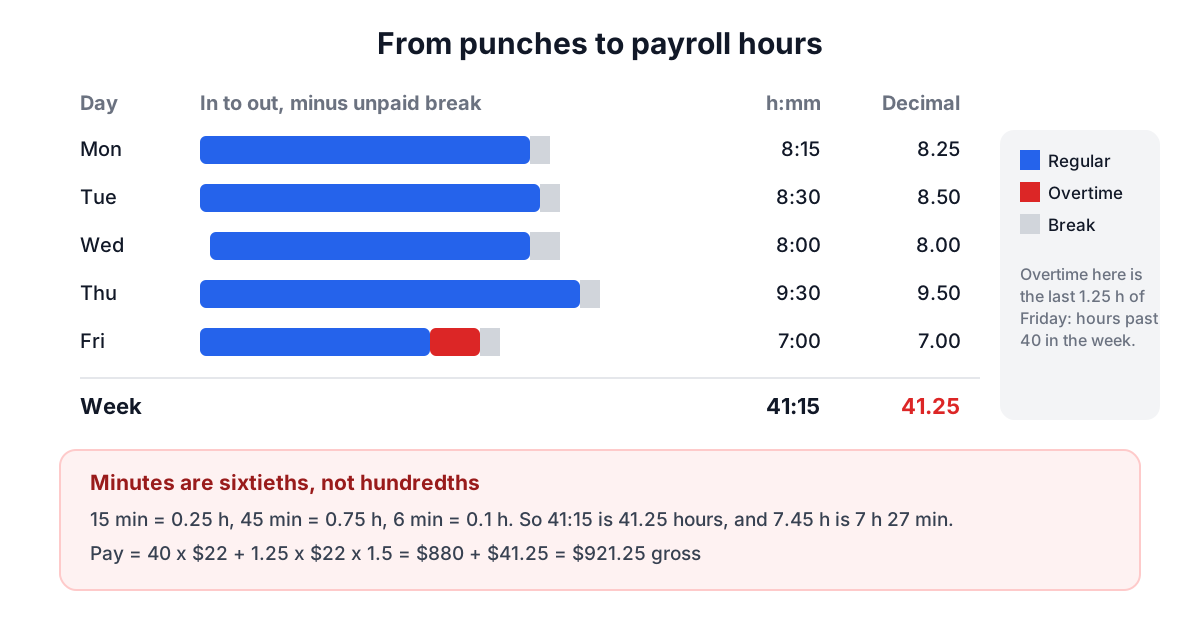
- 41 hours 15 minutes = 41.25 h, not 41.15
Going the other way, 7.45 hours is 7 hours and 0.45 x 60 = 27 minutes. If someone types "7.45" meaning 7:45, they have lost 18 minutes of pay. Always multiply decimal hours, never h:mm, by the hourly rate.
Overnight shifts
A shift from 22:00 to 06:30 gives a negative number if you subtract naively. The fix is to add 24 hours whenever the end is earlier than the start: 30:30 - 22:00 = 8:30. The Time Card Calculator does this automatically and marks the row as ending the next day.
Rounding and the 7-minute rule
Many employers round punch times. The federal regulation at 29 CFR 785.48(b) accepts recording start and stop times to the nearest 5 minutes, tenth of an hour or quarter hour, on one condition: the practice must average out so that, over time, employees are paid for all the time they actually worked.
Rounding to the nearest quarter hour is what payroll staff call the 7-minute rule. A punch 1 to 7 minutes past a quarter hour rounds back; 8 to 14 minutes rounds forward. Clocking in at 08:07 is recorded as 08:00 and clocking out at 16:53 becomes 17:00. Rounding that only ever goes the employer's way, such as always rounding clock-ins forward, is not neutral and is not what the regulation allows. If your employer rounds, set the same increment in the calculator so your totals match theirs.
Overtime: weekly, daily, never twice
Under the Fair Labor Standards Act, overtime is due for hours over 40 in a workweek, at no less than one and a half times the regular rate. Some states add a daily limit; California, for example, starts overtime after 8 hours in a day. When both apply, count daily overtime first, then apply the weekly limit only to the remaining straight-time hours. That way a long Monday is not counted as overtime twice. In the week above, Monday to Thursday add up to 34.25 hours, so the 40-hour line is crossed during Friday and the last 1.25 hours of Friday are overtime. At $22 an hour, pay is 40 x 22 + 1.25 x 33 = $921.25 before tax. For double time and seventh-day rules, use the Overtime Calculator.
Breaks deserve one more note. Under federal rules, short rest breaks of roughly 5 to 20 minutes are normally paid working time, while a genuine meal break of 30 minutes or more, with no duties, usually is not. Only the unpaid time belongs in the break column.
Adding and subtracting time
Durations carry at 60, not at 10, which is why 2:45:50 + 1:30:20 is 4:16:10 rather than 3:75:70. The reliable method is the one the Time Calculator uses:
- Turn every duration into seconds: days x 86,400 + hours x 3,600 + minutes x 60 + seconds.
- Add or subtract the seconds.
- Split the total back into days, hours, minutes and seconds.
For example, 2 h 45 m 50 s + 1 h 30 m 20 s - 16 m 10 s is 9,950 + 5,420 - 970 = 14,400 seconds, which is exactly 4:00:00. Because the units are only split at the end, you can type 90 minutes or 36 hours into a single field and it still works.
Clock times versus durations
A duration is an amount of time, such as 8 hours 25 minutes. A clock time is a position on a 24-hour circle, such as 06:40. Mixing the two needs care:
- Time between two clock times is end minus start, plus 24 hours if the end is earlier. From 22:15 to 06:40 is 8 hours 25 minutes.
- A clock time plus a duration wraps around midnight. 22:30 plus 3 hours is 01:30 the next day; 08:00 plus 50 hours is 10:00 two days later. Give the calculator a start date and it tells you the actual date and weekday.
Clock arithmetic usually ignores daylight-saving changes, and so does the calculator. On the one night a year when clocks go back or forward, real elapsed time differs from clock time by an hour, which matters for night shifts that span the change.
Quick checks before you trust a number
- An age in years should match the number of birthdays you can count on your fingers. If it is one off, check whether the birthday has happened yet this year.
- A daily total over 24 hours, or a negative one, means a time was typed wrong or a shift crosses midnight.
- Decimal hours keep the same whole hours as h:mm, and the decimals are the minutes divided by 60. If 8:45 shows as 8.45 rather than 8.75, something has gone wrong.
- Weekly overtime can never exceed total hours minus 40, unless your state has a daily rule.
These calculators do the counting for you, but the rules above are what they are applying, and knowing them is the fastest way to spot a typo before it reaches a form or a paycheck.