
AI for Civil and QA Engineers: Prompts That Respect the Engineer of Record
Using AI to draft RFI responses, site reports, test cases and bug reports, while keeping calculations, specifications and sign-off with the engineer who is accountable.
· 9 min read
Civil engineers and software QA engineers do very different work, but their relationship with AI drafting tools has the same shape. Both spend a large share of the week writing structured documents: RFI responses, daily site reports, method statements and meeting minutes on one side; test cases, bug reports, test plans and release notes on the other. Both are accountable for whether something is safe or correct, and that accountability cannot be handed to a model. And both can lose a lot of time cleaning up a confident draft that got one number or one requirement wrong.
This article looks at where a general AI assistant genuinely saves engineering time, where it should be kept away, the confidentiality issues with drawings and source code, worked prompts in a reusable format, a review routine and a 30-day trial plan. The AI Prompts for Civil Engineers and AI Prompts for QA Engineers kits hold ready versions of the prompts here, with fill-in fields, examples and a check-the-output list, all running in your browser.
Drafting work versus engineering judgement
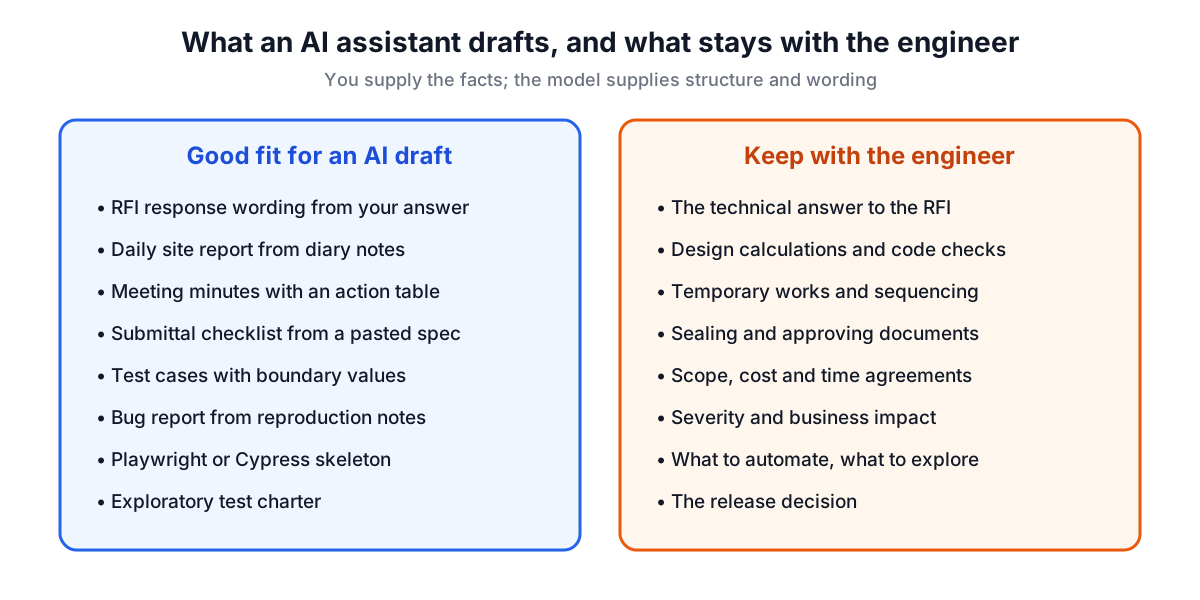
The useful split is between tasks where you supply the facts and the model supplies structure and wording, and tasks where the model would have to supply the engineering.
| Good fit for an AI draft | Keep with the engineer |
|---|---|
| RFI response wording from your technical answer | The technical answer itself |
| Daily site report from site diary notes | Judging whether a defect is structural |
| Method statement skeleton for a known activity | Temporary works design and sequencing decisions |
| Meeting minutes with an action table | Agreeing scope or cost changes |
| Submittal review checklist built from a spec section you paste | Approving the submittal |
| Test cases with boundary values from a user story | Deciding release readiness |
| Bug report from rough reproduction notes | Assessing severity for the business |
| Playwright or Cypress test skeleton | Choosing what to automate |
| Exploratory test charter | Running the session and noticing the odd thing |
On the civil side, the licensed engineer of record takes professional responsibility for design and seals the documents, under the licensing law of the state or country where the work is done. A model has no licence and no knowledge of your project's loads, ground conditions or the edition of the code your contract names. That is why the kit's "design calculation sanity check" prompt asks the model to list assumptions, units and order-of-magnitude checks for you to recompute, not to verify the design. A spreadsheet or calculator such as the Concrete Calculator or the Unit Converter is still how you check a number.
On the QA side, models are good at generating many variations quickly: equivalence classes, boundary values, negative paths, test data. They are weak at knowing what your product actually does, so a test case that looks complete may assert behaviour nobody specified.
Confidentiality: drawings, specs and source code
The privacy rules here are mostly contractual rather than about personal data, but they are just as binding. Construction contracts and NDAs often restrict sharing drawings, specifications and client information. Security-sensitive infrastructure (utilities, transport, defence) may have stricter handling rules. In software, source code, unreleased features, credentials, customer data in logs and screenshots of production systems all need care.
Practical rules before pasting:
- Use only AI tools your employer has approved, and check whether the provider's terms allow it to retain or train on your inputs.
- Paste the minimum excerpt: the spec clause, not the whole specification; the failing function, not the repository.
- Strip names and contact details from site diaries, RFIs and bug reports. Personal data of site workers, clients or users is covered by privacy law such as the GDPR, which asks for data minimisation (Article 5(1)(c)) and a processor contract with any vendor that handles it (Article 28).
- Never paste API keys, connection strings, tokens or passwords. Rotate anything you paste by mistake.
- Replace production data with generated data. The Database Seed Generator makes realistic fake rows.
The kits include a masking helper that replaces common identifier patterns in your pasted text, such as names after a title or label, email addresses, phone numbers, dates, account and record numbers, street addresses, postcodes, URLs and IP addresses, with tokens like [EMAIL-1]. It is pattern-based, so it will not recognise a project code name or a client mentioned without a title. Read the text before you copy it.
Worked prompts
The kits build every prompt from the same parts: role, context, task, constraints and output format. The constraints are the part that keeps the model honest.
An RFI response:
## Role
You are a drafting assistant for a civil engineer on a commercial building project. You write clear contract correspondence for the engineer to review and sign. You do not make design decisions.

## Context
- RFI question: Drawing S-201 shows 6 no. H16 bars in beam B3 but the schedule lists 5 no. H16. Please confirm.
- Engineer's answer: Drawing governs. Provide 6 no. H16 as shown. Schedule to be revised in next issue.

## Task
Draft the RFI response using the engineer's answer only.

## Constraints
- Do not add technical content, alternatives or justifications that are not in the answer.
- Reference drawing and schedule numbers exactly as given.
- State whether the response has cost or programme implications only if the engineer said so; otherwise write [CONFIRM: cost or time impact].

## Output format
Subject line, response paragraph under 120 words, and a list of documents to be revised.
Test cases from a user story:
## Role
You are a test design assistant for a QA engineer on a web checkout team. You draft test cases for the engineer to review.

## Context
User story: As a shopper I can apply one discount code per order. Codes are 6 to 12 alphanumeric characters, case-insensitive, and expire at midnight UTC on their end date.

## Task
Write test cases covering positive, negative and boundary conditions.

## Constraints
- Use boundary value analysis on code length (5, 6, 12, 13 characters) and on the expiry time.
- Mark any behaviour the story does not specify as [QUESTION FOR PO] instead of assuming it.
- No duplicated cases.

## Output format
A table: ID | title | preconditions | steps | expected result | technique. Then a list of open questions.
The "[QUESTION FOR PO]" constraint is the important one. Without it, the model quietly decides what happens when a shopper enters two codes, and the test case becomes an untested specification. The Regex Tester is handy for checking the validation pattern a developer wrote against the boundary values you listed.
Reviewing the output
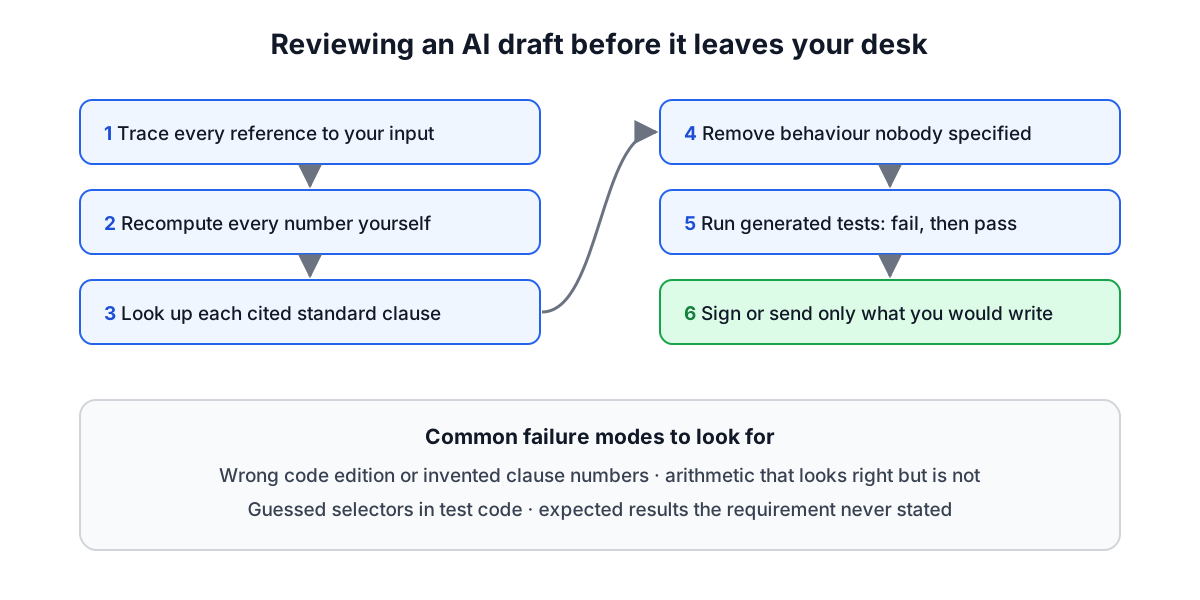
Engineering review of AI text is a short, repeatable checklist:
- Facts in, facts out. Every drawing number, clause reference, quantity, date and test ID in the draft should trace to your input.
- Recompute every number. If the draft contains arithmetic, redo it. Models produce sums that look right and are not.
- Check every standard you see cited. Code clauses, edition years and test standards are a common place for plausible fabrication. Look them up in the document your contract or test strategy names.
- Look for invented behaviour. In test cases and bug reports, check that expected results come from the requirement, not from the model's guess.
- Run generated code. A Playwright or Cypress skeleton is not done until it runs, fails for the right reason and passes for the right reason. Selectors in particular are often guessed.
- Sign only what you would have written. For civil work, the engineer of record's responsibility is the same whether a sentence was typed or generated.
A 30-day trial
| Week | Civil engineers | QA engineers |
|---|---|---|
| 1 | Confirm which AI tools your firm approves and what client contracts say about sharing documents. | Confirm approved tools and whether code or logs may be pasted. |
| 2 | Use the meeting minutes and daily site report templates on real but non-confidential notes. | Use the bug report and exploratory charter templates on internal issues. |
| 3 | Add RFI responses and submittal checklists, with every reference checked. | Add test cases from stories and one automation skeleton per day, run before commit. |
| 4 | Compare time spent per document with and without the template, including review. Keep the winners. | Count defects found by AI-drafted cases versus your usual set, and questions raised for the product owner. |
Write down what you measure. A template that saves ten minutes of typing and adds fifteen of checking is a net loss, and the record is how you notice. Export the kept templates as a Markdown library from the kit and put them in the team wiki so the whole team uses the same constraints.
If you build prompts of your own, the AI Prompt Builder gives you the same role, context, task, constraints and output structure, and the LLM Token Counter tells you whether a long spec excerpt will fit in a model's context window before you paste it.