
Quadratics, Scientific Notation and Roman Numerals: Writing Numbers Well
What the discriminant tells you, why the textbook quadratic formula fails on computers, how significant figures carry through a calculation, and the rules behind valid Roman numerals.
· 9 min read
Three tools that look unrelated share one concern: writing a number so that the next person reads it correctly. A quadratic's roots can be printed as 1.618034, as (1 + √5) / 2, or lost entirely to rounding. A measured value can be written as 1200, 1.2 × 10³ or 1.200 × 10³, and each says something different about how well it was measured. A year on a building can be MCMXCIX or a non-standard MIM that half your readers will decode wrongly.
This guide covers the maths and the conventions behind the Quadratic Equation Solver, the Scientific Notation Calculator and the Roman Numeral Converter, including the places where a careful answer differs from a quick one.
The quadratic formula and the discriminant
Any equation of the form ax² + bx + c = 0 with a ≠ 0 is solved by
x = (−b ± √(b² − 4ac)) / (2a)
The formula comes from completing the square, and the expression under the root, D = b² − 4ac, decides what kind of answer you get. If D is positive there are two different real roots and the parabola y = ax² + bx + c crosses the x-axis twice. If D is zero, the vertex touches the axis and the root is repeated. If D is negative, the square root is imaginary and the two roots are complex conjugates, p ± qi.
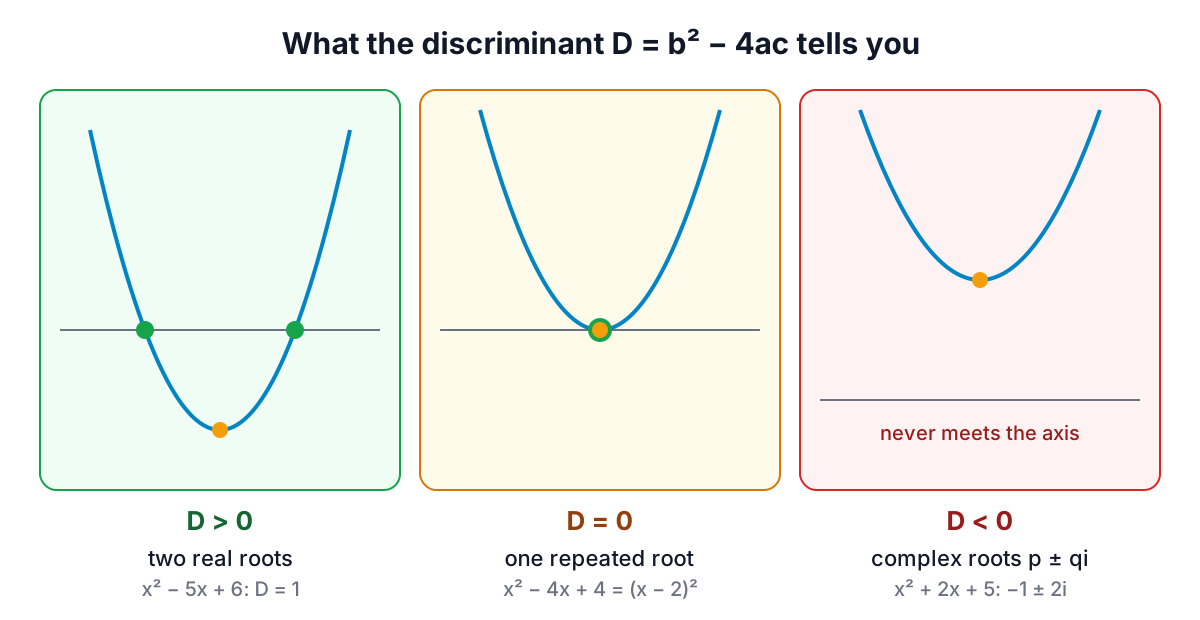
The discriminant also tells you whether to look for a factored form. With whole-number coefficients, the quadratic factors over the integers exactly when D is a perfect square. 2x² − 4x − 6 has D = 16 + 48 = 64 = 8², so the roots are rational (−1 and 3) and the polynomial is 2(x + 1)(x − 3). x² − x − 1 has D = 5, so its roots are the irrational (1 ± √5) / 2, one of which is the golden ratio 1.618…
The vertex and two quick checks
The parabola is symmetric about the vertical line x = −b / (2a), which is also the x-coordinate of the vertex. Substitute it back to get the height of the turning point: for 2x² − 4x − 6, x = 1 and y = −8. If a is positive the vertex is a minimum; if negative, a maximum. That is the whole of many optimisation problems: the best price, the tallest point of a throw, the cheapest dimension.
Two checks catch most mistakes. The roots should add up to −b/a and multiply to c/a (Vieta's formulas). For 2x² − 4x − 6, −1 + 3 = 2 = 4/2, and −1 × 3 = −3 = −6/2.
Why the textbook formula is wrong on a computer
Computers store about 16 significant digits. When b² is much larger than 4ac, √D is almost equal to |b|, and one of the two roots comes from subtracting two nearly equal numbers. Most of the digits cancel, leaving rounding noise. For x² + 10⁸x + 1 = 0 the small root is about −1 × 10⁻⁸, but the textbook formula in double precision returns −7.45 × 10⁻⁹, about 25% off, with every digit after the first wrong.
The fix, described in numerical analysis texts such as Numerical Recipes, avoids the subtraction:
q  = −(b + sign(b) × √D) / 2
x₁ = q / a
x₂ = c / q
The first root adds two numbers of the same sign, so nothing cancels, and the second uses the product of the roots (c/a) instead of a subtraction. The solver uses this form, and also keeps exact fractions and surds when the inputs are exact, so you can see the precise answer alongside the decimal.
Scientific notation and significant figures
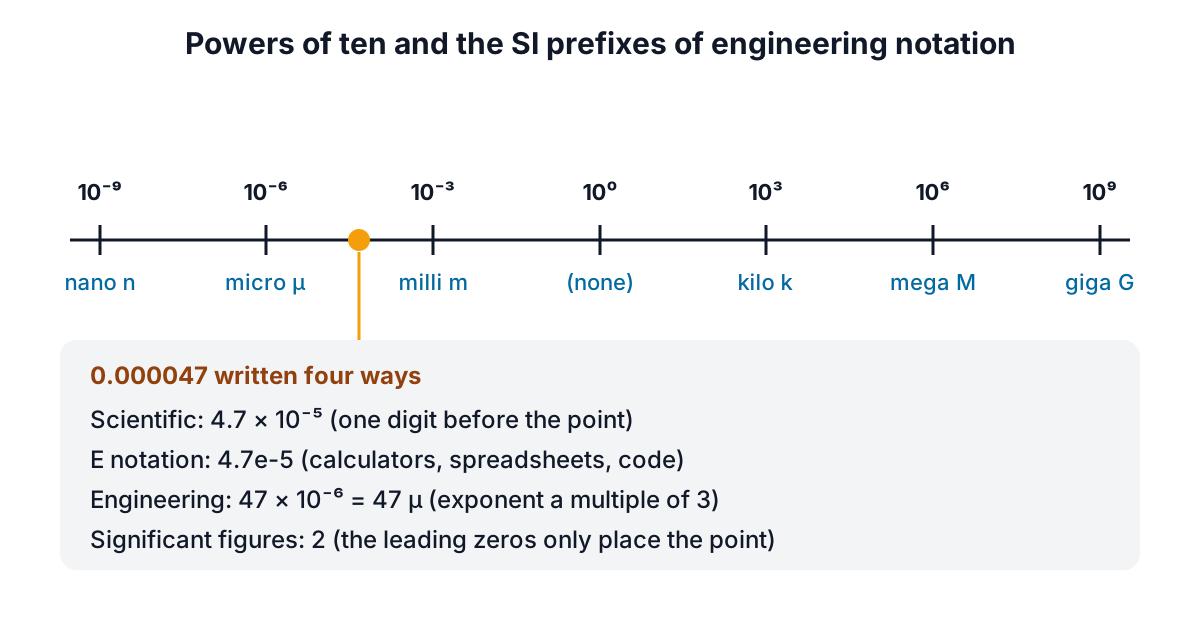
Scientific notation writes a number as m × 10ⁿ with one non-zero digit before the point: 4.7 × 10⁻⁵ instead of 0.000047. E notation, 4.7e-5, is the same thing for keyboards, and it is what spreadsheets and programming languages print. Engineering notation keeps the exponent a multiple of three, 47 × 10⁻⁶, so it maps straight onto SI prefixes: 47 micro.
The more interesting part is what the digits claim. Significant figures are the digits that carry real information:
- Non-zero digits always count, and so do zeros between them: 100.05 has five.
- Leading zeros never count: 0.00420 has three.
- Trailing zeros count when there is a decimal point: 2.50 has three, 2.5 has two.
- Trailing zeros in a whole number with no point are ambiguous: 1200 might have two, three or four. Write 1.20 × 10³ to say three.
Results carry the precision of their inputs. For multiplication and division, keep the smallest number of significant figures among the inputs: 3.0 × 10⁸ times 2.50 × 10⁻³ is 7.5 × 10⁵, two figures because 3.0 has two. For addition and subtraction the rule is about decimal places instead: 12.11 + 18.0 = 30.11, rounded to 30.1 because 18.0 is only known to tenths. Exact counts and defined constants never limit the result. Since the 2019 SI revision, Avogadro's number is exactly 6.02214076 × 10²³ and the elementary charge exactly 1.602176634 × 10⁻¹⁹ coulomb.
A practical warning for anyone working with data: when a spreadsheet shows a long ID or card number as 1.23457E+15, the digits beyond the 15th have usually already been lost. Format the column as text before importing, because no notation can bring them back.
Roman numerals: rules, not suggestions
Roman numerals use seven letters, I 1, V 5, X 10, L 50, C 100, D 500 and M 1000, and the modern standard is stricter than many converters admit. A number is written one decimal place at a time from the largest to the smallest, and only six subtractive pairs exist: IV (4), IX (9), XL (40), XC (90), CD (400) and CM (900). From those two ideas come all the validity rules:
- I, X, C and M repeat at most three times. 4 is IV, not IIII, and 40 is XL.
- V, L and D never repeat, because VV is X, LL is C and DD is M.
- Only I, X and C are ever subtracted, and only from the next two symbols up. 99 is XCIX (90 + 9), not IC. 1999 is MCMXCIX, not MIM.
- Each place is written separately, so 49 is XL + IX = XLIX, not IL.
These rules are a later standardisation. Roman inscriptions are not consistent, and clock faces still commonly use IIII. The converter accepts only the standard form and explains which rule a non-standard numeral breaks, which is what you want before something is carved or tattooed.
There is no zero, and with M repeating at most three times the largest standard number is 3,999, MMMCMXCIX. For larger values a bar (vinculum) over a numeral multiplies it by 1,000: V̅ is 5,000 and M̅ is one million. Usage for numbers like 4,000 varied historically, so state your convention if you use it.
For dates, convert month, day and year separately. 28 October 2026 is X.XXVIII.MMXXVI in month-day-year order or XXVIII.X.MMXXVI in day-month-year order. Agree the order before anyone commits it to stone or skin.
Choosing how to write the answer
- Exact or decimal roots? Give the surd or fraction when someone will continue working with the result; give the decimal, to a sensible number of figures, when it will be measured or built.
- How many figures? Match the least precise input. Reporting a speed as 12.3456 m/s from a stopwatch read to a tenth of a second claims precision you do not have.
- Scientific or engineering notation? Scientists usually prefer scientific notation; engineers prefer forms that line up with component values like 4.7 kΩ or 220 µF.
- Which numeral form? Use the standard subtractive form unless you are deliberately matching a historical or design convention, and then say so.
Each of these is a small decision, but together they decide whether the number on the page means what you intended.