
Area and Volume Formulas, and Why They Work
Where the formulas for triangles, circles, cones and spheres come from, how square and cubic units convert, and the measuring mistakes that matter more than the maths.
· 9 min read
Most people learned a list of area and volume formulas at school and kept about half of them. The good news is that the list is shorter than it looks. Nearly every formula comes from two ideas: a flat shape's area is some version of base times height, and a solid's volume is base area times height, divided by three when the solid comes to a point. Once you see that, the formulas stop being things to memorise and start being things you can rebuild.
This guide walks through where the formulas come from, how square and cubic units convert, and which measuring decisions matter more than the arithmetic. The numbers can be checked in the Area Calculator and the Volume Calculator.
Flat shapes: everything is base times height
Start with a rectangle: b columns of h unit squares, so the area is b × h. Every other straight-sided formula is a rearrangement of that rectangle.
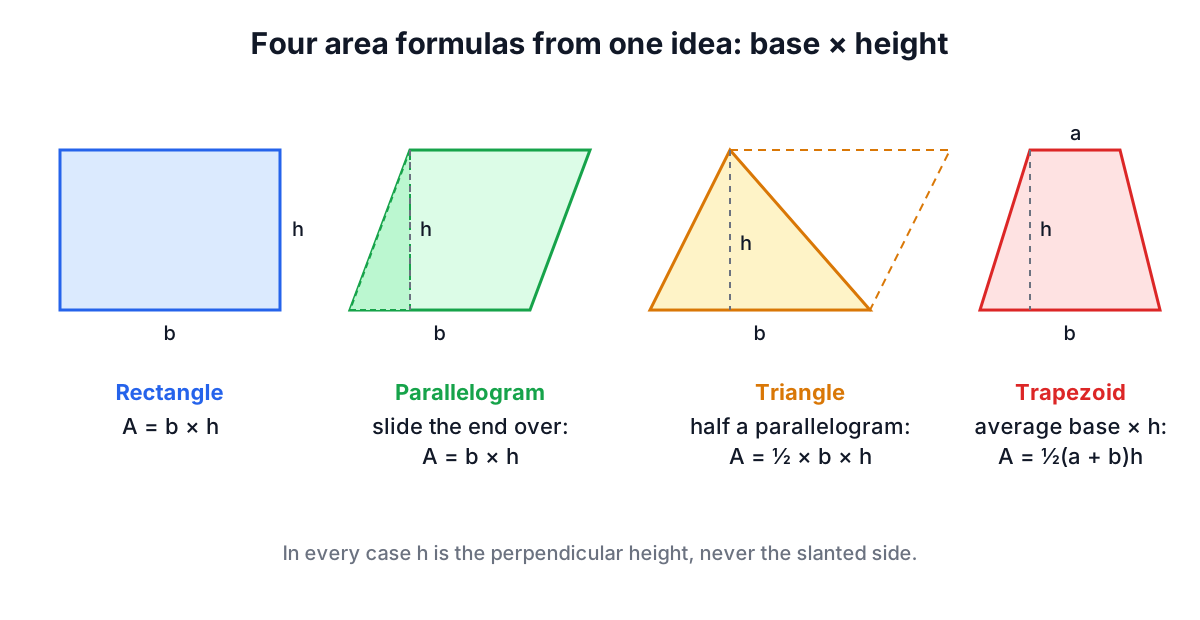
- Parallelogram. Cut the triangle off one end and slide it to the other. You now have a rectangle with the same base and height, so A = b × h. The slanted side length plays no part.
- Triangle. Two copies of any triangle fit together into a parallelogram, so a triangle is half of one: A = ½ × b × h.
- Trapezoid. Two copies, one turned upside down, form a parallelogram whose base is a + b. Halve it: A = ½ × (a + b) × h. Put another way, it is the average of the two parallel sides times the height.
- Rhombus. Its diagonals p and q cross at right angles and split it into four right triangles that fit inside a p × q rectangle with room for four more. A = p × q / 2.
The one measurement all of these share is the perpendicular height, the straight-line distance at a right angle to the base. Using the slanted side instead is the most common error in this whole topic, and it always overestimates the area.
When you cannot measure the height
On a real triangular garden bed you can measure the three edges but not the height. Heron's formula handles that:
s = (a + b + c) / 2
A = √(s(s − a)(s − b)(s − c))
A 13, 14, 15 triangle has s = 21 and A = √(21 × 8 × 7 × 6) = √7056 = 84. For irregular plots, split the shape into triangles with diagonals, measure every edge, and add the Heron areas. Surveyors call this triangulation, and it needs no angles at all.
Curves: circles, sectors and ellipses
A circle's area is πr². One way to see it: cut the circle into many thin pie slices and lay them alternately point-up and point-down. The result is close to a parallelogram whose height is r and whose base is half the circumference, πr. Base times height gives πr².
The other curved shapes follow from that:
- Sector. A slice with central angle θ is the fraction θ/360 of the full circle: A = (θ/360) × πr². A 120° slice of a radius 3 pizza is 3π, about 9.42 square inches.
- Ellipse. An ellipse is a circle stretched in one direction. Stretching by a factor scales area by the same factor, so a circle's πr × r becomes π × a × b, with a and b the semi-axes (half the full length and width).
- Regular polygon. n equal triangles meet at the centre. The result is A = n·s² / (4·tan(180°/n)). A regular hexagon with side 2 m is 10.39 m². As n grows, the polygon approaches a circle.
Ellipse perimeter is the odd one out. There is no closed formula; the exact value needs an elliptic integral. The calculator uses Ramanujan's second approximation, which is exact for a circle and stays within 0.04% even for an ellipse squashed almost flat. For a 10 by 5 ellipse it gives 48.442, matching the exact value to five significant figures.
Solids: base area times height, and the one-third rule
The volume equivalent of "base times height" is base area times height, and it covers every prism and cylinder. A box is l × w × h. A cylinder has a circular base, so V = πr²h. A cylinder 10 cm in radius and 30 cm tall holds 9,424.78 cm³, which is 9.42 litres.
Solids that taper to a point hold exactly one third of the prism with the same base and height. A cone is ⅓πr²h and a pyramid is ⅓ × base area × h. The one third comes from adding up cross-sections that shrink in proportion to the square of the distance from the tip.
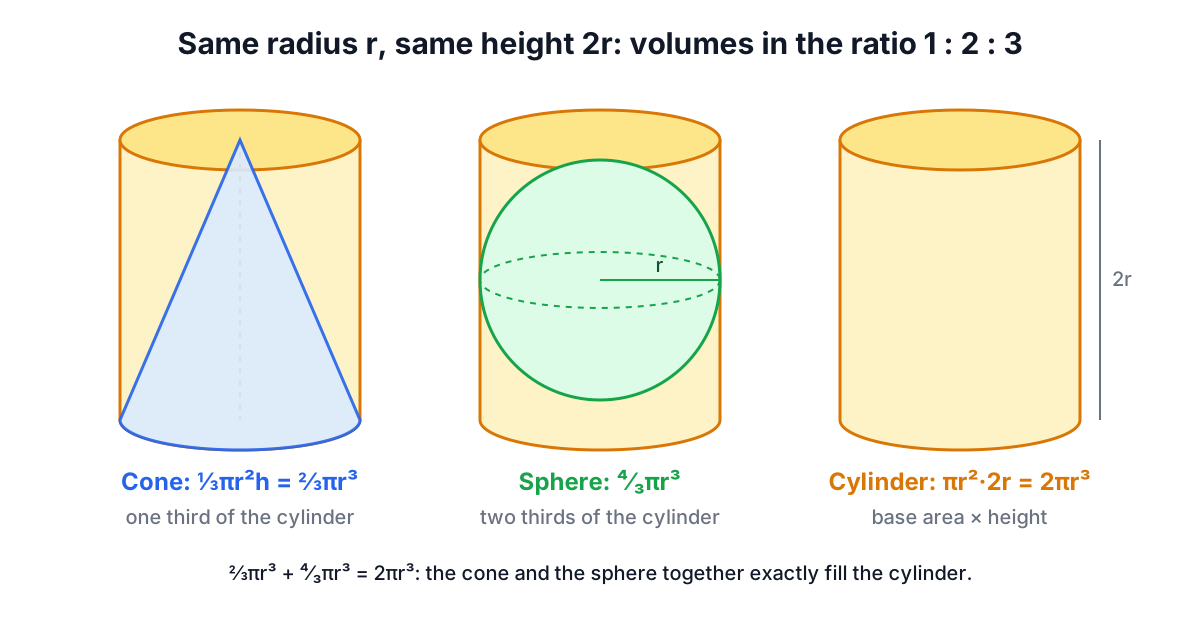
The sphere fits the same pattern. Put a sphere of radius r inside a cylinder of radius r and height 2r. The cylinder holds 2πr³, the sphere ⁴⁄₃πr³ (two thirds of it), and a cone in the same cylinder ⅔πr³ (one third). Cone plus sphere exactly fills the cylinder. This is Archimedes' result, and it means you only need to remember the cylinder.
The rest of the calculator's solids are combinations:
- Hemisphere: half a sphere, ⅔πr³.
- Capsule: a cylinder of length a with a hemisphere on each end, πr²a + ⁴⁄₃πr³.
- Frustum (a cone with the top cut off, like a bucket): the big cone minus the small one, ⅓πh(R² + Rr + r²). Set r to zero and it is a cone; set r = R and it is a cylinder.
- Tube: the outer cylinder minus the inner one, π(R² − r²)L. That is the material in a pipe wall. The water inside is the cylinder with the inner radius.
A tapered pot shows why the frustum matters. With a 15 cm bottom radius, 10 cm top radius and 30 cm height it holds 14.92 litres, well short of the 21.2 litres a straight cylinder of the bottom radius would hold.
Surface area
Surface area is the skin around a solid, in square units. For flat-faced solids it is the sum of the faces. For curved ones, unroll them: a cylinder's side is a rectangle 2πr wide and h tall, so the total with both ends is 2πr(r + h). A cone's side unrolls into a sector, giving πr × slant height. A sphere's surface is 4πr², exactly four times the area of its widest circle. Use the lateral (side-only) figure for a label around a can or the outside of an open pipe.
Square and cubic units do not convert like lengths
A metre is 3.2808 feet, but a square metre is 10.764 square feet and a cubic metre is 35.315 cubic feet. Each dimension converts, so the factor is squared for area and cubed for volume. Forgetting this is the single largest error in practical area and volume work, and it is never small.
The conversion factors are exact by definition:
- An inch is exactly 2.54 cm (the 1959 international yard and pound agreement), so a square foot is 0.09290304 m².
- An international acre is 43,560 square feet, or 4,046.8564224 m². A hectare is 10,000 m², about 2.471 acres. A square mile is 640 acres.
- A litre is 1,000 cm³. A cubic foot is 28.3168 litres.
- A US gallon is 231 cubic inches, exactly 3.785411784 litres. An imperial (UK) gallon is exactly 4.54609 litres, about 20% larger.
NIST retired the older US survey foot at the end of 2022. Land records based on it differ from the international foot by about two parts per million in length, so acreage shifts by about four parts per million, which no tape measure will notice.
The measurements matter more than the formulas
The formula is exact; your tape measure is not. A few judgment calls decide how good the final number is.
- Measure the right dimension. Inside dimensions for capacity, outside for material or displacement. A glass aquarium measured outside overstates the water it holds.
- Know the error you are carrying. Half an inch of error on each side of a 12 by 8 foot room shifts the area by close to 1%. Volume compounds three such errors, so round answers to match.
- Radius, not diameter. Formulas use the radius. Entering a diameter as a radius quadruples a circle's area and multiplies a sphere's volume by eight.
- Split irregular shapes. An L-shaped room is two rectangles; a bay window is close to a half circle or trapezoid. Add the parts in the same unit.
- Add waste for orders. Flooring, tile, concrete and mulch are cut, spilled or compacted. The Concrete Calculator, Tile Calculator and Gravel and Mulch Calculator add those allowances, and the Square Footage Calculator handles multi-room floors.
For problems that start from angles rather than lengths, such as a triangle given by two sides and an angle, the Triangle Calculator finds the missing measurements first. For any unit this guide does not list, the Unit Converter covers the rest.