
How Blood Alcohol Is Estimated: Widmark, Standard Drinks and Time
The Widmark formula worked by hand, standard drink sizes in the US, UK, Canada and Australia, how fast alcohol clears, and why estimates are not a driving test.
· 7 min read
Blood alcohol concentration, or BAC, is the amount of alcohol in a given volume of blood. In the US it is written as a percentage: 0.08% means 0.08 g of alcohol per 100 mL of blood. The UK writes the same thing as 80 mg per 100 mL, and much of Europe as 0.8 g per litre or 0.8 per mille. Police measure it with breath or blood tests. Everyone else, including the BAC Calculator, can only estimate it, and this guide explains how that estimate works, where it goes wrong, and why it should never decide whether you drive.
The Widmark formula
Erik Widmark, a Swedish physiologist and chemist, worked out the core relationship in the 1920s and published it in 1932. Alcohol spreads through body water, so the concentration it reaches depends on the dose and on how much water it has to dissolve in. He expressed the second part as body weight multiplied by a factor, r:
BAC (%) = alcohol (g) / (body weight (g) × r) × 100 − β × hours
Widmark measured r at about 0.68 for men and 0.55 for women. The difference is not about drinking experience; women on average have a higher share of body fat and a lower share of water per kilogram, so the same dose is less diluted. β, the elimination rate, is how fast the liver clears alcohol once it is absorbed. It is roughly constant over time, unlike most drugs, because the main enzyme, alcohol dehydrogenase, works at full capacity at quite low concentrations.
Take an 80 kg man who drinks three 355 mL beers at 5% and one 150 mL glass of 12% wine over two hours. First convert drinks to grams. Ethanol has a density of 0.789 g/mL, so each beer holds 355 × 0.05 × 0.789 = 14.0 g, and the wine 150 × 0.12 × 0.789 = 14.2 g. The total is 56.2 g. Then:
56.2 / (80,000 × 0.68) × 100 = 0.103%   (if absorbed all at once)
0.103 − 0.015 × 2 = 0.073%              (estimate after 2 hours)
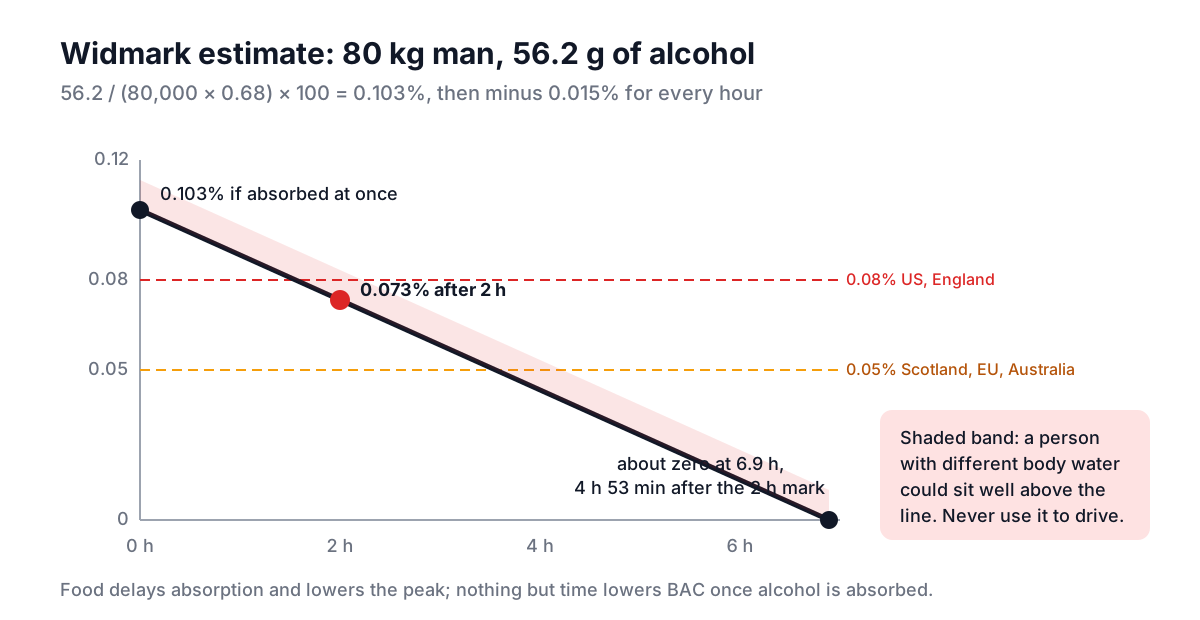
On paper he is just under the US limit of 0.08%. In practice the estimate could easily be 0.09% or 0.06%, because both r and β vary from person to person. That uncertainty is the most important thing to understand about any BAC calculator.
Standard drinks are not standard
Health advice is usually given in standard drinks or units, but the size of one depends on where you live:
| Country or body | One standard drink or unit | Pure alcohol |
|---|---|---|
| United States (NIAAA) | 12 fl oz beer at 5%, 5 fl oz wine at 12%, 1.5 fl oz spirits at 40% | 14 g |
| Canada | 341 mL beer at 5%, 142 mL wine at 12%, 43 mL spirits at 40% | 13.45 g (17.05 mL) |
| Australia, New Zealand, Ireland | Defined by grams | 10 g |
| United Kingdom | One unit is 10 mL of pure alcohol | 8 g |
| World Health Organization | Reference value | 10 g |
So a 568 mL pint of 4.5% lager, about 20 g of alcohol, is 1.4 US standard drinks, 2.0 Australian standard drinks, or 2.5 UK units. A large 250 mL glass of 13% wine is 25.6 g: nearly two US drinks and more than three UK units. Craft beers at 7 to 9% in 473 mL cans can hold 26 to 34 g, two US drinks in one can.
This matters because guidance is written in local units. The UK Chief Medical Officers advise no more than 14 units a week, about 112 g. US Dietary Guidelines suggest limiting intake to two drinks a day for men and one for women on days alcohol is consumed, or 28 g and 14 g. Counting the drinks you actually pour, not the ones on the guideline poster, is the first step to an honest estimate.
How fast alcohol leaves the body
Average elimination is about 0.015% per hour, which the calculator uses. Measured rates in healthy adults typically fall between about 0.010% and 0.020% per hour, and heavy regular drinkers can clear faster because the liver adapts. For an average adult, 0.015% per hour is roughly one US standard drink per hour.
The arithmetic has an uncomfortable consequence. Someone at 0.15% at midnight would still be at about 0.06% at 6 am, above the 0.05% limit used in Scotland, Australia and most of the EU, after what felt like a full night's sleep. Many drink-driving arrests happen the next morning for exactly this reason.
Nothing speeds elimination up. Coffee makes you more alert without lowering BAC. Water helps with dehydration but not with alcohol. Cold showers, exercise and sleep do nothing to the liver's rate. Eating before or while drinking does help, but in a different way: food keeps alcohol in the stomach longer, so it is absorbed more slowly and the peak is lower and later. That is why the calculator shows two figures: the "all absorbed at once" upper bound, and the estimate after subtracting elimination.
Why a calculator cannot tell you if you are safe
Every input to the formula has a range. Body water depends on body composition, not just weight and sex, so two 80 kg men with different builds can differ in r by 10% or more. Absorption depends on food, drink strength, carbonation and stomach emptying. Elimination varies with genetics, liver health, medication and drinking history. Put together, a real BAC can be 30% higher or lower than any formula predicts.
Impairment also starts well below legal limits. Studies of driving performance show slower reactions and poorer judgement from around 0.02% to 0.05%, and crash risk climbs steeply from there. Being under a limit is a legal threshold, not a safety guarantee. Several countries apply limits of 0.02% or zero to new, young or commercial drivers for that reason.
So use a BAC estimate the way you would use a nutrition label: to understand what you are consuming and how long it lingers, not to decide whether you are fit to drive, ride, swim or look after someone. If you have been drinking, the safe plan is a sober driver, a taxi, public transport, or staying put.
Signs that need help, not arithmetic
Alcohol poisoning is a medical emergency, and a calculator has nothing useful to say about it. Warning signs include confusion, vomiting while drowsy, seizures, slow or irregular breathing (fewer than eight breaths a minute), pale or bluish skin, low body temperature, and being hard to wake. Call emergency services, keep the person on their side in the recovery position, and stay with them. Do not let them "sleep it off" alone; BAC can keep rising for some time after the last drink as the stomach empties.
For everyday questions, the Hydration Calculator and Sleep Calculator cover the next-day basics, and the Calorie Calculator is a reminder that alcohol carries 7 kcal per gram, so 56 g of alcohol is about 390 kcal before counting any sugar in the drinks.