
Blood Pressure Categories Explained: ACC/AHA Stages vs ESH Grades
What normal, elevated, stage 1 and stage 2 mean, why Europe draws the line at 140/90, how to measure at home properly, and how to average readings like a clinician.
· 10 min read
High blood pressure rarely causes symptoms, yet it is the leading modifiable risk factor for stroke and heart disease worldwide. That makes the numbers on a home monitor important, and also easy to misread. The same reading can be "stage 1 hypertension" in the United States and "high normal" in Europe, and a single reading can be misleading in either system. This guide explains both classification systems, how to measure properly at home, how clinicians average readings, and what mean arterial and pulse pressure add. The Blood Pressure Category Checker applies all of it to your own readings.
The two numbers
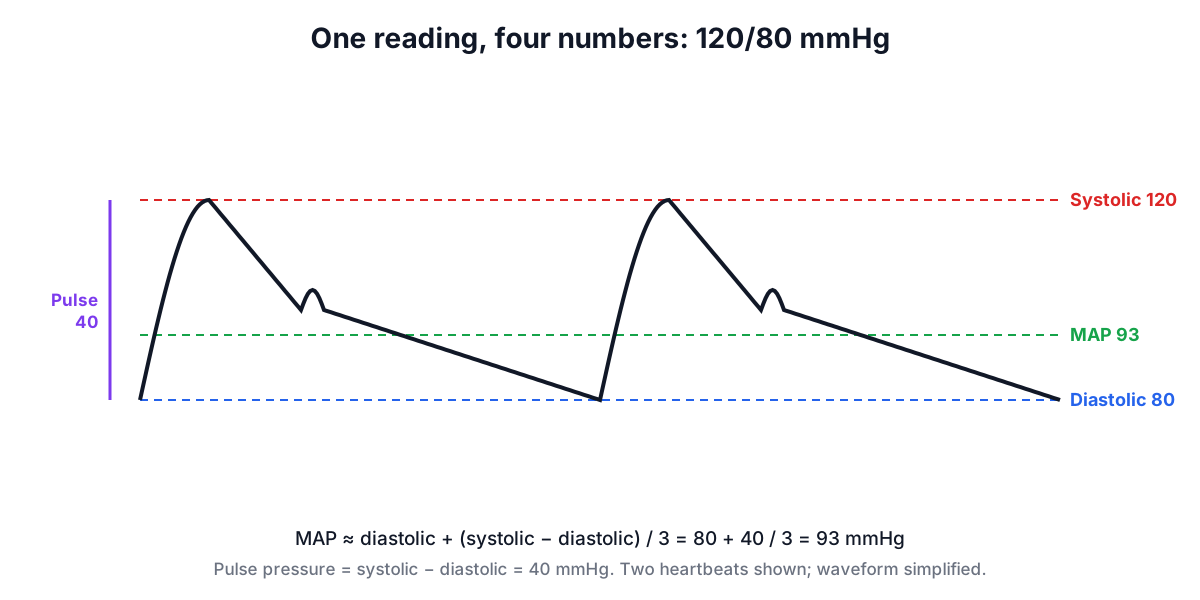
Blood pressure is written as systolic over diastolic, in millimetres of mercury (mmHg). Systolic, the top number, is the peak pressure in your arteries as the heart contracts. Diastolic, the bottom number, is the lowest pressure between beats as the heart refills. A reading of 128/82 means a peak of 128 mmHg and a trough of 82 mmHg.
Both numbers carry risk, and when they fall into different categories the higher category applies. After about age 50, systolic pressure becomes the stronger predictor of heart attack and stroke, because arteries stiffen with age and systolic pressure rises while diastolic often falls.
The ACC/AHA categories
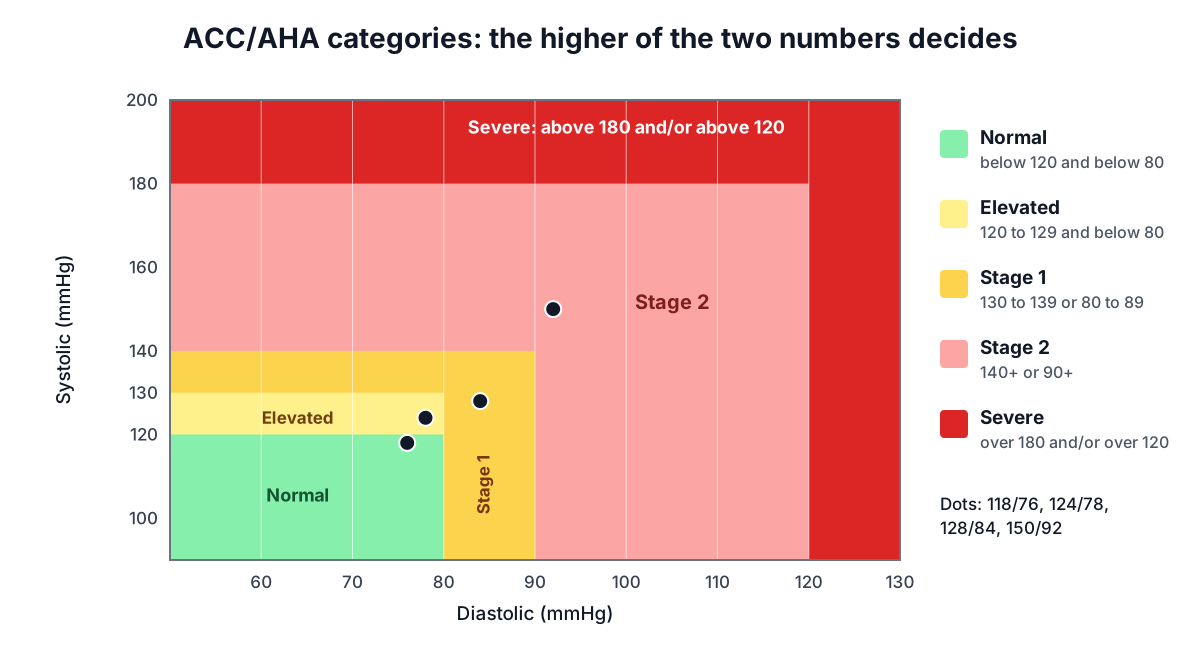
The 2017 guideline from the American College of Cardiology and American Heart Association, led by Paul Whelton, reshaped US practice by lowering the threshold for hypertension from 140/90 to 130/80. The committee drew on observational data showing that cardiovascular risk rises steadily from about 115/75 and on trials such as SPRINT (2015), where a systolic target below 120 reduced cardiovascular events compared with below 140 in high-risk adults. The 2025 AHA/ACC guideline kept the same categories.
| Category | Systolic | Diastolic | |
|---|---|---|---|
| Normal | below 120 | and | below 80 |
| Elevated | 120 to 129 | and | below 80 |
| Stage 1 hypertension | 130 to 139 | or | 80 to 89 |
| Stage 2 hypertension | 140 or higher | or | 90 or higher |
| Severe (hypertensive crisis range) | higher than 180 | and/or | higher than 120 |
Note the "or" from stage 1 upwards. A reading of 124/84 is stage 1 because of the diastolic value, even though the systolic would only count as elevated. Note also that "elevated" requires a diastolic below 80.
The European grades
The European Society of Hypertension (ESH) 2023 guideline, like the 2018 ESC/ESH guideline before it, kept 140/90 as the threshold for hypertension and grades readings in more steps:
| ESH 2023 category | Systolic | Diastolic | |
|---|---|---|---|
| Optimal | below 120 | and | below 80 |
| Normal | 120 to 129 | and/or | 80 to 84 |
| High normal | 130 to 139 | and/or | 85 to 89 |
| Grade 1 hypertension | 140 to 159 | and/or | 90 to 99 |
| Grade 2 hypertension | 160 to 179 | and/or | 100 to 109 |
| Grade 3 hypertension | 180 or higher | and/or | 110 or higher |
| Isolated systolic hypertension | 140 or higher | and | below 90 |
So 134/86 is stage 1 in the US and high normal in Europe; 150/85 is stage 2 in the US and grade 1 (isolated systolic) in Europe. The systems disagree on labels, not on biology. Both agree risk rises continuously, and both recommend lifestyle changes from the 130s; they differ on when to call it a disease and when to start drugs. (The 2024 ESC guideline introduced yet another scheme, "non-elevated", "elevated" and "hypertension", with similar thresholds; the calculator shows the ESH grades as the more widely used European comparison.)
Measuring properly at home
Technique causes more misclassification than any difference between guidelines. The AHA and ESH give almost identical instructions:
- Use a validated upper-arm monitor; wrist and finger devices are less reliable. In the US, validatebp.org lists devices that have passed independent testing.
- Pick the right cuff size. The bladder should wrap most of the way round your arm; a cuff that is too small reads high, sometimes by 10 mmHg or more.
- Avoid caffeine, exercise and smoking for 30 minutes, and empty your bladder.
- Sit with your back supported and feet flat for 5 minutes. Rest your arm on a table so the cuff is at heart level, on bare skin.
- Do not talk. Take two or three readings one minute apart.
- Measure morning and evening for about a week and record every reading.
Common errors and their typical effect: talking adds up to 10 mmHg, an unsupported arm or back adds several mmHg, crossed legs add a few, and a full bladder adds up to 10 mmHg.
Averaging like a clinician
Guidelines diagnose hypertension from averages, not single readings. The ACC/AHA guideline asks for the average of two or more readings on two or more occasions; the ESH suggests averaging the last two of three readings in a session, because the first is often higher.
Take a morning session of 138/88, 131/84 and 129/83. Averaging all three gives 132.7/85, which rounds to 133/85. Dropping the first gives 130/83.5, or 130/84. Both are stage 1 under ACC/AHA and high normal under ESH, but near a boundary the choice can flip a label, which is one reason clinicians look at a week of readings rather than one session.
Home readings tend to run lower than clinic readings, so their thresholds differ slightly. The 2017 ACC/AHA guideline gives equivalents:
| Clinic | Home average | Daytime ambulatory |
|---|---|---|
| 120/80 | 120/80 | 120/80 |
| 130/80 | 130/80 | 130/80 |
| 140/90 | 135/85 | 135/85 |
| 160/100 | 145/90 | 145/90 |
Home and ambulatory readings also catch two patterns a clinic visit misses. White-coat hypertension means readings are high in the clinic but normal elsewhere; masked hypertension is the reverse, normal in the clinic but high at home, and it carries risk similar to sustained hypertension.
Mean arterial pressure and pulse pressure
Two derived numbers appear on the checker.
Mean arterial pressure (MAP) is the average pressure through a heartbeat. Because the heart spends about two thirds of each cycle in diastole at rest, MAP is estimated as diastolic plus one third of the difference: for 120/80, 80 + 40/3 = 93 mmHg. In intensive care a MAP of at least about 65 mmHg is a common target to keep organs perfused.
Pulse pressure is systolic minus diastolic, usually about 40 mmHg. A wide pulse pressure, say 70 or more in an older adult, often reflects stiff arteries and is itself associated with cardiovascular risk.
Low blood pressure
There is no single official threshold for low blood pressure, but readings below 90/60 are usually described as low. In healthy young adults, especially women and endurance athletes, that can be completely normal. It matters when it causes symptoms such as dizziness, fainting or blurred vision, or when it is new, for example after starting a medicine. A fall of 20 systolic or 10 diastolic within three minutes of standing is called orthostatic hypotension and is worth mentioning to a doctor.
When a reading is an emergency
Readings above 180/120 need prompt attention. Rest for five minutes and measure again. If the reading is still that high and you have no symptoms, contact your doctor the same day. If you have chest pain, shortness of breath, back pain, numbness or weakness, a change in vision or difficulty speaking, call emergency services, because these can be signs of organ damage such as stroke or heart attack.
What lowers blood pressure
For elevated blood pressure and stage 1, guidelines start with lifestyle changes, each worth a few mmHg and more together:
- Losing excess weight: roughly 1 mmHg per kilogram lost in people with overweight.
- A DASH-style diet rich in vegetables, fruit, whole grains and low-fat dairy.
- Less sodium, ideally under 1,500 mg a day, and more potassium from food.
- Regular aerobic exercise, about 90 to 150 minutes a week.
- Limiting alcohol to no more than one or two drinks a day.
Medication decisions depend on your average readings and your overall cardiovascular risk, and belong in a conversation with your clinician.
Summary
Know which system you are reading: ACC/AHA calls 130/80 hypertension, ESH calls it high normal. Measure carefully, average readings over days, and treat any single number with caution, except readings above 180/120, which need action. Paste your home readings into the Blood Pressure Category Checker for averages, both classifications, MAP and pulse pressure. For related risk markers see the Waist-to-Hip Ratio Calculator, and for a calm pre-measurement routine try the Breathing Exercises.
Sources: Whelton PK et al., 2017 ACC/AHA guideline for high blood pressure in adults, Hypertension 2018;71:e13-e115; 2025 AHA/ACC guideline for the prevention, detection, evaluation and management of high blood pressure in adults; Mancia G et al., 2023 ESH guidelines for the management of arterial hypertension, J Hypertens 2023;41:1874-2071; SPRINT Research Group, N Engl J Med 2015;373:2103-16.
Related searches
- blood pressure categories chart
- stage 1 hypertension 130 80
- acc aha vs esh blood pressure
- how to measure blood pressure at home
- white coat hypertension
- mean arterial pressure formula
- home blood pressure targets
- when is blood pressure an emergency