
Board Game Night: Picking Teams and Who Goes First
Fair ways to pick the first player and split teams: a single die that cannot tie, why roll-offs need a d20, rotating the start, snake drafts, and how much going first is worth.
By Redbison Dev · · Updated · 8 min read

The box is open, the board is set up, and four people are looking at each other: who goes first? The fairest quick answer is a single random pick everyone can see, such as one roll of a die with as many sides as there are players, followed by passing the first turn to the left in every later game so it evens out over the night. Teams work the same way: split them at random, or let two captains pick in a snake order so the first pick does not decide the evening.
Below are the methods that work, the ones that quietly favour someone, and what is known about how much going first is worth.
Does going first matter?
In some games it matters a great deal, which is why serious players compensate for it.
- Connect Four has been solved. James D. Allen announced a solution in October 1988, and Victor Allis found one independently 15 days later: with perfect play, the player who moves first wins on the standard 7 by 6 board.
- Go gives White extra points, called komi, because Black moves first. Standard komi is 6.5 points under Japanese and Korean rules and 7.5 under Chinese and AGA rules; the half point means a game almost never ends in a tie.
- Penalty shootouts in football are a natural experiment, because a coin toss decides which team kicks first. Jose Apesteguia and Ignacio Palacios-Huerta studied 129 shootouts and reported a first-mover advantage in the American Economic Review in 2010, but Martin Kocher, Marc Lenz and Matthias Sutter widened the sample to 540 shootouts and found no significant advantage (Management Science, 2012). Even a famous first-mover edge can shrink when more games are counted.
For a casual board game, nobody has measured your table's edge, and it depends on the game and the players. The practical response is the same either way: choose the first player at random so nobody can complain about the pick, and rotate the start across games so any edge is shared.
One roll, no ties: a die with one side per player
The common rule "everyone rolls, highest goes first" has a flaw: ties. Each tie means another roll, and with ordinary six-sided dice ties for the top are frequent.
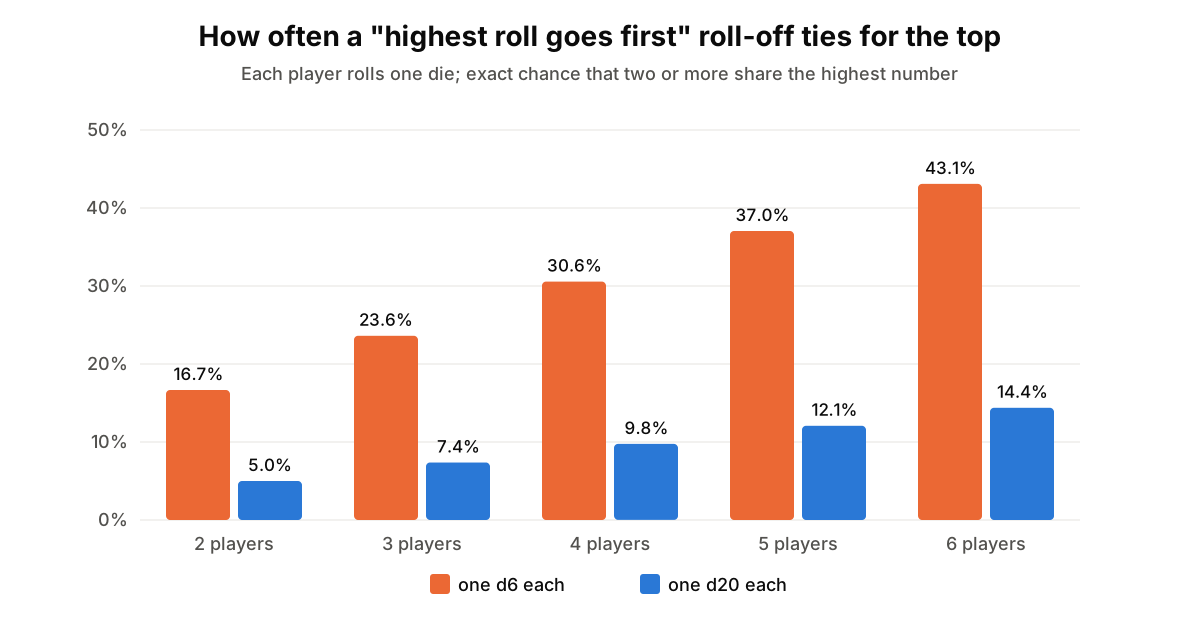
With four players each rolling one d6, two or more share the highest number 30.56% of the time, nearly one start in three. Switching to a d20 cuts that to 9.75%, which is why many groups roll a d20 for initiative.
There is a cleaner method: one roll of one die whose number of sides equals the number of players. Physical dice only come in a few sizes, but the Dice Roller accepts any die from 2 to 1,000 sides.
Worked example: five players, one roll
- Number the seats clockwise from the host: 1 to 5.
- Open the Dice Roller, type
d5in the Dice notation box and press Roll. - Read the odds table: totals 1 to 5 each show 20% in the Exactly column. Every seat has the same chance.
- The seat matching the number starts. If the dice show 3, seat 3 goes first, and nobody rolls again.
For four players type d4 (25% each), for three d3, and for seven d7. One roll settles it, there is nothing to tie, and the whole table watches the same result. The roll uses the browser's cryptographic random generator with rejection sampling, so no seat is even slightly favoured.
If you would rather see names than numbers, put the players' names on the Spin Wheel and spin it on a screen everyone can see. Each name gets an equal slice and an equal chance. For two players or two teams, the Coin Toss does the job in one flip.
Rotate the start across the evening
A random first player is fair for one game. Over a night of several games, rotation is fairer still: whoever started the last game passes the first turn to the player on their left. With four players and four games, everyone starts exactly once, and any first-player advantage is spread evenly instead of falling on whoever won the coin toss.
To see who won the night, keep a tally in the Score Keeper:
- Add the players, choose "Highest total wins", and type the number of games you plan to play in "Number of rounds".
- After each game, type 1 for the winner in the next empty row (press Add round when you need a new row) and 0 for everyone else (or each game's final score, if the games use similar scales).
- The running totals show the leader as you go, and the banner names the overall winner, or a shared win, when the last game is entered.
Rotate by seat, or jot each game's starter on paper, and nobody has to remember who went first last time.
Picking teams: random split or snake draft
For team games there are two fair approaches, and they suit different groups.
A random split is quickest and avoids anyone being picked last. Paste the names into the Group Splitter, set Grouping Method to By Number of Groups, enter the number of teams, and leave Assignment Method on Random. Use it when skill levels are similar or unknown; the Group Splitter section of fair random decisions explains how it keeps team sizes even.
A snake draft suits groups that know who is strong and want even teams. Two captains take turns choosing, but the order reverses each round: A, B, B, A, A, B, B, A. The plain alternating order (A, B, A, B) hands the first captain the better player in every pair. Here is the difference with eight players ranked 1 (strongest) to 8:
| Order | Captain A gets | Rank total | Captain B gets | Rank total |
|---|---|---|---|---|
| Alternating A, B, A, B | 1, 3, 5, 7 | 16 | 2, 4, 6, 8 | 20 |
| Snake A, B, B, A | 1, 4, 5, 8 | 18 | 2, 3, 6, 7 | 18 |
A lower rank total means a stronger team. Alternating leaves Captain A 4 rank places stronger; the snake order brings both teams to 18. Real skill does not line up as neatly as ranks, but the snake order removes the built-in edge of picking first. Flip the coin to decide which captain picks first.
Methods that look fair but are not
- "The youngest goes first." Some rulebooks print a rule like this. It is a tradition, not a random pick, and the same person gets the advantage every time you play with the same group. Use it once, then rotate.
- Re-rolling until someone likes the result. Agree on the method before the roll and accept the first result. A second roll because someone did not like the first is a new draw that favours whoever asked for it.
- A d6 roll-off with five or six players. The ties are frequent enough to slow the start down: 43.09% of the time with six players. Use a d20, or one roll of a
d5ord6, one number per player. - Captains picking in a fixed order. Without a snake order or a coin toss, the same captain gets the first pick every time.
Tools for this job
- Dice Roller: one roll of a die with one side per player, or a d20 roll-off with fewer ties.
- Spin Wheel: pick the first player or the next game by name, on a screen everyone can see.
- Coin Toss: settle a two-player or two-captain decision in one flip.
- Group Splitter: random teams with sizes that differ by at most one.
- Score Keeper: track wins across a night of games and name the overall winner.
Our game night kit covers dice notation, brackets and running scores in more depth, and fair random decisions explains how these tools avoid biased picks.
Frequently asked questions
What is the fairest way to decide who goes first in a board game?
Number the players around the table and roll one die with that many sides, such as a d4 for four players or a d5 for five. Every player has the same chance and there can be no tie. In later games, pass the first turn to the left so everyone starts in turn.
Why do ties happen so often when everyone rolls a d6?
Six faces are not many to share. With four players, the chance that at least two share the highest number is 30.56%, and with six players it is 43.09%. A d20 lowers those to 9.75% and 14.38%.
Is going first an advantage?
In some games, clearly: Connect Four is a first-player win with perfect play, and Go gives the second player 6.5 or 7.5 points of komi to make up for it. In most casual board games the size of the edge is unmeasured, so pick the first player randomly and rotate it between games.
What is a snake draft?
A picking order that reverses every round: A, B, B, A, A, B, B, A. It stops the captain who picks first from getting the better player in every pair. With eight ranked players it gives both teams the same rank total.
Sources and further reading
- Connect-4, John Tromp. Solution history and results showing a first-player win on the standard board.
- Komi (Go), Wikipedia. Standard komi under Japanese, Korean, Chinese and AGA rules.
- Psychological Pressure in Competitive Environments: Evidence from a Randomized Natural Experiment, American Economic Association. Apesteguia and Palacios-Huerta, 2010, on penalty shootout order.
- Psychological Pressure in Competitive Environments: New Evidence from Randomized Natural Experiments, EconPapers. Kocher, Lenz and Sutter, Management Science 58(8), 2012: no significant first-mover advantage in 540 shootouts.
- Coin Tossing, Wolfram MathWorld. The probability behind fair coin flips.
- Algorithm 235: Random permutation, Communications of the ACM. Durstenfeld's shuffle, used to deal random teams.