
Classic Browser Games: Rules and Strategies That Actually Work
How Tetris, Snake, 2048, Wordle, Sudoku, Minesweeper and two arcade dodgers really work, and the specific habits that win more of them.
· 8 min read

Most people lose at 2048 the same way: the big tile drifts out of its corner on move 300 and the board fills with 2s within twenty moves. Most Minesweeper losses on Beginner are not bad luck either, they are a missed 1-2-1 pattern. Small games have small rule sets, which means a handful of habits decides most outcomes. This guide covers the eight quick games on RedBison, what their rules actually are (including the edge cases each one handles), and the strategies that measurably help.
All of them run in the browser with no account. A few save progress in local storage, which the sections below point out.
Tetris: flat stacks and one open column
Tetris here uses the standard 10 by 20 well and the seven tetrominoes. Each locked piece scores 10 points and each cleared line scores 100 times your level, so four lines at once on level 3 is worth 1,200, and four single clears on the same level are worth exactly the same. Unlike official versions, there is no bonus for a four-line clear. The level rises every 10 lines; gravity starts at 500 ms per row and drops 50 ms per level to a floor of 80 ms.
Two things differ from modern official versions. Pieces are chosen uniformly at random rather than from a 7-bag, so long waits for an I piece happen. And rotation has no wall kicks: if a turn would overlap a wall or the stack, it is refused.
What works:
- Keep the surface flat. Any step of two rows or more can only be filled by one or two shapes, and the randomiser will not deliver them on time.
- Clear lines as they come. Scoring has no multi-line bonus, so a deep well waiting for an I piece only adds risk, and with no 7-bag that wait can be long.
- Rotate before you reach the wall. Without kicks, a piece pressed against the side often cannot turn.
- Use the time limit to practise. A 3 minute game rewards efficient clears rather than survival.
Snake: sweep the edges, follow your tail
Snake runs on a 20 by 20 grid at one move every 150 ms. Each food adds 10 points and one segment. Two rules decide fairness and both are handled here: the tail leaves its cell on the same tick the head moves, so chasing your own tail is legal; and a new direction is checked against the direction the snake actually last moved, so two fast key presses cannot sneak a 180-degree turn into one tick.
The strategy is about space, not speed. Once the snake is longer than about a third of the board width, stop cutting through the middle. Travel in long sweeps along the walls and come back in parallel lanes, like mowing a lawn. Cutting across splits the free space into two regions, and the food will appear in the one you cannot reach. When the path to the food is not clear, follow your own tail: that cell is always about to become free.
Wall wrapping changes the game. With wrap on, the board has no edges, distances shrink, and the mowing pattern stops working because there is no wall to sweep against. Pick a mode and learn it; the habits do not transfer well.
2048: one corner, two directions
2048 slides every tile as far as it can go, merges equal pairs, adds the merged value to your score, then spawns a 2 (90% of the time) or a 4 (10%). A tile merges only once per move, and the pair nearest the wall you are moving toward merges first. So [2, 2, 2, 2] slid left becomes [4, 4], and [2, 2, 2] becomes [4, 2].
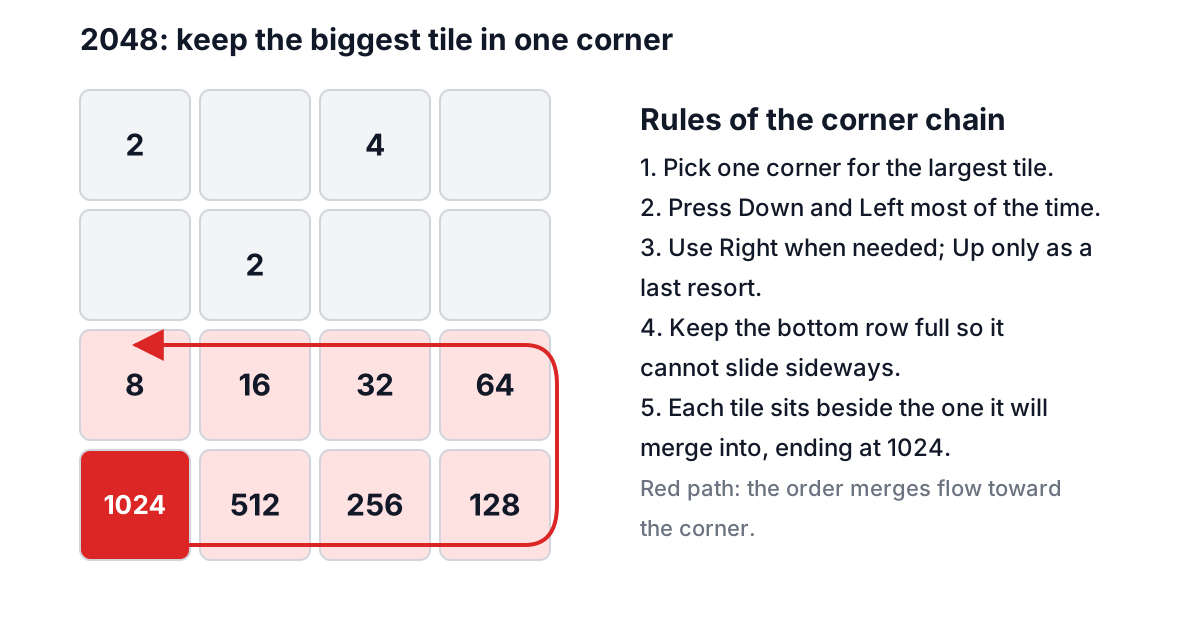
The strategy that works for nearly everyone is the corner chain:
- Pick a corner for your largest tile, say bottom-left.
- Mostly press Down and Left. Use Right when you have to. Press Up only when nothing else moves.
- Keep the bottom row full. A full row cannot slide sideways, so pressing Right will not drag the big tile out of its corner.
- Build a descending chain: 1024, 512, 256, 128 along the bottom row, then continue on the row above in the opposite direction, so each tile sits next to the one it will merge into.
The common failure is chasing an easy merge on the far side of the board. It scores a few points and pulls a gap into your chain that a 2 then fills. If you play only Down and Left for long stretches you will be surprised how far the chain carries you.
Wordle: test letters, then solve
The Wordle game gives you six guesses at a five-letter word. Green is the right letter in the right place, yellow is in the word elsewhere, grey is not in the word. Repeated letters follow a two-pass rule: exact matches are coloured first and use up their letter, and a letter turns yellow only while the answer has an unused copy left.
| Answer | Guess | Result | Why |
|---|---|---|---|
| WORLD | HELLO | grey, grey, grey, green, yellow | WORLD's only L is claimed by the green L in position 4 |
| HOTEL | LLAMA | yellow, grey, grey, grey, grey | One L in the answer, so only one guessed L is coloured |
| HELLO | LLAMA | yellow, yellow, grey, grey, grey | HELLO has two Ls, so both guessed Ls earn yellow |
Strategy is mostly about guess two. Use it to test five new common letters rather than to fit the clues from guess one. RAISE followed by COUNT covers ten of the most frequent letters with no overlap. From guess three on, play to win. This version draws answers from a list of about 500 common words and only accepts guesses from that list, which keeps answers fair but rejects some valid openers.
Sudoku: scan first, then singles
Sudoku asks for the digits 1 to 9 once in every row, column and 3 by 3 box. Every puzzle here is generated with a uniqueness check: cells are removed one at a time and a solver confirms that exactly one solution remains, so logic alone always suffices. Easy aims for about 40 givens and Expert for about 24. For context, 17 is the proven minimum for any unique puzzle.
Work in this order and most Easy and Medium grids fall without guessing:
- Cross-hatching. Pick a digit, say 7. For each box that lacks a 7, follow the rows and columns that already contain a 7 through the box. Often only one cell is left.
- Naked singles. For an empty cell, list what its row, column and box already contain. If eight digits are taken, the ninth goes there.
- Pairs. If two cells in a unit can only be {3, 8}, no other cell in that unit can be 3 or 8.
- Pointing. If a box's only candidates for a digit lie in one row, that digit cannot appear elsewhere in that row.
The red mistake highlighting compares against the solution, so it is a strong hint. Ignore it, or treat a red digit as a lesson about which step you skipped. Export Puzzle makes a PDF if you prefer paper and pencil marks.
Minesweeper: patterns before guesses
Minesweeper offers the classic Beginner (9 by 9, 10 mines), Intermediate (16 by 16, 40) and Expert (30 by 16, 99) boards. Mines are placed after your first click and never on that square or its eight neighbours, so the first click always opens an area.
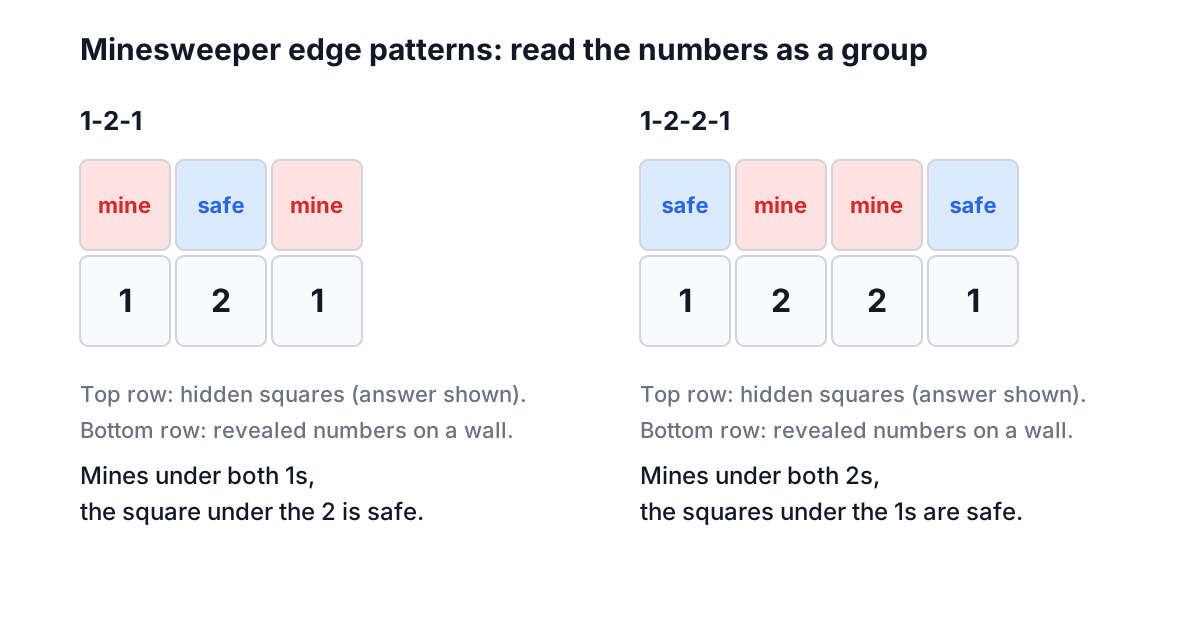
Most of the game is a few repeating shapes:
- Satisfied numbers. If a 2 already touches two flags, every other hidden neighbour is safe. This single rule clears most of a Beginner board.
- 1-2-1 against a wall (or against revealed squares): mines under both 1s, the square under the 2 is safe.
- 1-2-2-1: mines under the two 2s, safe under the 1s.
- 1-1 from an edge: the third square along from the edge, next to the second 1, is safe.
When you must guess, guess where there is the least information pressure: a square far from high numbers, or a corner of a large unopened area where the chance of opening a blank is highest. There is no chording in this version, so clear around satisfied numbers by clicking each square.
Helicopter and Bug on Wire: small inputs early
The two arcade games share one lesson: react early with small inputs.
In the Helicopter Game you hold to climb and release to fall. Thrust ramps in over a fraction of a second, and vertical speed is capped, so long holds build momentum you then have to cancel. Tap in short pulses to stay nearly level and fly through the middle of the cave. Most crashes come from riding the ceiling when it suddenly dips. Harder levels narrow the cave and scroll faster; Easy scrolls at 85% of Normal speed and Insane at 125%.
Bug on Wire puts you on one of four vertical wires while birds dive down them. Speed rises every 5 seconds and birds spawn more often every 10 seconds. Sit on one of the two middle wires so every other wire is at most two steps away, and watch the top of the screen rather than your bug. With the mouse, the bug jumps to whichever wire is nearest the pointer, so make short, deliberate movements.
Which game for which break
| You have | Try | Why |
|---|---|---|
| 1 minute | Bug on Wire, Helicopter Game | Instant restart, short rounds |
| 3 to 5 minutes | Tetris or Snake with a time limit | The limit ends the game for you |
| 10 minutes | Minesweeper Beginner, Wordle | Pure logic, one sitting |
| Spread across a day | 2048, Sudoku | Both auto-save after every move |
For a longer logic puzzle, the Fifteen Puzzle has its own guide, How to Solve the 15 Puzzle, which explains the parity rule that makes half of all shuffles impossible. If you want a timer for your own challenges, the Stopwatch works alongside any of these.
Pick one game, apply one habit from its section for a week, and compare: corner chains in 2048 and the 1-2-1 pattern in Minesweeper are the two that change results fastest.