
Molar Mass, Molarity, Dilutions and Half-Life: Lab Maths
From a chemical formula to grams on the balance: molar mass with IUPAC atomic weights, molarity and C1V1 = C2V2 dilutions, and exponential decay with half-lives.
· 9 min read

Most quantitative chemistry, whether in a teaching lab, a biology prep room or a quality-control bench, comes down to a few moves: turn a formula into a molar mass, turn a mass into moles, turn moles into a concentration, and dilute that concentration to what the experiment needs. Radioactive decay adds one more pattern, the exponential, which also governs first-order reactions and drug clearance. This guide explains each step and the judgment calls around it, with numbers you can check in the Molecular Weight Calculator, the Molarity Calculator and the Half-Life Calculator.
From formula to molar mass
The molar mass of a compound is the sum of the atomic weights of its atoms. Water, H2O, is 2 × 1.008 + 15.999 = 18.015 g/mol. Glucose, C6H12O6, is 6 × 12.011 + 12 × 1.008 + 6 × 15.999 = 180.156 g/mol.
Where do those atomic weights come from? The Commission on Isotopic Abundances and Atomic Weights (CIAAW) of IUPAC evaluates them from isotope measurements. Natural isotope ratios vary a little between sources, so for elements such as hydrogen, carbon, oxygen and chlorine the commission publishes an interval rather than one number. For everyday work it also publishes an abridged table with single values to about five significant figures, such as H 1.008, C 12.011, N 14.007, O 15.999, S 32.06 and Cl 35.45. That abridged table is what the molecular weight calculator uses, so quoting a molar mass to four or five significant figures is honest, and quoting seven is not.
A few notation habits avoid most mistakes:
- Capital letters start symbols. Co is cobalt (58.933); CO is carbon monoxide (28.010). A formula typed in lower case is ambiguous, so the calculator refuses it rather than guessing.
- Brackets multiply everything inside. Ca(OH)2 has two oxygens and two hydrogens; Al2(SO4)3 has twelve oxygens. Brackets can nest, as in K4[Fe(CN)6], 368.345 g/mol.
- Hydrates count their water. Copper(II) sulfate pentahydrate, CuSO4·5H2O, is 249.677 g/mol; the anhydrous salt is 159.602 g/mol. If the bottle contains the blue crystals and you use the anhydrous figure, your solution ends up 36% weaker than intended.
- Charges do not change the mass in practice. An electron is about 1/1836 of a hydrogen atom, so SO4^2- is treated as 96.056 g/mol.
Mass percent follows directly: oxygen is 15.999 / 18.015 = 88.81% of water by mass, and nitrogen is 28.85% of caffeine (C8H10N4O2, 194.194 g/mol). Percent composition is how combustion analysis leads back to an empirical formula, and how you compare which salt delivers more of an ion per gram.
Moles and molarity
A mole is 6.02214076 × 10²³ entities, a number fixed exactly in the 2019 redefinition of the SI. Moles are mass divided by molar mass, n = m / M, and molarity is moles per litre of solution, c = n / V. Combined:
c = m / (M × V), or rearranged, m = c × V × M.
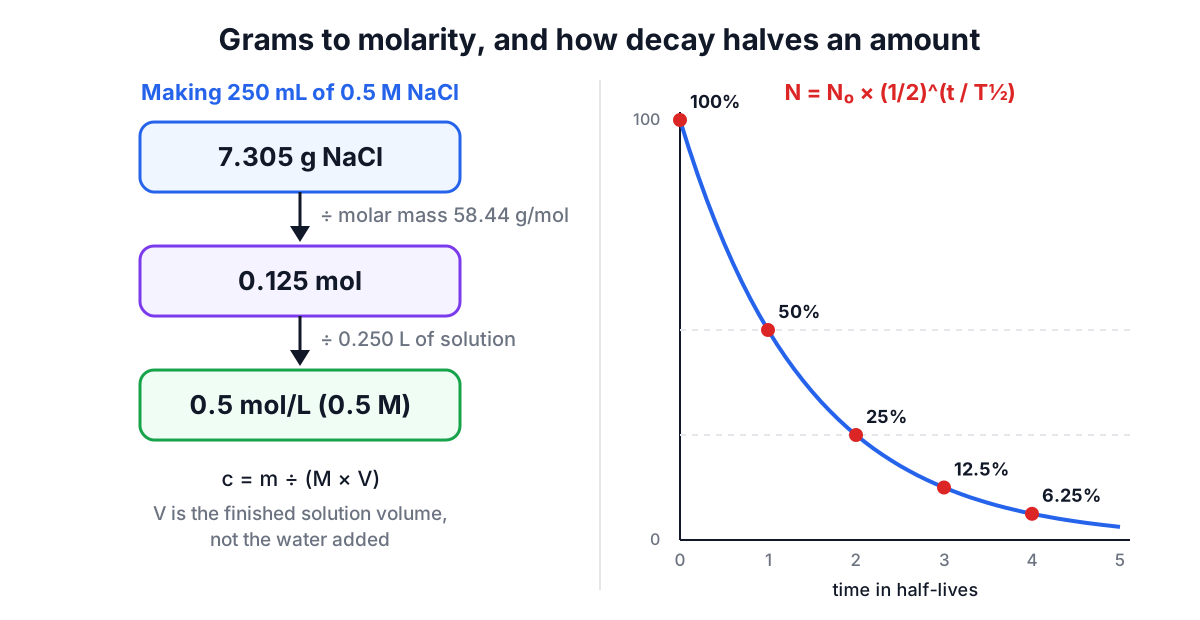
To make 250 mL of 0.5 M sodium chloride you need 0.5 × 0.250 × 58.44 = 7.305 g. The diagram traces the same calculation forwards.
The volume in that formula is the volume of finished solution, not the volume of water you pour in. Dissolving a solid changes the volume, so the reliable method is to dissolve the solid in less solvent than you need, transfer it to a volumetric flask and make up to the mark. Molarity also shifts slightly with temperature because liquids expand, which is why physical chemists use molality (moles per kilogram of solvent) for freezing point and boiling point work.
Two practical cautions are worth knowing. Some solids are not what their formula says: sodium hydroxide pellets absorb water and carbon dioxide from the air, so a 0.1 M NaOH solution made by weighing 2.000 g into 500 mL is only approximately 0.1 M until it is standardised by titration. And percent solutions are a different unit: 1% w/v means 1 g per 100 mL, which is 10 g/L; divide by molar mass to get molarity.
Dilutions: C1V1 = C2V2
Diluting a solution adds solvent but not solute, so the moles you take from the stock equal the moles in the final solution: C1 × V1 = C2 × V2. Solve for whichever is unknown, usually V1.
To make 500 mL of 1 M hydrochloric acid from a 12 M stock, V1 = 1 × 500 / 12 = 41.67 mL. The dilution factor is 12, and the remaining 458.33 mL is roughly the water to add. Three rules keep this safe and accurate:
- Units just need to match on each side. Use mM with mM and mL with mL; nothing needs converting to litres.
- Fill to volume rather than adding a calculated volume of water. Volumes are not perfectly additive; acid and water, or ethanol and water, shrink on mixing.
- Add acid to water. Diluting concentrated acid releases heat, and adding water to acid can boil and spatter.
For a serial dilution, apply the same equation step by step. A tenfold series from 1 M takes 1 mL of each solution into 9 mL of diluent, giving 100 mM, 10 mM, 1 mM and so on. Errors compound along a series, so pipette accuracy matters more than it does for a single step.
Half-life and exponential decay
Radioactive decay is random for any one nucleus but predictable for a population. Each half-life, half of what remains decays: 100% becomes 50%, then 25%, 12.5%, 6.25%. The general formula is N = N₀ × (1/2)^(t / T½), or equivalently N = N₀ × e^(−λt) with the decay constant λ = ln 2 / T½. The mean lifetime, the average time a nucleus survives, is τ = 1 / λ, about 1.44 half-lives.
Solving the other way needs a logarithm: t = T½ × log₂(N₀ / N). A sample with a quarter of its original carbon-14 has been through two half-lives, so with the current evaluated half-life of 5,700 years it is about 11,400 years old. After 10,000 years, 29.64% of the carbon-14 remains.
The numbers behind the isotope presets come from evaluated nuclear data (NNDC NuDat, built on ENSDF): iodine-131 8.0252 days, technetium-99m 6.0067 hours, cobalt-60 5.2714 years, caesium-137 30.08 years, uranium-238 4.468 billion years. A few points of judgment:
- Radiocarbon convention. Laboratories report "conventional radiocarbon ages" using Willard Libby's original half-life of 5,568 years, then convert them to calendar dates with calibration curves such as IntCal, because atmospheric carbon-14 has not been constant. A half-life calculation gives a physics answer, not a calibrated date.
- Activity decays the same way. Becquerels and curies fall with the same half-life as the number of atoms, so a source's activity after storage uses the same formula.
- Effective half-life in the body. A medical isotope is removed both by decay and by excretion: 1/T_eff = 1/T_phys + 1/T_bio. Iodine-131 has a physical half-life of about 8 days, but the effective half-life in a patient is usually shorter.
- Ten half-lives is a rule of thumb. After ten, about 0.1% remains. Whether that is "gone" depends on how much you started with.
The same exponential describes first-order chemical reactions, the elimination of many drugs, and the discharge of a capacitor through a resistor (where the half-life is ln 2 × RC). Once you can move between half-life, decay constant and time constant, all of these become the same calculation.
A worked lab session
Suppose a protocol asks for 100 mL of 0.2 M copper(II) sulfate made from the pentahydrate, and later a 1:20 dilution of it. The molecular weight calculator gives 249.677 g/mol for CuSO4·5H2O. The molarity calculator gives 0.2 × 0.100 × 249.677 = 4.994 g to weigh. For the dilution, C2 = 0.2 / 20 = 0.01 M; to make 50 mL you need V1 = 0.01 × 50 / 0.2 = 2.5 mL of the stock made up to 50 mL. Each step is a single formula, but doing them in sequence with the right molar mass, the right volume and consistent units is what keeps the final concentration correct.