
Estimating Concrete, Flooring, Tile and Gravel Without Running Short
How to turn measurements into cubic yards, square feet, boxes and tons: the unit traps, bag yields, waste allowances and densities that decide what you actually order.
· 9 min read
Most estimating mistakes on small building jobs are not arithmetic mistakes. The multiplication is easy. The trouble is that the measurements arrive in one set of units, the material is sold in another, and the gap between "what the drawing says" and "what you have to buy" is filled by judgment: how much to allow for waste, which bag yield to trust, how heavy a yard of stone really is. This guide walks through those judgment calls for four common jobs, with numbers you can reproduce in the Concrete Calculator, the Square Footage Calculator, the Tile Calculator and the Gravel and Mulch Calculator.
Units first: why 27 and 9 and 43,560 matter
A length conversion is a single factor. An area conversion is that factor squared, and a volume conversion is the factor cubed. One yard is 3 feet, so one square yard is 9 square feet and one cubic yard is 27 cubic feet. Forgetting the exponent is the most expensive error in estimating, because it produces answers that are wrong by a factor of 3 or 9 and still look plausible.
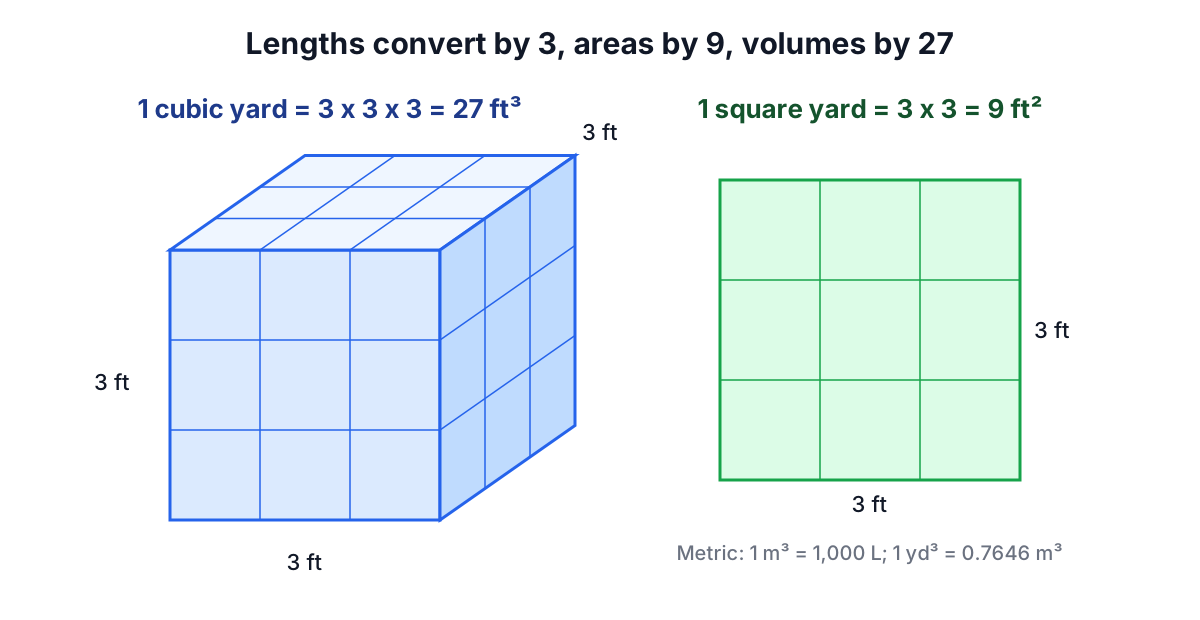
The metric side has the same trap with different numbers: 1 metre is 100 cm, so 1 m² is 10,000 cm² and 1 m³ is a million cm³. The bridge between the systems is the international foot, defined in 1959 as exactly 0.3048 m. That makes a square foot exactly 0.09290304 m² and a cubic yard exactly 0.764554857984 m³. When a calculator is accurate to the last digit, this is why.
The other habit worth building is converting thickness before multiplying. Slabs, mulch and gravel are specified in inches or centimetres of depth but measured in feet or metres across. Divide inches by 12 (or centimetres by 100) first, then multiply. A 10 x 10 ft patio 4 inches thick is 10 x 10 x 0.333 = 33.3 cubic feet, and 33.3 / 27 = 1.23 cubic yards.
Concrete: volume, bag yields and when to call a truck
Every concrete shape reduces to a few formulas:
slab, footing, wall   V = length x width x thickness
round column or hole  V = pi x (diameter / 2)^2 x depth
curb and gutter       V = (curb depth x (curb height + flag) + gutter width x flag) x length
steps (n steps)       V = width x run x rise x n(n+1)/2
The steps formula surprises people. A solid set of steps poured on grade is a stack of blocks, and the top step is n times as tall as the bottom one, so three 7 inch steps 36 inches wide with 11 inch treads hold 9.6 cubic feet, and exactly half of it sits in the top step.
Converting volume to bags needs a yield, not a weight. QUIKRETE's data sheet for its standard Concrete Mix lists about 0.30 cubic feet of mixed concrete from a 40 lb bag, 0.45 from 60 lb and 0.60 from 80 lb; Sakrete gives the same 0.6 for 80 lb. So a cubic yard takes 27 / 0.6 = 45 bags of 80 lb. Kilogram bags work the same way: scaling the 80 lb yield by weight gives roughly 11.7 litres per 25 kg bag, but the printed yield on the bag is always the better number.
Those bag counts set a practical ceiling. The 10 x 10 patio with 10% extra is 1.36 cubic yards, which is 62 bags of 80 lb, nearly 5,000 lb of dry mix that someone has to lift twice and mix in batches before the first batch sets. Ready-mix plants batch by the cubic yard or metre and many dispatch in quarter-yard steps, so the same job is a 1.5 yard order. Short loads often carry a fee, but past about one cubic yard the truck is usually cheaper as well as faster. The calculator shows both prices side by side so you can see the crossover with your local numbers.
How much extra? Formed slabs on a compacted, level base need about 5%. Dug footings and post holes are rarely the size you planned, so 10% or more is normal there. Running short mid-pour is the worse failure, because the joint between old and new concrete is a weak plane.
Square footage: break the room into shapes you can measure
Area estimating is mostly about drawing. Sketch the space, split it into rectangles, triangles, circles and trapezoids that do not overlap, measure each one, and add. Anything you will not cover, such as a kitchen island, a hearth or a built-in cabinet, is a negative section.
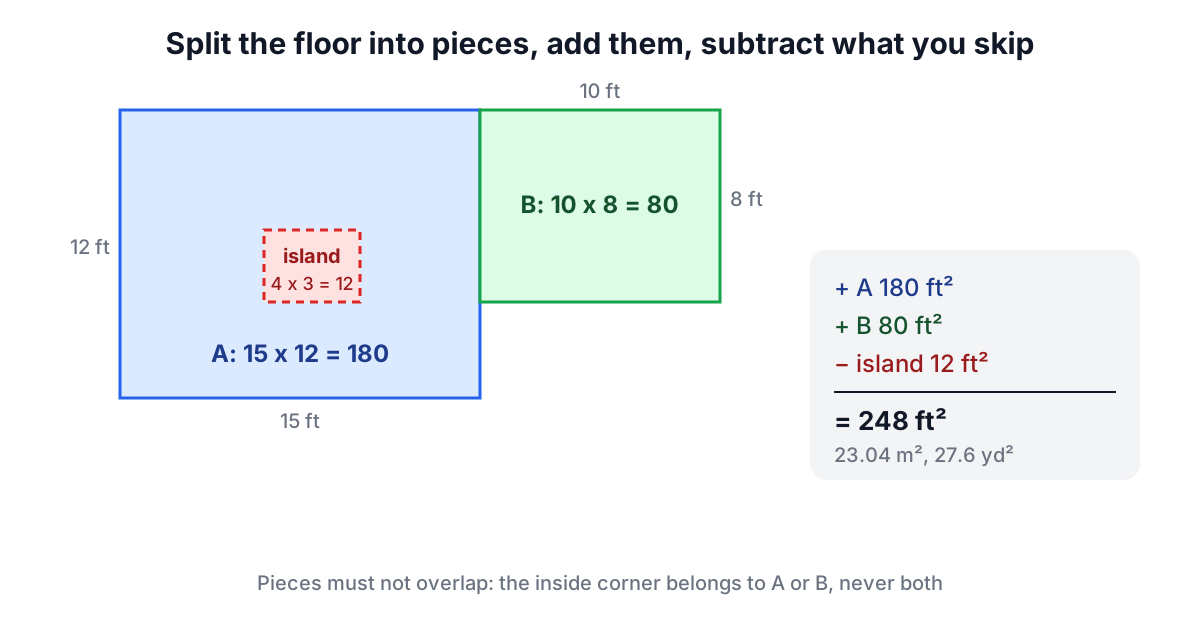
In that example the answer is 180 + 80 - 12 = 248 ft², which is 23.04 m² or 27.6 square yards. The two common slips are overlapping the pieces (counting the inside corner of an L twice) and converting an area with a length factor. Dividing 248 ft² by 3.28 to "get metres" gives 75.6, more than three times the real answer; the right divisor is 3.28 squared, about 10.76.
Square footage also has formal definitions that a tape measure alone does not settle. Real-estate gross living area under ANSI Z765 excludes some spaces and measures to the exterior of walls; a flooring estimate measures to the inside of walls. Be clear which one you need before comparing numbers with someone else.
Tile: joints, layout waste and whole boxes
A tile count has three adjustments the plain area does not. First, openings: subtract the tub, shower tray or cabinets that the tile will not go under. Second, joints: each tile takes up its own size plus one grout joint in each direction, so a 12 inch tile with a 1/8 inch joint occupies 12.125 x 12.125 inches. On a 120 ft² floor that alone moves the exact count from 120 to 117.5 tiles. Third, waste, which depends on the layout:
| Layout | Typical waste |
|---|---|
| Straight grid | 10% |
| Brick or offset | 10 to 12% |
| Diagonal (45 degrees) | 15% |
| Herringbone | 15 to 20% |
Diagonal and herringbone patterns cut almost every edge tile at an angle, and the offcuts are triangles that rarely fit elsewhere. Large-format tiles also waste more per bad cut. The calculator fills in a preset when you pick a layout, but the right number is the one your installer gives you after seeing the room. Then round up to whole boxes and keep the leftovers: the next batch of the same tile will not be quite the same colour.
Grout is estimated with the formula many adhesive makers print on their technical sheets: kg per m² = (A + B) / (A x B) x C x D x 1.6, with tile length A, width B, thickness C and joint D in millimetres. For 300 x 300 mm tiles, 8 mm thick with 3 mm joints, that is about 0.26 kg per square metre, so a small bag covers a bathroom.
Gravel, mulch and soil: from volume to tons
Loose material is the same volume problem as concrete (area times depth), followed by a weight problem, because quarries often sell by the ton. The density depends on the material and on how wet it is, and it varies more than people expect:
| Material (loose, dry, approximate) | lb per cubic yard | short tons per cubic yard | kg per m³ |
|---|---|---|---|
| Gravel | 2,800 | 1.40 | 1,660 |
| Crushed stone | 2,700 | 1.35 | 1,600 |
| Sand | 2,700 | 1.35 | 1,600 |
| Topsoil | 2,200 | 1.10 | 1,300 |
| Wood mulch | about 600 | 0.30 | 360 |
These are typical figures, not a standard. Wet sand and soil can weigh 10 to 20% more, and the stone grading matters. The calculator keeps the density editable for that reason; ask your supplier what conversion they use and type it in. A 10 x 10 ft path at 3 inches with 5% extra is 0.97 cubic yards, or about 1.36 tons of gravel at 2,800 lb per yard.
Depth is the setting that moves the order most. Going from 2 to 3 inches of mulch is a 50% larger order, and mulch deeper than about 3 inches tends to hold moisture against stems and bark. Bagged material is sold by volume: a cubic yard is 13.5 bags of 2 cubic feet, so 200 ft² of beds at 3 inches is 27 bags or about 2 yards in bulk.
Compacted base is the exception to small waste allowances. Crushed stone with fines shrinks when it is tamped, so driveways and paver bases need 15 to 25% extra over the loose volume.
A short checklist before you order
- Convert depths to the same unit as length and width before multiplying.
- Split irregular areas into pieces that do not overlap, and subtract what you will not cover.
- Use the yield on the bag, not its weight, to count bags.
- Pick a waste allowance from the job (formed slab, dug hole, diagonal tile, compacted base), not a single habit number.
- Ask the supplier for their density and order increment, and check delivery minimums.
None of this replaces a structural design or the advice of a contractor who has seen the site, but it does mean the numbers on the order form are ones you understand.