
Density, Mass and Volume: Formula, Units and the Archimedes Test
How to calculate and convert density, what specific gravity means, why water is 1 g/cm³, how temperature changes it, and how to measure an irregular object by weighing it in water.
· 9 min read

Density tells you how much mass is packed into a given volume. It is why steel sinks and oak floats, why a litre of petrol weighs less than a litre of water, and how jewellers can catch a fake gold bar without cutting it open. The formula is one of the simplest in science, but the units, the temperature dependence and the measurement of volume all trip people up. This post covers the formula, the unit conversions, specific gravity, a table of real values, and the water-displacement method. You can follow along in the Density Calculator.
The formula
Density (the Greek letter ρ, rho) is mass divided by volume:
ρ = m ÷ V
Rearranged, it gives the other two quantities:
- mass = density × volume
- volume = mass ÷ density
Worked example: identify a metal block
A small block has a mass of 500 g and measures 185 cm³ (for instance 5 cm × 5 cm × 7.4 cm). Its density is 500 ÷ 185 = 2.70 g/cm³. That matches aluminium (2.70 g/cm³) and rules out steel (7.85), titanium (4.51) and magnesium (1.74). One measurement narrows the field a long way.
Worked example: the weight of a steel part
A steel part has a volume of 2 litres (0.002 m³). With carbon steel at 7,850 kg/m³ its mass is 7,850 × 0.002 = 15.7 kg, or 34.6 lb. The same shape in aluminium would weigh 5.4 kg. Engineers use exactly this calculation to estimate the weight of beams, plates and castings before anything is made.
Units and conversions
The SI unit is the kilogram per cubic metre (kg/m³). Laboratories usually use grams per cubic centimetre, which happens to be identical to grams per millilitre and kilograms per litre. In the US, pounds per cubic foot and pounds per gallon are common.
| Unit | In kg/m³ | Water (about 4 °C) |
|---|---|---|
| kg/m³ | 1 | 1,000 |
| g/cm³ = g/mL = kg/L | 1,000 | 1.000 |
| g/L | 1 | 1,000 |
| lb/ft³ | 16.0185 | 62.43 |
| lb/in³ | 27,679.9 | 0.0361 |
| lb/gal (US) | 119.826 | 8.345 |
The quick rule: to go from g/cm³ to kg/m³, multiply by 1,000. Steel is 7.85 g/cm³ or 7,850 kg/m³. The "lb/gal" figure explains the old American rhyme "a pint's a pound the world around": a US pint of water weighs about 1.04 lb.
Why water is (almost) exactly 1
When the metric system was designed in the 1790s, the gram was defined as the mass of one cubic centimetre of water at the temperature of melting ice, later at its maximum density. The kilogram has since been redefined in terms of the Planck constant, but the link survives: pure, air-free water is densest at about 4 °C, where it is 999.97 kg/m³, within 0.003% of 1 g/cm³.
Water's density changes with temperature, and for careful work that matters. The International Committee for Weights and Measures (CIPM) recommends the formula of Tanaka and colleagues (2001), which gives:
| Temperature | Water density |
|---|---|
| 0 °C | 999.84 kg/m³ |
| 4 °C | 999.97 kg/m³ |
| 10 °C | 999.70 kg/m³ |
| 20 °C | 998.21 kg/m³ |
| 25 °C | 997.05 kg/m³ |
| 40 °C | 992.22 kg/m³ |
Ice is much less dense, about 917 kg/m³ at 0 °C, which is why it floats with roughly 92% of its volume below the surface. Seawater, with about 35 g of salt per kilogram, is about 1,025 kg/m³.
Specific gravity
Specific gravity (SG), also called relative density, is a material's density divided by the density of water. Since it is a ratio, it has no units, and it is numerically almost equal to the density in g/cm³:
SG = ρ material ÷ ρ water
- SG below 1: floats in fresh water (oak, pine, ice, most oils, petrol).
- SG above 1: sinks (stone, glass, metals, most plastics such as PVC and PLA).
A floating object sinks until it has displaced its own weight of water, so the fraction submerged equals SG ÷ SG of the liquid. A pine plank with SG 0.5 floats half submerged; ice at 0.917 floats 92% submerged in fresh water and about 89% in seawater.
Different industries use different reference temperatures. This calculator compares with water at its maximum density (999.97 kg/m³); the petroleum industry uses 60 °F (15.6 °C), and brewers often use 20 °C. The differences are at the 0.1% level.
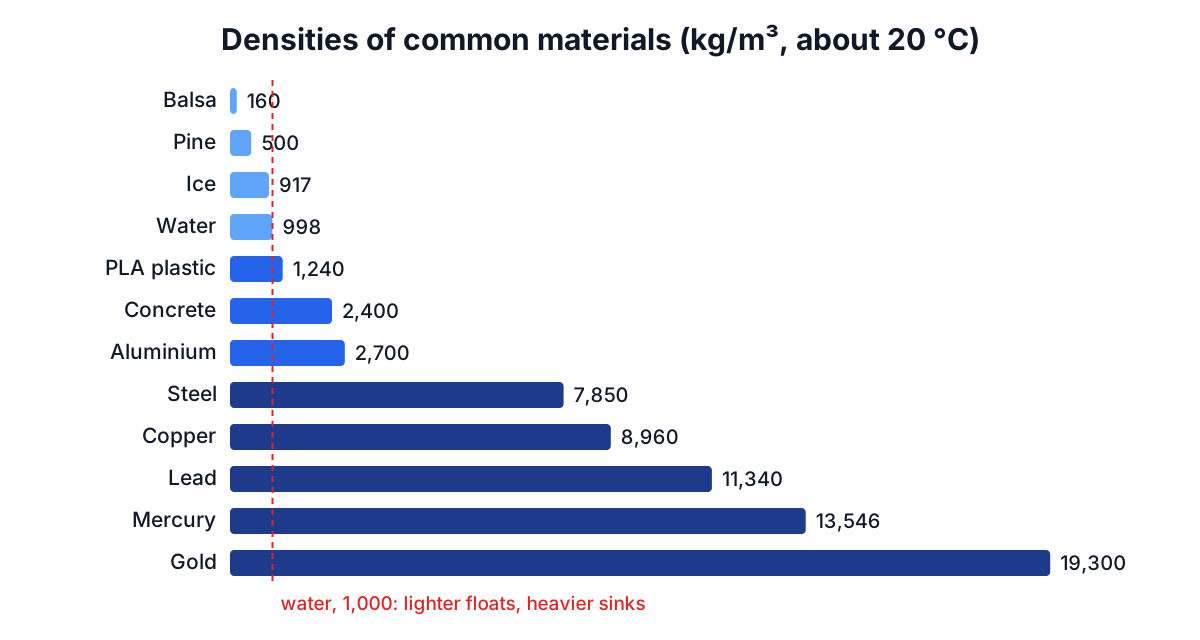
Densities of common materials
| Material | kg/m³ | g/cm³ |
|---|---|---|
| Air (20 °C, 1 atm) | 1.204 | 0.0012 |
| Balsa wood (typical) | 160 | 0.16 |
| Pine, dry (typical) | 500 | 0.50 |
| Petrol (typical) | 745 | 0.745 |
| Ethanol | 789 | 0.789 |
| Ice (0 °C) | 917 | 0.917 |
| Water (20 °C) | 998 | 0.998 |
| Seawater (typical) | 1,025 | 1.025 |
| Concrete (typical) | 2,400 | 2.4 |
| Aluminium | 2,700 | 2.70 |
| Titanium | 4,506 | 4.51 |
| Carbon steel (typical) | 7,850 | 7.85 |
| Copper | 8,960 | 8.96 |
| Silver | 10,490 | 10.49 |
| Lead | 11,340 | 11.34 |
| Mercury (20 °C) | 13,546 | 13.55 |
| Gold | 19,300 | 19.30 |
| Platinum | 21,450 | 21.45 |
Pure elements and liquids follow the CRC Handbook of Chemistry and Physics. Alloys, woods, plastics, fuels and concrete vary with composition and are typical values; wood in particular can vary by 50% within one species depending on moisture and growth.
Measuring volume: the hard part
Mass is easy to measure to 0.1% with a kitchen scale. Volume is harder. For regular shapes you can measure dimensions, but a 1% error in each of three dimensions becomes a 3% error in volume. For liquids, a measuring cylinder or a volumetric flask works. For irregular solids there are two classic methods.
Displacement. Lower the object into a measuring cylinder of water and read the rise in level. Simple, but a 100 mL cylinder can usually only be read to about 1 mL, which is a 20% error on a 5 cm³ ring.
Hydrostatic weighing. Weigh the object in air, then weigh it again hanging from a thread, fully under water and not touching the container. Archimedes' principle says the water pushes up with a force equal to the weight of water displaced, so the scale reads less. The loss in mass equals the mass of displaced water:
V = (m air − m water) ÷ ρ water, and ρ = m air ÷ V
Since a balance can be read to 0.01 g, this is far more precise than reading a cylinder.
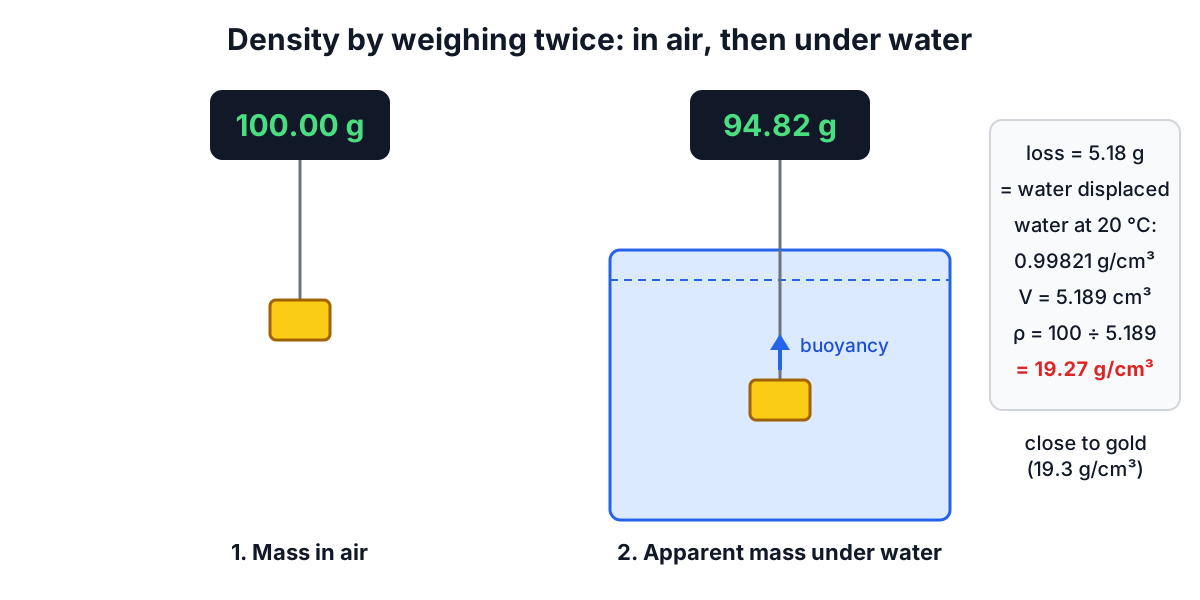
Worked example: testing a gold bar
A bar reads 100.00 g in air and 94.82 g hanging under water at 20 °C. The loss is 5.18 g, so the volume is 5.18 ÷ 0.99821 = 5.189 cm³, and the density is 100 ÷ 5.189 = 19.27 g/cm³. Pure gold is 19.30 g/cm³, so the bar is consistent with gold. A bar with a lead core would come out near 11 to 15 g/cm³, and one made of 14-carat gold (58.5% gold) would be around 13 to 14.6 g/cm³ depending on the other metals.
There is a well-known limit: tungsten (19.25 g/cm³) has almost the same density as gold, so a gold-plated tungsten bar passes this test. Bullion dealers therefore add ultrasonic thickness testing or X-ray fluorescence. The story behind the method, Archimedes and King Hiero's crown, comes from the Roman architect Vitruvius; historians doubt Archimedes used water displacement as the story describes, because the measurement would have been too coarse, and a balance-based method like this one would have worked far better.
Tips for accurate hydrostatic weighing
- Use thin thread or fishing line, and subtract the thread's own submerged reading.
- Knock off air bubbles stuck to the object; each bubble makes it read lighter under water and inflates the volume.
- Use water at a known temperature, ideally between 15 and 25 °C, and correct its density.
- Make sure the object is fully submerged and not touching the sides or bottom.
Density of gases
Gas density depends strongly on pressure and temperature. For an ideal gas, ρ = P M ÷ (R T), where M is the molar mass. Dry air at 15 °C and 101.325 kPa is 1.225 kg/m³, the sea-level value of the standard atmosphere; at 20 °C it is 1.204 kg/m³. Helium (M = 4.0 g/mol) is about seven times lighter than air, which is why it lifts balloons, while carbon dioxide (44 g/mol) is about 1.5 times heavier and collects in cellars. For gas calculations, the Ideal Gas Law Calculator gives the density directly.
Common mistakes
- Mixing g/cm³ and kg/m³. They differ by a factor of 1,000.
- Using bulk volume for porous materials. A bag of sand has a bulk density of about 1,600 kg/m³ even though quartz grains are 2,650 kg/m³, because about 40% of the volume is air.
- Ignoring temperature for liquids. Petrol expands by about 0.1% for every degree, so a litre bought cold contains more fuel than a litre bought warm.
- Assuming "1 litre = 1 kg" for every liquid. True only for water. A litre of olive oil is about 0.915 kg and a litre of honey about 1.42 kg.
Try it
The Density Calculator solves for density, mass or volume in eight density units, fills in the density from a table of about 35 materials, names the closest material to a measured density, and has a hydrostatic weighing tab that corrects for water temperature. For the mass of steel sections specifically, see the Steel Weight Calculator, and for concentrations in solution, the Molarity Calculator.
Sources
- M. Tanaka, G. Girard, R. Davis, A. Peuto and N. Bignell, "Recommended table for the density of water between 0 °C and 40 °C based on recent experimental reports", Metrologia 38 (2001) 301 to 309.
- CRC Handbook of Chemistry and Physics, density of the elements and of common liquids.
- NIST Special Publication 811: conversion factors for pound, foot, cubic foot and US gallon.
- ISO 2533:1975, Standard Atmosphere: sea-level air density.
- Vitruvius, De Architectura, Book IX, preface (the story of Archimedes and the crown).
Related searches
- density formula
- how to calculate density
- g/cm3 to kg/m3
- specific gravity
- water displacement method
- archimedes principle density
- density of metals table
- test gold with water