
Depreciation Methods Compared: Straight-Line, DDB, SYD and MACRS
How each depreciation method spreads an asset's cost, when declining balance switches to straight-line, how partial years work, and where MACRS differs from book depreciation.
· 7 min read
A bakery buys a 10,000 oven that should last five years and fetch 1,000 at the end. Under straight-line depreciation its book value after two years is 6,400. Under double-declining balance it is 3,600. Same oven, same bread, and the balance sheet differs by 2,800, with profit shifted between years to match. Neither figure is wrong. They come from different choices about how to spread a cost over time.
This guide explains how each common method works, worked through on the same 10,000 asset, then covers partial first years, the switch from declining balance to straight-line, and how US tax depreciation (MACRS) differs from the depreciation in your own books. Every schedule here can be reproduced in the Depreciation Calculator. It explains the mechanics, not which policy is right for your business or tax return.
What depreciation is for
When a business buys something that will be used for several years, charging the whole price as an expense in the year of purchase would make that year look terrible and the following years look better than they were. Depreciation matches the cost to the years that benefit from the asset. Three inputs drive every method:
- Cost: the purchase price plus what it took to get the asset working, such as delivery and installation.
- Salvage value: what you expect to get for it at the end. Cost minus salvage is the depreciable base, the amount to spread.
- Useful life: how long you expect to use it, in years or in units of output.
Depreciation is an accounting allocation, not a valuation. Book value after three years is cost minus accumulated depreciation; it is not what the asset would sell for. Land is never depreciated, because it does not wear out.
Straight-line: the default
Straight-line charges the same amount every year:
annual depreciation = (cost - salvage) / useful life
                    = (10,000 - 1,000) / 5 = 1,800
Book value falls 10,000, 8,200, 6,400, 4,600, 2,800, 1,000. It is the most common method in financial statements because it is simple, easy to audit and fits assets that give roughly equal service each year, such as furniture, buildings and many machines.
Accelerated methods: declining balance and sum-of-years
Some assets lose most of their usefulness early. Computers, vehicles and technology equipment are worth much less after a year or two, and repairs rise as they age. Accelerated methods charge more at the start and less later.
Declining balance
Declining balance applies a fixed rate to the opening book value each year. The rate is a factor divided by the life. Double-declining balance (DDB) uses a factor of 2, so a 5-year asset is depreciated at 40% a year. A 150% declining balance on a 10-year asset is 15% a year.
Year 1: 10,000 x 40% = 4,000   book value 6,000
Year 2:  6,000 x 40% = 2,400   book value 3,600
Year 3:  3,600 x 40% = 1,440   book value 2,160
Year 4:  2,160 x 40% =   864   book value 1,296
Year 5: brought down to salvage   296   book value 1,000
Two details trip people up. First, salvage is not subtracted before applying the rate; you multiply the full book value. Second, book value must never fall below salvage, so the charge is capped in whichever year would cross it. With a 3,000 salvage value on the same asset, year three is only 600 and years four and five are zero.
The switch to straight-line
A pure declining balance never quite reaches zero, because it always takes a percentage of what is left. The usual fix is to switch to straight-line in the first year when straight-line over the remaining life would give a larger charge. For a 1,000 asset with no salvage on a 5-year DDB, the charges are 400, 240 and 144; in year four, the 216 left over two remaining years gives 108 a year, more than 40% of 216 (86.40), so the schedule switches and charges 108 twice. The calculator marks the switch year in the table.
Sum-of-the-years' digits
Sum-of-the-years' digits (SYD) is accelerated but gentler than DDB. Add up the year numbers of the life: for 5 years, 1 + 2 + 3 + 4 + 5 = 15, which is n(n + 1) / 2. Year one takes 5/15 of the depreciable base, year two 4/15, down to 1/15:
9,000 x 5/15 = 3,000
9,000 x 4/15 = 2,400
9,000 x 3/15 = 1,800
9,000 x 2/15 = 1,200
9,000 x 1/15 =   600
The charge falls by the same 600 every year, and unlike declining balance it lands exactly on salvage without any plug.
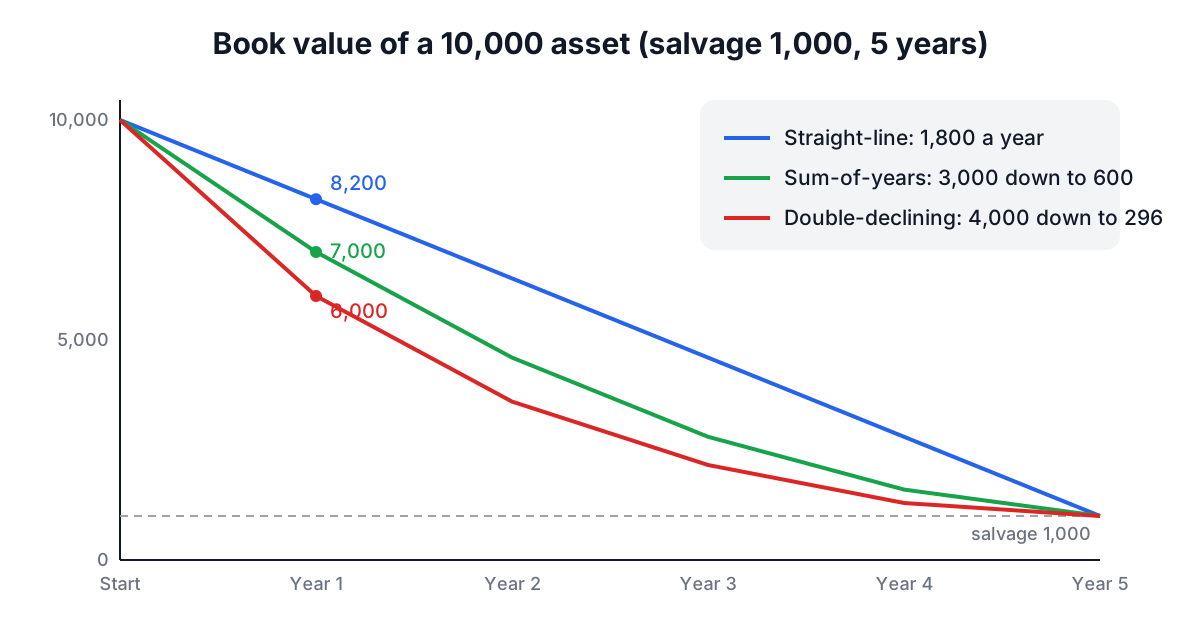
All three methods charge the same 9,000 in total. They differ only in timing, and timing is what moves reported profit and taxable income between years.
Units of production: depreciation by use
When wear follows output rather than time, such as a delivery van's miles or a press's impressions, units of production is the closest match. Divide the depreciable base by the total units the asset should produce, then charge each year by the units actually used. A 50,000 machine with 5,000 salvage and a 100,000-unit life depreciates 0.45 per unit; a year of 30,000 units costs 13,500 and an idle year costs nothing. The schedule stops at salvage even if the asset keeps running past its estimate.
Partial first years
Assets rarely arrive on the first day of the financial year. If a 5-year asset goes into use with four months of the year left, straight-line charges 4/12 of 1,800, which is 600, in year one. The rest of that first asset-year slides into the following fiscal year, and so on, so the schedule runs into a sixth fiscal year with the remaining 1,200. For sum-of-years the calculator blends adjacent asset-years: each fiscal year takes part of one asset-year's charge and the rest of the next. For declining balance the first year is simply the rate times the months fraction.
MACRS is tax depreciation, not book depreciation
In the United States, most business property placed in service after 1986 is depreciated for tax under the Modified Accelerated Cost Recovery System. It looks familiar but follows different rules:
- Salvage is ignored. The whole basis is recovered.
- Lives are fixed classes, not your estimate: computers and cars are 5-year property, office furniture is 7-year property, and so on.
- Conventions set the first year. Under the half-year convention every asset is treated as placed in service mid-year, so a 5-year asset is deducted over six tax years. If more than 40% of the year's purchases arrive in the last quarter, the mid-quarter convention applies instead.
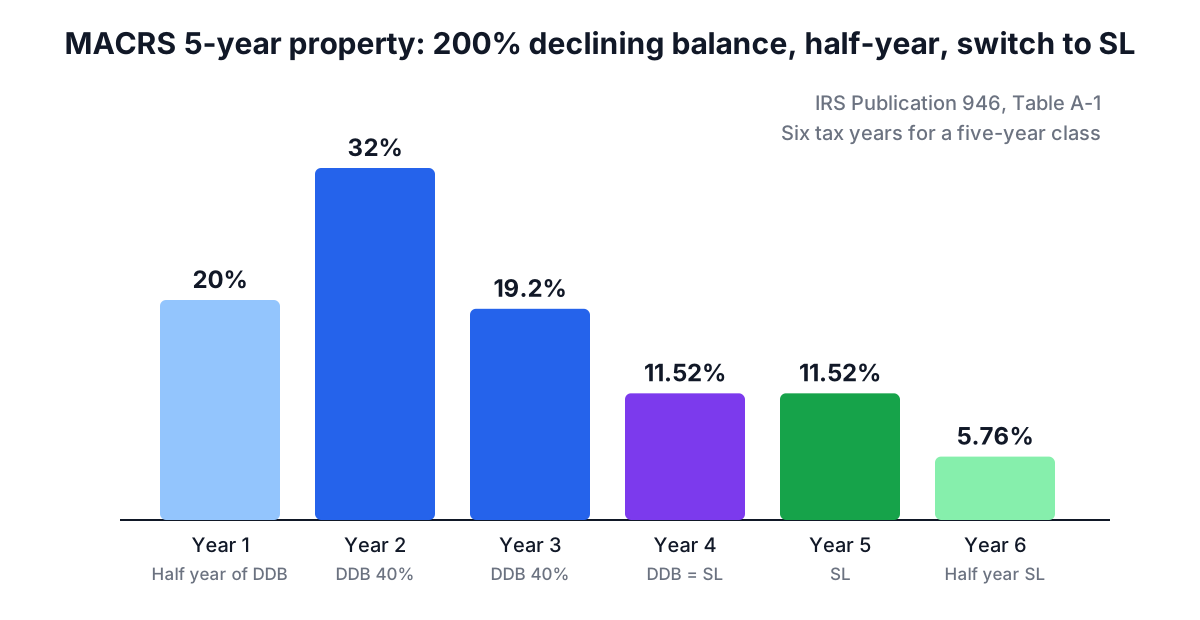
The 3, 5, 7 and 10-year classes use 200% declining balance with a switch to straight-line; the 15 and 20-year classes use 150%. If you run double-declining with the switch and a 6-month first year in the calculator, you get 20, 32, 19.2, 11.52, 11.52 and 5.76 for a 5-year asset, which are the percentages in IRS Publication 946, Table A-1. The MACRS option in the calculator uses those published percentages directly. For 10,000 of 7-year property it returns 1,429, 2,449, 1,749, 1,249, 893, 892, 893 and 446, matching the worked example in the publication.
The tool does not cover Section 179 expensing, bonus depreciation, the mid-quarter or mid-month conventions, real property or listed-property limits. Those can change a first-year deduction dramatically, so treat its MACRS output as a check and confirm a return with a tax professional.
Choosing a method
For your own financial statements, pick the method that best matches how the asset gives up its usefulness, and apply it consistently. Straight-line is the safe default. Declining balance or SYD suit assets that are most productive early or lose value quickly. Units of production suits assets whose wear follows measurable use. Tax rules may require a different method, which is why many businesses keep separate book and tax schedules and record the timing difference as deferred tax.
When you compare an equipment purchase against leasing or against other projects, depreciation itself is not a cash flow; only its tax effect is. Use the NPV and IRR Calculator for the cash comparison, and the Break-Even Calculator to see how a new machine's yearly depreciation adds to the fixed costs your sales have to cover. Then build the schedule in the Depreciation Calculator and keep it with the asset register.