
Fuel Costs, MPG and Tire Sizes: The Driving Maths Explained
Why US and UK MPG disagree, why L/100 km is the fairer unit, what a trip really costs in gas or electricity, and how a tire size code turns into diameter and speedometer error.
· 9 min read
Two numbers decide a lot about what a car costs to run and how it behaves on the road: its fuel economy and the size of its tires. Both look simple, and both hide traps. A 30 MPG car is 36 MPG in Britain. A tire that looks only slightly bigger can make the speedometer read 4 mph low. This guide works through the arithmetic behind the Fuel Cost Calculator and the Tire Size Calculator so you can check any figure by hand and know which judgment calls matter.
Trip fuel cost in two lines
Every fuel cost calculation is the same two steps once the units agree:
- Fuel needed = distance / fuel economy (or distance x consumption)
- Cost = fuel needed x price per unit of fuel
A 250 mile trip in a car that does 30 miles per US gallon needs 250 / 30 = 8.33 gallons. At $3.40 a gallon that is $28.33, or about 11 cents a mile. Make it a round trip and both numbers double. Share it between three people and each pays a third.
In countries that measure consumption in litres per 100 km the multiplication runs the other way. A 420 km drive in a car using 6.8 L/100 km needs 420 x 6.8 / 100 = 28.56 litres each way. At 1.75 per litre, a return journey costs 99.96.
The part that goes wrong is almost never the multiplication. It is mixing units: a UK MPG figure with a US gallon price, or a per-litre price with a per-gallon economy. The calculator converts everything to litres and kilometres internally using exact definitions, then converts back for display.
US gallons, UK gallons and L/100 km
There are two gallons in common use. The US gallon is defined as 231 cubic inches, exactly 3.785411784 litres. The imperial gallon used in the UK is 4.54609 litres, about 20% larger. Since a bigger gallon takes the car further, the same car has a bigger MPG number in Britain:
- MPG (UK) = MPG (US) x 1.20095
- 30 MPG (US) = 36.0 MPG (UK) = 7.84 L/100 km
L/100 km is a different kind of number. MPG is distance per fuel; L/100 km is fuel per distance. They are reciprocals, linked by two constants:
- L/100 km = 235.215 / MPG (US)
- L/100 km = 282.481 / MPG (UK)
That reciprocal relationship matters when you compare cars. Suppose you drive 10,000 miles a year. Swapping a 15 MPG truck for a 20 MPG one saves 667 - 500 = 167 gallons. Swapping a 40 MPG car for a 50 MPG one saves only 250 - 200 = 50 gallons, even though the MPG gain is bigger. In L/100 km the first change is 15.7 to 11.8 and the second is 5.9 to 4.7, which shows the real saving at a glance. This is sometimes called the MPG illusion, and it is a good reason to judge fuel savings in fuel per distance rather than distance per fuel.
Finding your real fuel economy
Official ratings are lab figures. The US EPA and the European WLTP cycle are carefully controlled, and real driving often comes in 10 to 20% worse, especially at sustained motorway speeds where aerodynamic drag, which rises with the square of speed, dominates.
The way to know your own number is the fill-to-fill method:
- Fill the tank until the pump clicks off and reset the trip meter.
- Drive as you normally do.
- Fill again the same way and note how much fuel went in.
- Divide the trip distance by the fuel added.
350 miles on 11.2 US gallons is 31.25 MPG, or 7.53 L/100 km. One tank is noisy, because pumps click off at slightly different levels, so average three or four. The fill-up mode in the Fuel Cost Calculator does the division and gives all four units at once.
Electric cars: kWh, losses and MPGe
For an electric car, the equivalent of MPG is energy per distance, quoted as kWh per 100 km, kWh per 100 miles or its inverse, miles per kWh. A car doing 3.5 miles per kWh uses 0.286 kWh a mile. A 250 mile trip therefore puts 71.4 kWh into the motor.
What you pay for is the energy drawn from the wall, which is higher because charging is not lossless. Home charging commonly loses around 10%, sometimes more in cold weather. With a 10% loss, the wall energy is 71.4 / 0.9 = 79.4 kWh. At $0.17 per kWh, the trip costs $13.49, about 5.4 cents a mile, against 11.3 cents a mile for the 30 MPG petrol car above.
The comparison changes with the electricity price. Public rapid chargers often charge $0.40 to $0.60 per kWh, which pushes the same trip to $32 to $48. That is why the calculator asks for your actual price rather than assuming a home tariff.
US window stickers rate EVs in MPGe, miles per gallon equivalent. The EPA treats 33.705 kWh as the energy in one gallon of gasoline, so MPGe = 33.705 / kWh per mile. At 3.5 mi/kWh battery-to-wheels that is 118 MPGe. It is a useful efficiency comparison, but it says nothing about cost, because a kWh and a gallon are priced very differently.
Reading a tire size code
A metric tire size such as 225/45R17 is a compact formula:
- 225 is the section width in millimetres.
- 45 is the aspect ratio: the sidewall height as a percentage of the width.
- R means radial construction (ZR adds a high-speed rating; older bias-ply tires use D or a dash).
- 17 is the wheel diameter in inches.
Anything after that, such as 91V, is the load index and speed rating, which do not affect dimensions. A P prefix marks a passenger tire and LT a light-truck tire with heavier construction.
From those numbers:
- Sidewall = 225 x 0.45 = 101.25 mm
- Overall diameter = 17 x 25.4 + 2 x 101.25 = 634.3 mm = 24.97 in
- Circumference = pi x 634.3 = 1,993 mm
- Revolutions per mile = 1,609,344 / 1,993 = 808
Off-road and truck tires often use flotation sizes, which give the outside dimensions directly. 33x12.50R15 is 33 inches tall, 12.5 inches wide, on a 15 inch wheel, so each sidewall is (33 - 15) / 2 = 9 inches.
These are design dimensions. A loaded tire squats slightly, so its rolling radius is a little smaller, and tread depth varies between models. Tire makers publish measured revs per mile that can differ from the calculated value by a percent or two.
Changing size: diameter, the 3% guideline and speedometer error
When you change tire size, the number that matters most is the change in overall diameter. The car's speedometer counts wheel revolutions and assumes each one covers the stock circumference. Fit a taller tire and each revolution covers more road, so the car travels faster than the dial says:
- True speed = indicated speed x new diameter / old diameter
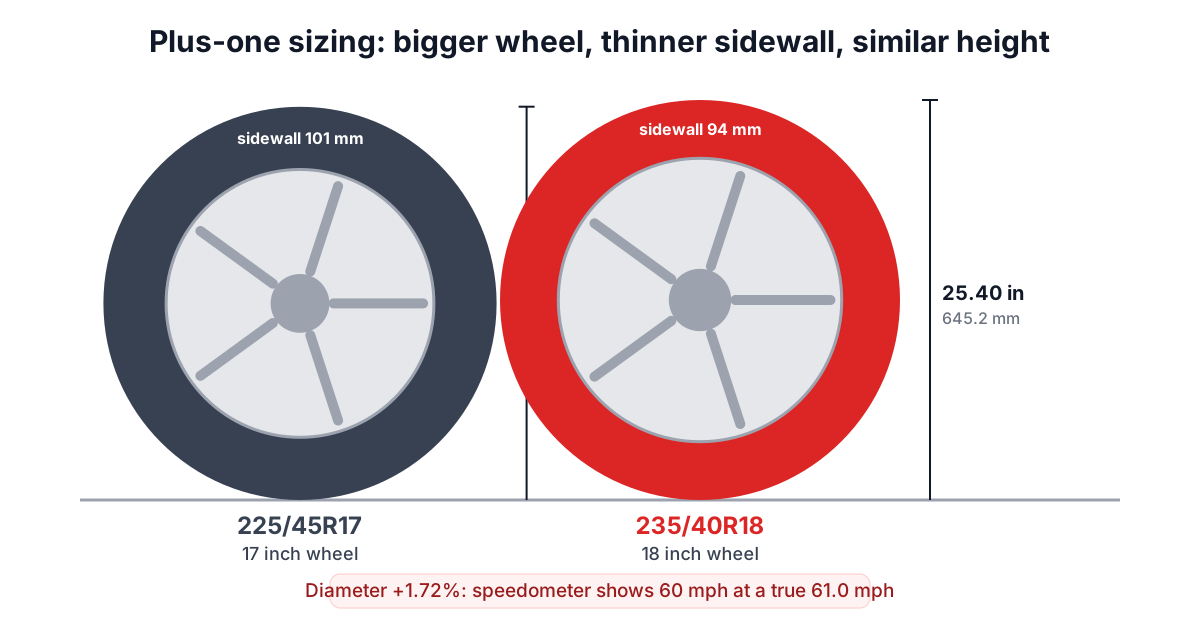
Moving from 225/45R17 to 235/40R18 raises the diameter from 634.3 to 645.2 mm, +1.72%. At an indicated 60 mph you are doing 61.0 mph. The odometer under-records by the same 1.72%.
A widely used rule of thumb in the tire trade is to keep a replacement within about 3% of the original diameter. Inside that range, speedometer error, ABS and stability control calibration, gearing and clearance usually stay acceptable. It is a guideline, not a regulation, and it is not the only test. The load index and speed rating must be at least the original specification, the wheel width must be inside the tire maker's approved range, and the tire must clear suspension and bodywork at full steering lock and compression.
The classic plus-one change keeps diameter almost constant by trading sidewall for wheel: 205/55R16 to 225/45R17 is only +0.38%. Lifted trucks are the opposite case. Going from 265/70R17 to 285/75R17 adds 7.04% to the diameter and 28 mm of clearance under the axle, but at an indicated 65 mph the truck is doing 69.6 mph. That is well outside the guideline, and a speedometer recalibration is the usual fix.
Putting it together
Fuel cost and tire size meet in one place: a taller tire makes the odometer under-count distance, so fill-to-fill fuel economy comes out low by the same percentage. If you have fitted taller tires and your MPG seems to have dropped, multiply the recorded distance by the new-to-old diameter ratio before you blame the engine. Smaller tires do the reverse and flatter the figure.
For the everyday questions, the calculators do the work: the Fuel Cost Calculator for trip budgets, real MPG and EV charging costs, and the Tire Size Calculator for decoding sizes and checking a swap. For journey times rather than costs, the Speed, Distance and Time Calculator handles the other half of trip planning, and the Electricity Cost Calculator prices home charging alongside your other appliances.