
Exchange Rates Explained: Reference Rates, Cross Rates and Markups
Where ECB reference rates come from, how a cross rate is built, why your bank's rate differs, and how to work out what a conversion really costs.
· 7 min read
Look up "100 dollars in euros" on three websites and you may get three slightly different answers, and none of them will match what your card statement shows a week later. That is not because anyone has the maths wrong. It is because there are several different exchange rates for the same pair at the same moment, published for different purposes. This guide explains the reference rates the Currency Converter uses, how a rate between two non-euro currencies is built, and how to work out what a conversion is really costing you.
Where the ECB reference rates come from
The European Central Bank publishes the euro foreign exchange reference rates once every working day. According to the ECB, they come from a daily concertation procedure between central banks across Europe that normally takes place around 14:10 CET, and they are usually published at about 16:00 CET. They are not published on TARGET closing days, such as weekends, Christmas Day and 1 May.
The list covers roughly 30 currencies: the major ones (US dollar, pound sterling, yen, Swiss franc) and many others, including the Indian rupee, Chinese renminbi, Brazilian real, South African rand and the currencies of the EU members outside the euro. Some currencies are absent, and the ECB suspended its rouble rate in 2022.
The ECB is explicit that the rates are published for information purposes only and that using them for transactions is strongly discouraged. That tells you what they are good for: a neutral, dated, citable rate for budgeting, invoicing, accounting and checking quotes. They are not a price anyone has promised to trade at.
The converter fetches these rates through the open-source Frankfurter API, which republishes the ECB table and can rebase it to any currency in the list. Your browser asks for the table for your "from" currency; the request contains only currency codes, and the multiplication by your amount happens on your device. If the service cannot be reached, the converter says so instead of showing old numbers.
How a cross rate is built
Every ECB rate is quoted against the euro. There is no separate "USD to INR" rate in the table; it has to be built from the two euro rates.
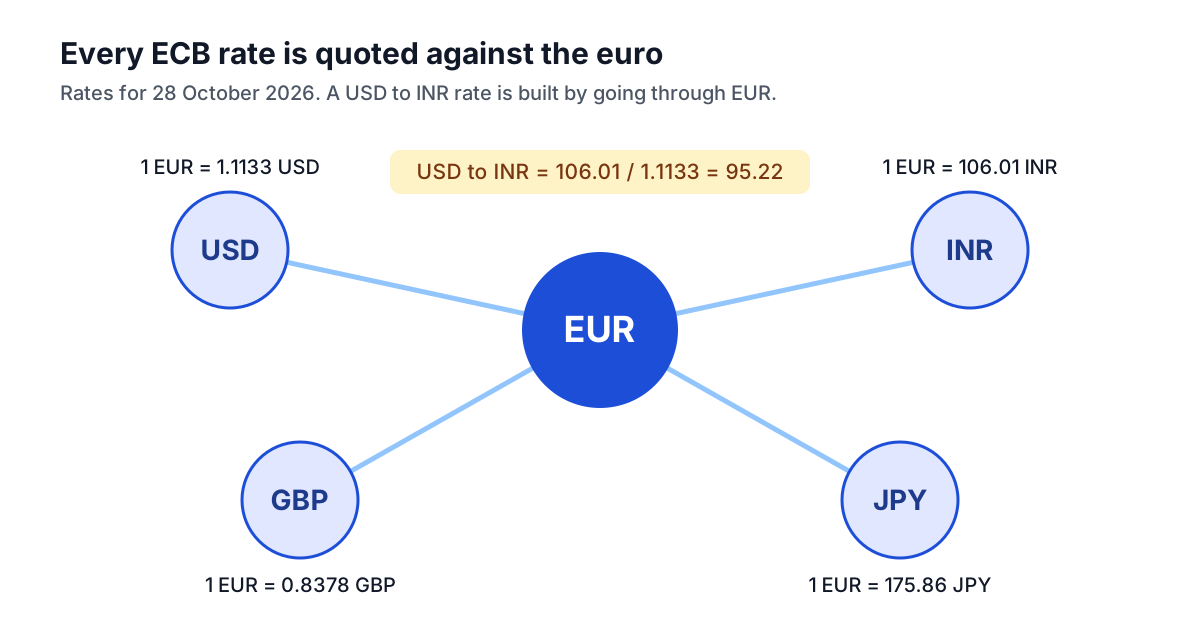
With the rates for 28 October 2026, 1 EUR = 1.1133 USD and 1 EUR = 106.01 INR. To go from dollars to rupees you go from dollars to euros (divide by 1.1133) and then from euros to rupees (multiply by 106.01):
rate(USD → INR) = (EUR → INR) / (EUR → USD)
                = 106.01 / 1.1133
                = 95.22
So 100 USD is ₹9,522.00. The same logic gives 100 USD = €89.82, £75.26, ¥15,796 and CA$140.47 on that day. Two details are worth knowing. The inverse of a rate is simply 1 divided by it: if 1 USD = 0.8982 EUR then 1 EUR = 1.1133 USD. And rounding matters: each euro rate is published to a fixed number of decimal places (175.86 for the yen, 106.0095 for the rupee on that day), so a cross rate built from rounded quotes can differ from another site's in the last digit.
Why your bank's rate is different
A reference rate, or a "mid-market" rate quoted on financial sites, sits in the middle between the price at which dealers will buy a currency and the price at which they will sell it. Anyone who actually exchanges money for you earns their living from the gap, in one of three ways:
- A spread on the rate. Your bank converts at, say, 0.8712 EUR per dollar instead of 0.8982. There is no visible fee, but you receive fewer euros.
- An explicit fee. A foreign transaction fee on a card, or a fixed charge on a transfer.
- Both. Common at airport bureaus and in some transfer apps.
To compare offers, convert both ways at the reference rate and work out the markup as a percentage:
markup = (reference rate − rate you are offered) / reference rate
       = (0.8982 − 0.8712) / 0.8982
       = 3.0%
On $1,000 that is about €27 you did not receive. Add any flat fee and divide by the amount to get the total cost as a percentage. The figure tells you more than any advertised "zero commission".
Dynamic currency conversion
When you pay by card abroad, a terminal or ATM may offer to charge you in your home currency. That is dynamic currency conversion: the merchant's provider sets the rate, usually with a larger margin than your card network would apply. Choosing to pay in the local currency lets your card issuer do the conversion instead, which in most cases is cheaper. The converter helps here: if a terminal offers to charge you $112.40 for a €100 bill, compare that with €100 at the reference rate ($111.33 on the date above) and the extra is the cost of saying yes.
When the rate date matters
Because reference rates are fixed once per working day, the date shown beside them is as important as the number. A rate looked up on a Sunday morning is Friday's. A rate looked up at 10:00 CET on a Tuesday is Monday's, because Tuesday's has not been published yet. For most planning that lag is irrelevant, but on a day when a currency moves sharply, a live market rate can be well away from the last fixing.
For anything contractual, write the rate source and date into the document, for example "converted at the ECB reference rate of 28 October 2026". That makes an invoice or expense claim checkable by anyone later, which is the main reason businesses use reference rates at all. The VAT Calculator and Sales Tax Calculator are useful next steps when the converted amount feeds into a tax figure.
The trend line is context, not a forecast
The converter's 30-day sparkline shows the daily fixings for the first target currency, with the period's high, low and change. It answers "is today's rate unusual compared with last month?", which is handy when deciding whether to convert a large sum now or in parts. It does not predict tomorrow's rate. Exchange rates respond to interest-rate decisions, trade data and sentiment, and professional forecasts are wrong often enough that spreading a large conversion over several dates is a more reliable way to avoid a bad day than trying to pick the best one.
A short checklist
- Note the rate date and source before relying on a number.
- Build cross rates through the euro, and expect tiny last-digit differences between sites.
- Measure every offer as a percentage markup over the reference rate, plus fees.
- Decline dynamic currency conversion unless you have checked its rate.
- For crypto amounts, the Cryptocurrency Unit Converter handles units such as satoshi and gwei, which the ECB does not publish.