
Exponent Rules: Negative, Zero and Fractional Powers Explained
Why b⁰ = 1 and b⁻ⁿ = 1/bⁿ, how fractional exponents become roots, the negative-base trap in software, 0⁰, and how to count the digits of enormous powers.
· 9 min read
Exponents start as shorthand: 2⁵ is 2 × 2 × 2 × 2 × 2 = 32. Then the exponent becomes zero, negative, a fraction, a decimal, or a number so large the answer has millions of digits, and the shorthand stops being obvious. The good news is that every one of those cases follows from a single pattern, and once you see it the rules stop being things to memorise. This article builds the rules from that pattern, covers the cases where calculators and programming languages disagree, and shows how to handle powers too big to write down. You can check every example with the Exponent Calculator.
One pattern behind all the rules
For a whole-number exponent, bⁿ means n copies of b multiplied together. Multiplying two powers of the same base just counts the copies:
b³ × b² = (b × b × b) × (b × b) = b⁵ so bᵐ × bⁿ = bᵐ⁺ⁿ
Every other rule is what you get by insisting that this one keeps working.
| Rule | Example | Why it must be true |
|---|---|---|
| bᵐ × bⁿ = bᵐ⁺ⁿ | 2³ × 2² = 2⁵ = 32 | Counting factors |
| bᵐ / bⁿ = bᵐ⁻ⁿ | 2⁵ / 2² = 2³ = 8 | Cancelling factors |
| (bᵐ)ⁿ = bᵐⁿ | (2³)² = 2⁶ = 64 | n groups of m factors |
| (ab)ⁿ = aⁿbⁿ | (2 × 5)³ = 8 × 125 = 1000 | Rearranging factors |
| b⁰ = 1 | 7⁰ = 1 | b³ / b³ = b⁰ must equal 1 |
| b⁻ⁿ = 1 / bⁿ | 2⁻³ = 1/8 | b³ × b⁻³ = b⁰ = 1 |
| b^(1/n) = ⁿ√b | 9^(1/2) = 3 | (b^(1/n))ⁿ = b¹ = b |
| b^(m/n) = (ⁿ√b)ᵐ | 8^(2/3) = 4 | Combine the last two rules |
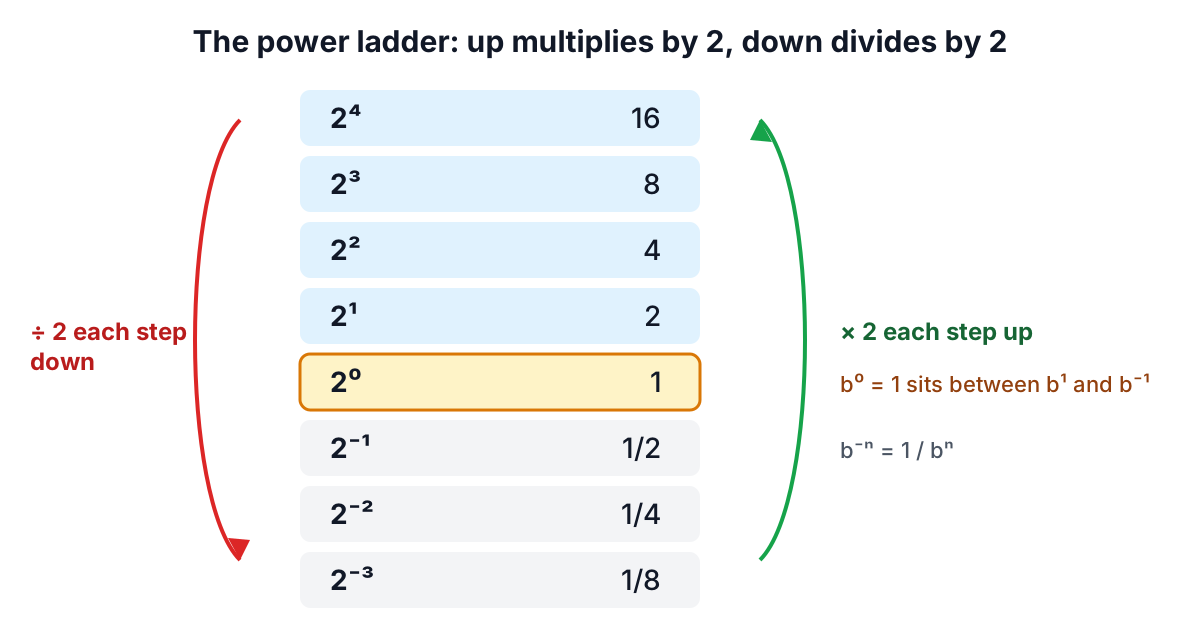
The ladder picture is the quickest way to remember the zero and negative cases. Going up one rung multiplies by the base; going down one rung divides by it. From 2¹ = 2, one step down gives 2⁰ = 1, and further steps give 1/2, 1/4, 1/8. Nothing special happens at zero, so b⁰ = 1 is not a definition plucked from the air but the only value that keeps the ladder regular.
Negative exponents
A negative exponent is a reciprocal, not a negative number:
2⁻³ = 1 / 2³ = 1/8 = 0.125
10⁻⁶ = 1 / 1,000,000 = 0.000001
(2/3)⁻² = (3/2)² = 9/4
The sign of the exponent decides whether you multiply or divide; it does not change the sign of the answer. That is why scientific notation can write 0.000047 as 4.7 × 10⁻⁵ and why SI prefixes such as micro (10⁻⁶) and nano (10⁻⁹) are negative powers of ten. A fraction to a negative power flips over, which is often the simplest way to compute it.
Fractional exponents are roots
If b^(1/2) squared must give b, then b^(1/2) is the square root of b. In general the denominator of the exponent is a root and the numerator is a power:
b^(m/n) = (ⁿ√b)ᵐ = ⁿ√(bᵐ)
8^(2/3)  = (∛8)²  = 2²  = 4
16^(3/4) = (⁴√16)³ = 2³ = 8
27^(−2/3) = 1 / (∛27)² = 1/9
Taking the root first keeps the numbers small, which is why it is the usual hand method. When the root is not exact the answer is irrational, and the clean way to write it is a simplified radical: 2^(3/2) = √(2³) = √8 = 2√2 ≈ 2.828427. The Root Calculator explains how those simplifications work.
Type the fraction, not the decimal
0.667 is not 2/3. It is 667/1000, so 8^0.667 asks for the 1000th root of 8⁶⁶⁷, which is about 4.0028, not 4. Rounding an exponent changes the question. Enter repeating exponents as fractions; the calculator reduces them to lowest terms and finds the exact root when there is one.
Negative bases: where software disagrees
A negative base with a whole-number exponent is simple: an even power is positive and an odd power is negative. (−2)⁴ = 16 and (−2)³ = −8. With fractional exponents it gets interesting.
- (−8)^(1/3) is the real cube root of −8, which is −2, because (−2)³ = −8.
- (−8)^(1/2) is the square root of −8, which is not a real number. Its principal complex value is 2√2 i.
- (−8)^(2/3) is (∛−8)² = (−2)² = 4.
The rule is to write the exponent in lowest terms: if the denominator is odd, the real root exists; if it is even, there is no real answer. Many calculators and programming languages ignore this. They compute bⁿ as exp(n × ln b), and since the natural log of a negative number is not real, they return an error or NaN for (−8)^(1/3). In JavaScript, Math.pow(−8, 1/3) is NaN, partly because 1/3 cannot even be stored exactly in binary, so the language cannot know the denominator is 3. The Exponent Calculator keeps exponents as exact fractions so it can apply the odd-denominator rule.
−2² is not (−2)²
Order of operations applies exponents before the leading minus sign, so −2² means −(2²) = −4. Spreadsheets are an exception that catches people: in Excel, =-2^2 returns 4 because Excel applies the unary minus first. If a formula depends on this, add brackets.
Zero to the power zero
0⁰ is the one case without a single answer from the pattern, because two rules collide: x⁰ = 1 for every non-zero x, but 0ⁿ = 0 for every positive n. The convention used in algebra, combinatorics and computing is 0⁰ = 1. It keeps the binomial theorem and polynomial notation working (the constant term of a polynomial is a₀x⁰, which must equal a₀ at x = 0), and the IEEE 754 floating-point standard defines pow(x, 0) = 1 for every x, including zero. In calculus, though, an expression that approaches the form 0⁰ is indeterminate: its limit depends on how the base and exponent approach zero. The calculator returns 1 with a note to that effect.
0 to a negative power is different and has no defensible value: 0⁻¹ = 1/0, a division by zero. The calculator reports it as undefined.
Growth: why exponents run away
Repeated multiplication grows faster than intuition expects, which is why exponents appear wherever something grows by a fixed percentage. Money at 5% a year for 30 years grows by a factor of 1.05³⁰:
1.05^30 = 4.321942375150662009157288198886473341473378241062164306640625
That is exact, because 1.05 = 21/20 and any whole power of a fraction with a power-of-ten denominator ends after a fixed number of decimal places, here 60. A quick check is the rule of 72: money doubles in roughly 72 / rate years, so at 5% it doubles about every 14.4 years, and 30 years is just over two doublings, a factor of a little more than 4. The Compound Interest Calculator builds the same factor into a full schedule.
Counting the digits of enormous powers
Some powers are too big to print. Writing 2^136279841 in full would take 41 million digits, and one less than it, M136279841, is the largest known prime, found by the Great Internet Mersenne Prime Search in October 2024. You can still say a great deal about such a number.
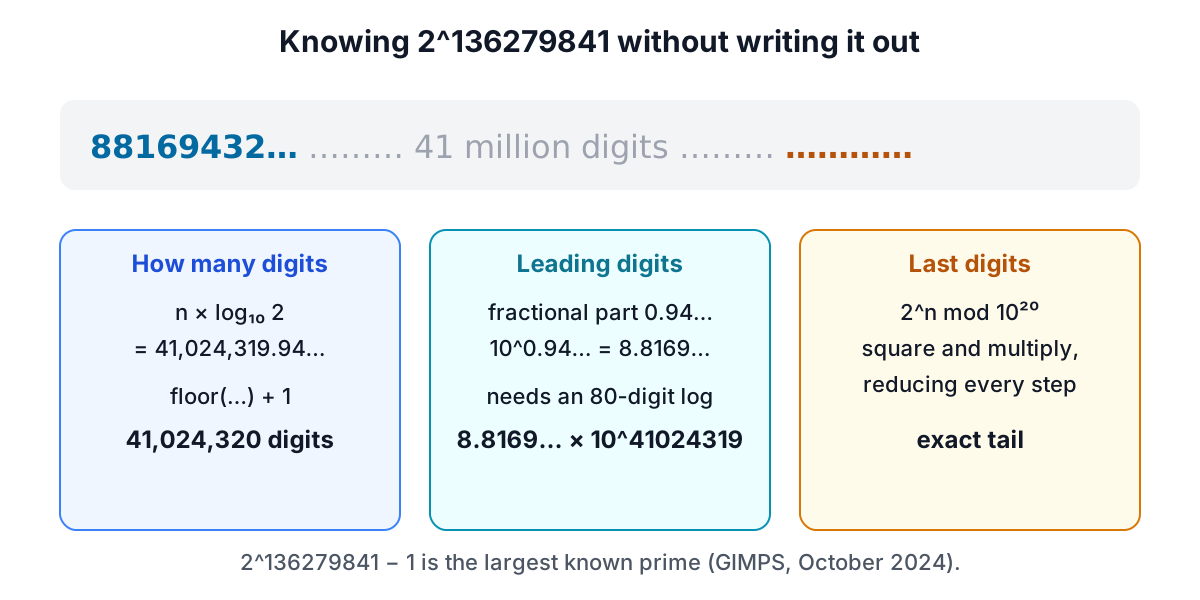
Number of digits. A positive integer N has floor(log₁₀ N) + 1 digits. For bⁿ, log₁₀ bⁿ = n × log₁₀ b, so 2^1000 has floor(1000 × 0.30103) + 1 = 302 digits, and 2^136279841 has floor(41,024,319.6…) + 1 = 41,024,320 digits.
Leading digits. The fractional part of n × log₁₀ b gives the leading digits: 10 raised to that fraction. This needs many digits of log₁₀ 2, because the integer part of the product uses up some of the precision. With an 80-digit logarithm the calculator still has about 70 digits to spare for an exponent in the hundreds of millions.
Last digits. Modular arithmetic finds the tail without the rest: compute bⁿ mod 10²⁰ by repeated squaring, reducing after every step, and the numbers never grow beyond 40 digits. This is the same square-and-multiply method that RSA encryption uses for modular powers.
Smaller giants are printed in full. 2^1000 = 10715086071862673209…205668069376, and every digit is available to copy.
A quick reference
- b⁰ = 1 for any b ≠ 0; 0⁰ = 1 by convention.
- A negative exponent means a reciprocal: b⁻ⁿ = 1/bⁿ.
- A fractional exponent means a root: b^(m/n) = (ⁿ√b)ᵐ.
- A negative base with a fractional exponent is real only when the reduced denominator is odd.
- Exponents do not distribute over addition: (a + b)² = a² + 2ab + b², not a² + b².
- Digits of bⁿ = floor(n log₁₀ b) + 1.
The Exponent Calculator applies these rules, shows which one it used, and keeps the answer exact whenever it can. For the reverse question, what exponent gives a certain number, use the Logarithm Calculator.
Sources
- IEEE 754-2019, Standard for Floating-Point Arithmetic, recommended pow operation special cases, including pow(x, ±0) = 1.
- Great Internet Mersenne Prime Search (GIMPS), announcement of M136279841, 41,024,320 digits, October 2024.
- ECMAScript Language Specification, Math.pow (returns NaN for a negative base with a non-integer exponent).
- Microsoft Support, Excel calculation operators and precedence (negation before exponentiation).
Related searches
- exponent rules
- negative exponents explained
- fractional exponents
- why is anything to the power of zero 1
- negative base fractional exponent
- how many digits in a large power
- zero to the power of zero
- compound growth exponent