
Exposure Value Explained: Stops, Sunny 16 and Equivalent Exposures
How aperture, shutter speed and ISO trade against each other in stops, what an EV number means, the scene brightness table behind sunny 16, and how to find an equivalent exposure quickly.
· 10 min read

Every exposure is a deal between three settings. The aperture decides how wide the lens opens, the shutter speed decides how long the sensor collects light, and ISO decides how much the signal is amplified. Photographers count all three in the same currency, the stop, and the exposure value (EV) is the bookkeeping system that ties them together. Once you can think in stops you can swap one setting for another in your head, read a light meter, and know why "sunny 16" works. The Exposure Calculator does the arithmetic for you, but the ideas behind it are short.
One stop is a factor of two
A stop is a doubling or halving of light. Each control has its own scale:
- Shutter speed. 1/250 s to 1/125 s is one stop more light, because the shutter stays open twice as long.
- Aperture. The f-number N is the focal length divided by the diameter of the opening. The area of the opening, and so the light, goes with 1/N². Doubling the light therefore multiplies the diameter by √2 and divides N by √2 (about 1.41). That is why the full-stop series is 1, 1.4, 2, 2.8, 4, 5.6, 8, 11, 16, 22: each number is the previous one times √2, rounded.
- ISO. ISO 200 needs half the light of ISO 100 for the same brightness in the picture, so it is one stop more sensitive.
Cameras also step in thirds of a stop: 1/125, 1/160, 1/200, 1/250 for shutter speeds, f/5.6, f/6.3, f/7.1, f/8 for apertures and 100, 125, 160, 200 for ISO. The marked numbers are rounded, so two settings that look a third of a stop apart might be 0.3 or 0.35 stops apart in reality.
The exposure value formula
The exposure value of an aperture and shutter speed is
EV = log₂(N² ÷ t)
where t is in seconds. EV 0 is f/1 for 1 second. Each step of +1 EV halves the light the settings let in, so a higher EV suits a brighter scene. Some examples:
| Settings | EV |
|---|---|
| f/1.0, 1 s | 0 |
| f/2.8, 1/30 s | 7.9 |
| f/8, 1/125 s | 12.97 |
| f/16, 1/125 s | 14.97 |
| f/16, 1/1000 s | 17.97 |
Any combination with the same EV lets in the same light. f/8 at 1/125 s, f/5.6 at 1/250 s and f/11 at 1/60 s are all about EV 13. These are equivalent exposures; they differ only in depth of field and motion blur.
Bringing ISO in: EV100
The formula above says nothing about ISO, so a second number is used to describe the scene: the EV at ISO 100, often called EV100 or light value. If you shoot at a different ISO, the camera setting EV and the scene EV100 differ by the ISO change in stops:
EV100 = log₂(N² ÷ t) − log₂(ISO ÷ 100)
At ISO 400, f/8 and 1/125 s (setting EV 12.97) correctly expose a scene of EV100 10.97. The scene is two stops darker than at ISO 100, and the higher ISO makes up the difference. The calculator shows both numbers: the setting EV and the EV100 of the scene those settings suit.
Finding an equivalent exposure
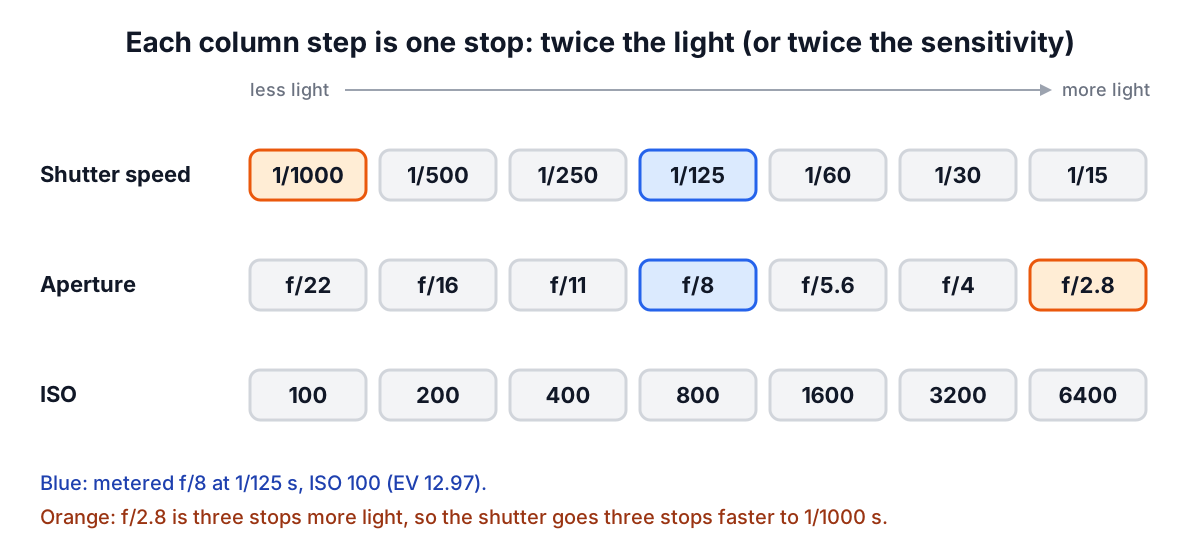
Say your meter reads f/8 at 1/125 s, ISO 100, and you want f/2.8 to blur the background. The scene is EV100 12.97. Keep it constant and solve for the new shutter time:
t = N² ÷ 2^(EV100 + log₂(ISO ÷ 100)) = 2.8² ÷ 2^12.97 = 0.00098 s
That is 1/1020 s; the nearest camera setting is 1/1000 s, 0.03 stop away. You can reach the same answer by counting stops: f/8 to f/2.8 is three stops (8, 5.6, 4, 2.8), so the shutter must be three stops faster: 1/250, 1/500, 1/1000.
The same base exposure can be solved for the other settings:
- Aperture for 1/500 s at ISO 100: f/4 exactly (two stops faster shutter, two stops wider aperture).
- ISO for f/8 at 1/1000 s: ISO 800 (three stops faster shutter, three stops more gain).
When a solved value falls between marked settings, the calculator reports the nearest one and the gap in stops. For apertures the gap is counted in stops of light, so f/5.4 is about 0.1 stop from the marked f/5.6, not 0.05.
Scene brightness and the sunny 16 rule
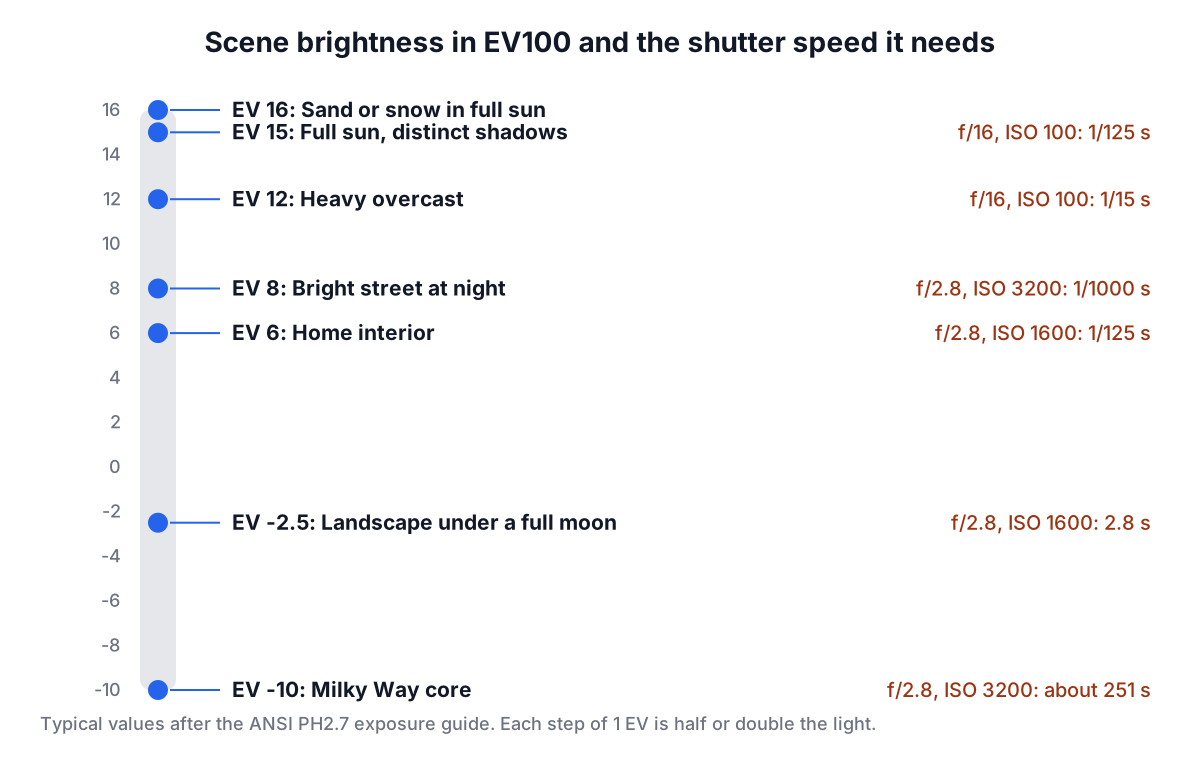
Light meters measure brightness and suggest an EV. Before meters were in every camera, published tables gave typical EV100 values for common scenes. The figures below are those collected in the Wikipedia "Exposure value" article, which follow the American national standard exposure guide (ANSI PH2.7):
| Scene | EV100 |
|---|---|
| Sand or snow in full sun | 16 |
| Full or slightly hazy sun, distinct shadows | 15 |
| Hazy sun, soft shadows | 14 |
| Bright cloud cover, no shadows | 13 |
| Heavy overcast, or open shade in clear sun | 12 |
| Bright street scenes at night | 8 |
| Offices and work areas | 7 to 8 |
| Home interiors | 5 to 7 |
| Floodlit buildings and monuments | 3 to 5 |
| The full moon itself, through a long lens | 15 |
| Landscape lit by a full moon | −3 to −2 |
| Milky Way core | −11 to −9 |
The sunny 16 rule falls out of the second row. On a clear day, set f/16 and a shutter speed of 1/ISO: at ISO 100, f/16 and 1/100 s is EV100 14.6, close to 15. With third-stop cameras, 1/125 s at f/16 lands almost exactly on EV 15. For snow, close down a stop (f/22); for open shade, open up three stops (f/8).
The moon rows show a subtlety. The moon's surface is in full sunlight, so photographed through a long lens it needs daylight settings. A landscape lit by that moon is about 17 stops darker.
The tables assume a subject of average reflectance. Snow, a black dog or a backlit subject all fool both meters and tables, so use exposure compensation and check the histogram.
Worked examples from the scene table
Here the calculator's "Settings from the scene" mode is used with typical choices:
- Bright sun, ISO 100, f/16 (EV 15). Exact shutter 1/130 s; nearest setting 1/125 s.
- Heavy overcast, ISO 100, f/16 (EV 12). 1/16 s, too slow to hand-hold. Opening to f/5.6 (three stops) gives 1/125 s.
- Bright street at night, ISO 3200, f/2.8 (EV 8). 1/1040 s exact, so 1/1000 s. Plenty of speed for people walking.
- Home interior, ISO 1600, f/2.8 (EV 6). 1/130 s exact, nearest 1/125 s.
- Moonlit landscape, ISO 1600, f/2.8 (EV −2.5). 2.8 s, which needs a tripod.
- Milky Way core, ISO 3200, f/2.8 (EV −10). About 251 s. That is far longer than stars allow before they trail on a fixed tripod, which is why night-sky images are often shot at higher ISO, wider apertures, stacked, or tracked. The Star Trail Calculator gives the longest shutter time for your lens.
Exposure value versus brightness in the picture
EV describes how much light reaches the sensor, not how bright the photo looks. Raising ISO from 100 to 1600 does not let in more light; it amplifies a four-stops-smaller signal, and noise grows relative to the image. That is why photographers prefer to gain stops from the aperture or the shutter first and use ISO when neither can move. The modern rule of thumb is to collect as much light as depth of field and motion allow, then set ISO to bring the image to the right brightness.
When you need a shutter speed far longer than the light allows, for example 30 seconds in daylight to smooth water, you remove light with a neutral density filter instead. The ND Filter Calculator converts a filter's strength into the new shutter time.
Common mistakes
- Counting aperture stops linearly. f/4 to f/8 is two stops, not one, because N is squared.
- Mixing the setting EV and EV100. A meter reading at ISO 400 and a scene table in EV100 differ by two.
- Trusting nominal markings for precise work. 1/60 s is really 1/64 s in a strict doubling series; f/11 is really f/11.3. The differences are small but add up in long chains.
- Forgetting reciprocity on film. Very long film exposures need more time than the arithmetic says. Digital sensors do not have this problem.
Sources
- Wikipedia, "Exposure value" (definition, EV100, and the table of scene values after the ANSI PH2.7 photographic exposure guide).
- ISO 2720:1974, General purpose photographic exposure meters (photoelectric type): guide to product specification (the calibration equation linking meter readings, ISO and the aperture and shutter settings).
- Ray, Sidney F., Applied Photographic Optics, Focal Press (f-number and the √2 series).
Try your own meter readings and equivalent settings in the Exposure Calculator.
Related searches
- exposure value formula
- what is ev in photography
- equivalent exposure calculator
- sunny 16 rule explained
- ev100 meaning
- one stop of light
- third stop shutter speeds
- exposure value table for scenes
- iso and ev relationship