
Field of View and Crop Factor: What a Lens Really Sees
Angle of view from focal length and sensor size, horizontal versus diagonal figures, equivalent focal lengths on APS-C and Micro Four Thirds, and how wide a scene a lens covers at a distance.
· 10 min read

A focal length on its own does not tell you what a lens will show. A 50 mm lens frames a scene one way on a full-frame camera, noticeably tighter on APS-C and tighter again on Micro Four Thirds. What you actually want to know is the angle the lens takes in, and how wide a slice of the world that angle covers at the distance you will stand. Both come from one line of trigonometry, and the Field of View Calculator does it for any lens and sensor. This article explains the geometry, the crop factor that sits on top of it, and the places where the simple model stops being exact.
The geometry: a triangle from the sensor to the lens
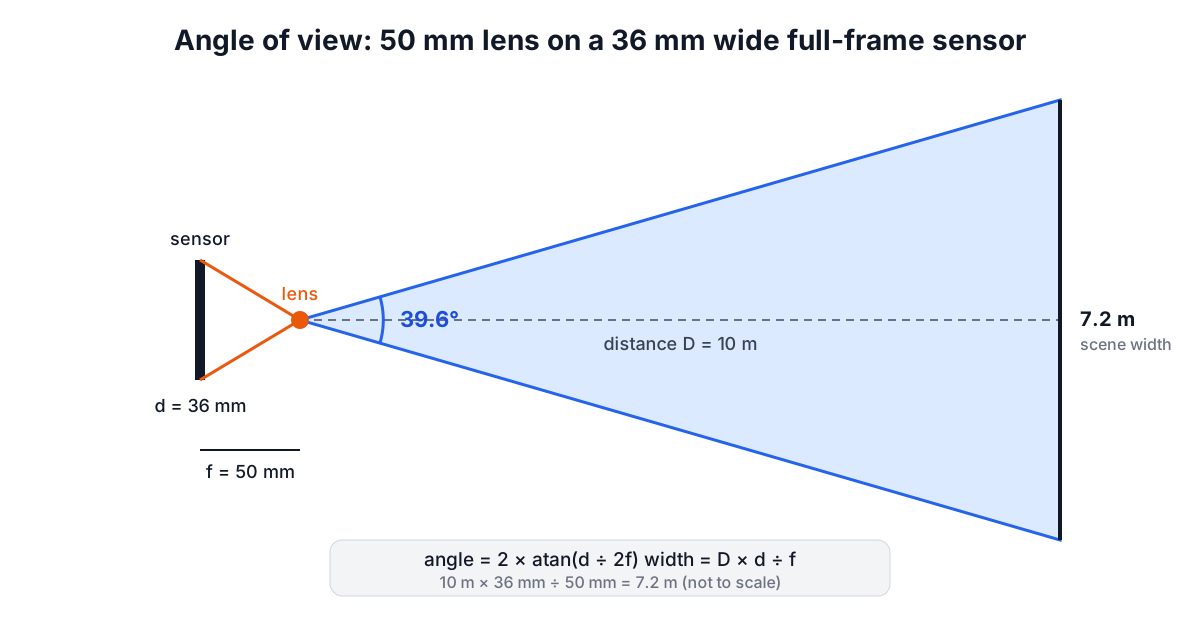
Picture the lens as a single point a distance f in front of the sensor when it is focused at infinity. Light from the edges of the scene passes through that point and lands on the edges of the sensor. The sensor dimension d and the focal length f form a triangle, and half the angle of view is the angle whose tangent is (d ÷ 2) ÷ f. So:
angle of view = 2 × atan(d ÷ 2f)
Use the sensor width for the horizontal angle, the height for the vertical angle and the diagonal for the diagonal angle. On a 36 × 24 mm sensor (diagonal 43.27 mm) a 50 mm lens gives:
- horizontal: 2 × atan(36 ÷ 100) = 39.6°
- vertical: 2 × atan(24 ÷ 100) = 27.0°
- diagonal: 2 × atan(43.27 ÷ 100) = 46.8°
The same triangle, extended out into the scene, gives the coverage at a distance D. Similar triangles mean the scene width is simply D × d ÷ f. A 50 mm lens on full frame at 10 m covers 10 × 36 ÷ 50 = 7.2 m across and 4.8 m top to bottom. Double the distance and the coverage doubles; double the focal length and it halves.
Horizontal, vertical or diagonal: which number is quoted
Lens makers almost always publish the diagonal angle, because it is the largest of the three and because it does not depend on the aspect ratio of the camera. That is why a 24 mm lens is sold as an "84° lens" even though it covers 73.7° across the long side of a full-frame image and 53.1° top to bottom. Action cameras and webcams muddy this further: some quote diagonal, some horizontal, and a few quote a figure for a cropped video mode.
When you compare two lenses or cameras, make sure both numbers are the same kind. The calculator always shows all three. Here is the full-frame set for common focal lengths, with the width covered at 10 m:
| Focal length | Horizontal | Vertical | Diagonal | Width at 10 m |
|---|---|---|---|---|
| 14 mm | 104.3° | 81.2° | 114.2° | 25.71 m |
| 24 mm | 73.7° | 53.1° | 84.1° | 15.00 m |
| 35 mm | 54.4° | 37.8° | 63.4° | 10.29 m |
| 50 mm | 39.6° | 27.0° | 46.8° | 7.20 m |
| 85 mm | 23.9° | 16.1° | 28.6° | 4.24 m |
| 135 mm | 15.2° | 10.2° | 18.2° | 2.67 m |
| 200 mm | 10.3° | 6.9° | 12.3° | 1.80 m |
Notice that the angle does not halve exactly when the focal length doubles, because the tangent is not linear at wide angles. The scene width at a fixed distance does follow the focal length exactly, which is why the width column is often the more useful one.
Crop factor and equivalent focal length
Crop factor is the ratio of the full-frame diagonal (43.27 mm) to another sensor's diagonal. It answers one question: what focal length on full frame would give the same angle of view? Multiply the real focal length by the crop factor and you get the equivalent.
| Sensor | Size (mm) | Crop factor | 50 mm lens: horizontal | 50 mm lens: width at 10 m |
|---|---|---|---|---|
| Medium format 645 digital | 53.4 × 40 | 0.65 | 56.2° | 10.68 m |
| Medium format 44 × 33 | 43.8 × 32.9 | 0.79 | 47.3° | 8.76 m |
| Full frame | 36 × 24 | 1.00 | 39.6° | 7.20 m |
| APS-C Nikon, Sony, Fujifilm | 23.5 × 15.6 | 1.53 | 26.4° | 4.70 m |
| APS-C Canon | 22.3 × 14.9 | 1.61 | 25.1° | 4.46 m |
| Micro Four Thirds | 17.3 × 13 | 2.00 | 19.6° | 3.46 m |
| 1-inch type | 13.2 × 8.8 | 2.73 | 15.0° | 2.64 m |
| 1/2.3-inch type | 6.17 × 4.55 | 5.64 | 7.1° | 1.23 m |
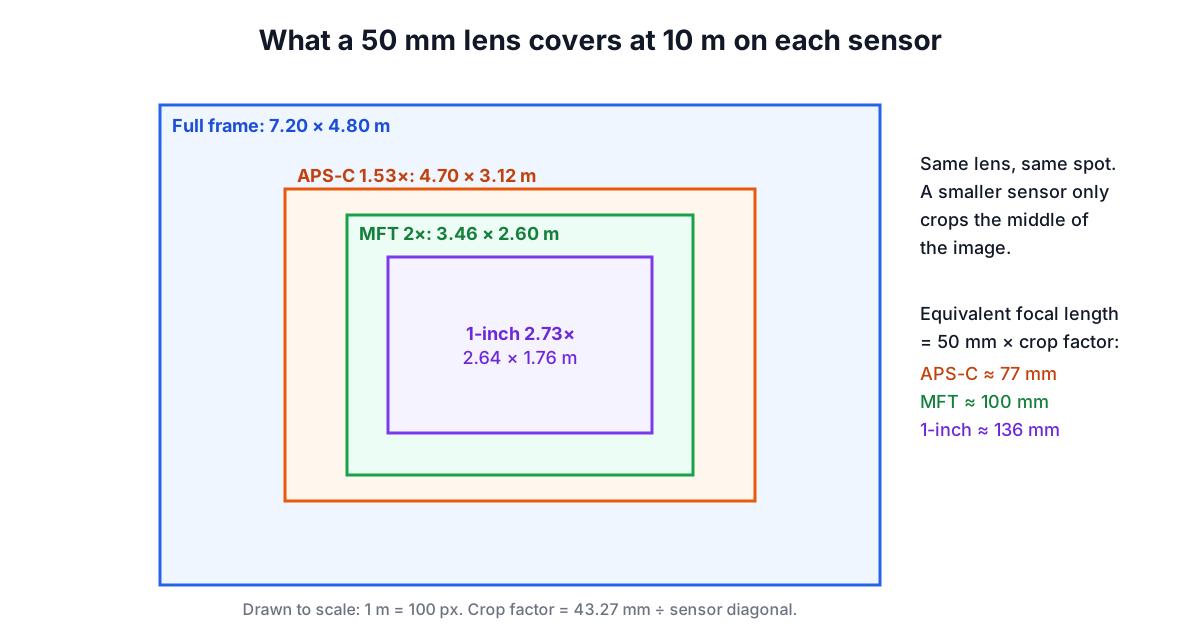
So a 35 mm lens on a 23.5 × 15.6 mm APS-C sensor frames like a 53.7 mm lens on full frame, and a 25 mm lens on Micro Four Thirds frames like a 50 mm (its diagonal angle is 46.8°, the same as 50 mm on full frame). Phone makers use this language too: a phone's "24 mm" main camera is a 24 mm equivalent, not a 24 mm lens. To compare a phone with a camera, put the equivalent focal length into the full-frame preset.
Equivalence describes framing and nothing else. The 35 mm lens on APS-C is still a 35 mm lens. From the same position it gives the same perspective as any other lens; it simply crops the middle out of the image a 35 mm lens would project onto full frame. Its f-number, and therefore the exposure, does not change either. Depth of field at the same framing does change, which the depth of field guide works through.
One caution on aspect ratio: crop factor is defined by the diagonal. Micro Four Thirds is 4:3 rather than 3:2, so its horizontal angle with a 25 mm lens is 38.2°, a little narrower than 50 mm on full frame (39.6°), while its vertical angle is wider (29.1° against 27.0°). If you care about one dimension, compare that dimension rather than the equivalent focal length.
Working backwards: which lens frames this scene?
Rearrange the coverage formula and you get the focal length for a scene of known width W at distance D:
f = D × d ÷ W
Say you need to fill the frame with a 12 m wide stage from the back of a hall 30 m away, on full frame: f = 30 × 36 ÷ 12 = 90 mm. An 85 mm lens leaves a small margin, and a 70-200 mm zoom covers it with room to tighten on a single performer. On APS-C the same shot needs 30 × 23.5 ÷ 12 = 58.8 mm, so a standard zoom at its long end will do.
The calculator has this reverse mode built in: enter the distance and the width you want to fill and it suggests the focal length for your sensor, plus the full-frame equivalent. The same sum works for security and machine-vision cameras, where you know the mounting distance and the width of the gate or conveyor belt.
Where the simple formula is not exact
The 2 × atan(d ÷ 2f) formula assumes three things, and each can be off in practice.
Focus at infinity. When a lens focuses closer, it moves away from the sensor, and the image distance becomes about f × (1 + m), where m is the magnification. The angle of view narrows slightly. For a 50 mm lens focused at 0.45 m, m is about 0.125 and the horizontal angle drops from 39.6° to about 35.5°. Beyond a few metres the effect is negligible. Many modern zooms and internal-focus primes also change their real focal length as they focus (focus breathing), which video shooters notice as the frame shifting during a focus pull.
A rectilinear lens. The formula describes lenses that keep straight lines straight. Fisheye lenses use a different projection (often equidistant or equisolid), so a 15 mm full-frame fisheye covers about 180° diagonally rather than the 110.5° a rectilinear 15 mm would. Distortion correction applied in camera or in software can also crop the edges a little.
The whole sensor. Many cameras record video from a cropped area of the sensor, and electronic stabilisation crops further. If your camera records 4K from a 1.5× crop, enter that area as a custom sensor to get the real angle. The same goes for shooting in a 16:9 or 1:1 aspect ratio: the stills sensor is cropped top and bottom or at the sides.
Practical uses
- Buying a lens. The difference between 16 mm and 24 mm on full frame is 96.7° against 73.7° horizontally, far more than the 8 mm suggests. Check angles rather than focal lengths.
- Architecture and interiors. Measure the room or facade, note how far back you can stand, and check that the vertical angle covers it before you go.
- Events and sport. From a fixed position, the width-at-distance column tells you which lens fills the frame with a single player or a whole team.
- Night sky. A wider field shows more sky but makes stars smaller; combine the angle of view with the shutter-speed limits in the Star Trail Calculator.
- Video crops. Enter the recorded sensor area for each mode to see how much a camera's 4K or 120 fps mode tightens the view.
Common mistakes
- Comparing a diagonal figure with a horizontal one. Action camera specs are the usual culprit.
- Multiplying the f-number by the crop factor for exposure. f/2.8 is f/2.8 for exposure on every sensor.
- Using the equivalent focal length in depth of field or star-trail formulas. Those formulas want the real focal length; sensor size enters separately.
- Thinking a longer lens changes perspective. Perspective comes from where the camera stands. A long lens only crops the view.
- Forgetting the video crop. A lens that frames a room nicely for stills may be too tight in a cropped video mode.
Sources
- Rudolf Kingslake, Optics in Photography (SPIE Press), chapters on angle of view and image size for the thin-lens relations used here.
- Sensor dimensions from manufacturer specifications for full frame (36 × 24 mm), APS-C (23.5 × 15.6 mm and 22.3 × 14.9 mm), Four Thirds (17.3 × 13 mm), 1-inch type (13.2 × 8.8 mm) and medium format.
- Wikipedia, "Angle of view" and "Crop factor", for the definitions of diagonal angle and diagonal-based crop factor.
The Field of View Calculator runs these numbers for any sensor and lens, including custom sizes and the reverse calculation. For how sensor size changes sharpness and background blur at the same framing, read Depth of Field and Hyperfocal Distance, Worked Out.
Related searches
- field of view calculator
- angle of view formula
- crop factor explained
- equivalent focal length aps-c
- how wide is 50mm field of view
- focal length for a given width
- diagonal vs horizontal angle of view
- micro four thirds equivalent focal length
- lens coverage at distance