
Force Field Analysis: Planning Change by Removing Resistance
Kurt Lewin's force field method explained with a scored example: rating driving and restraining forces, reading the net force, and why removing restraints works best.
· 6 min read
A finance director wants every expense claim in the company to go through a new expense app by 1 March. The case looks obvious: spreadsheets get lost, receipts go missing, and month-end takes two days longer than it should. Six weeks into the rollout, half the sales team is still emailing spreadsheets. Nobody openly objected. The resistance came from places the business case never listed: a clunky mobile receipt capture, managers who liked approving by email, and a commission process that still needed the old spreadsheet.
Force field analysis is a way to list those forces before the rollout instead of after it. You put the change in the middle, the forces pushing for it on one side and the forces holding it back on the other, and rate each one. This guide covers the idea behind it, how to score forces honestly, how to read the result, and how to run one in the Force Field Analysis tool.
Kurt Lewin's idea: change as a balance of forces
The method comes from Kurt Lewin, a German-American social psychologist who developed field theory in the 1940s. Lewin argued that any stable situation, such as how a team handles expenses today, is held in place by a balance of forces. Some push toward change (cost pressure, audit findings, a frustrated CFO). Others push back (habit, effort, tools that do not fit, people who lose something). As long as the two sides balance, nothing moves.
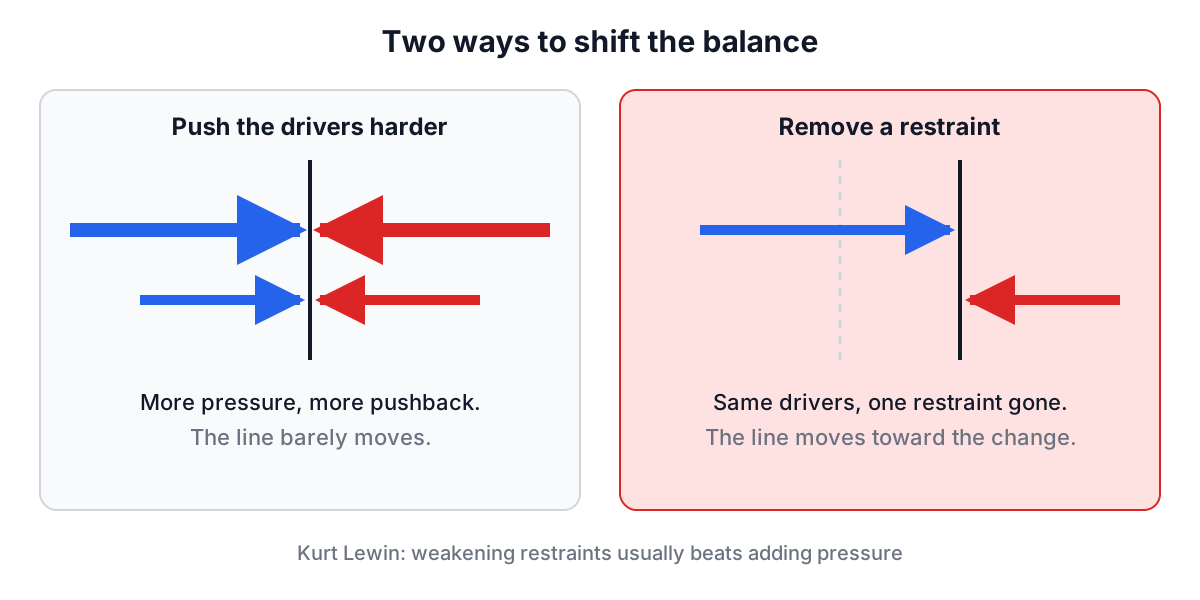
From that view, there are only two ways to create change: strengthen the driving forces or weaken the restraining ones. Lewin's practical observation, and the one most change plans ignore, is that the second usually works better. Push harder on the drivers (more emails from the CFO, a compliance deadline) and resistance tends to rise to meet it. Remove a restraint (fix the mobile receipt capture) and the balance shifts without that reaction.
Lewin's better-known three-stage model of change, unfreeze, change, refreeze, comes from the same work. Force field analysis is the unfreeze step made concrete: you cannot loosen a situation until you can see what holds it in place.
Scoring forces
Each force gets a strength from 1 to 5. The tool adds the strengths in each column and subtracts the restraining total from the driving total:
Net force = total driving strength - total restraining strength
A positive net is labelled Change Favored, a negative one Change Opposed, and zero Balanced.
The numbers are structured opinion, not measurement. A useful way to keep them honest is to define the scale in terms of effect on the decision:
| Strength | Meaning |
|---|---|
| 1 | Minor; would not change anyone's mind on its own |
| 2 | Noticeable; people mention it but work around it |
| 3 | Significant; affects how fast the change can happen |
| 4 | Major; could delay the change by months on its own |
| 5 | Decisive; the change will not happen (or will happen regardless) because of this |
Score forces by how much they would move the outcome, not by how often people complain about them. The loudest objection in the room is often a 2.
Worked example: the expense app rollout
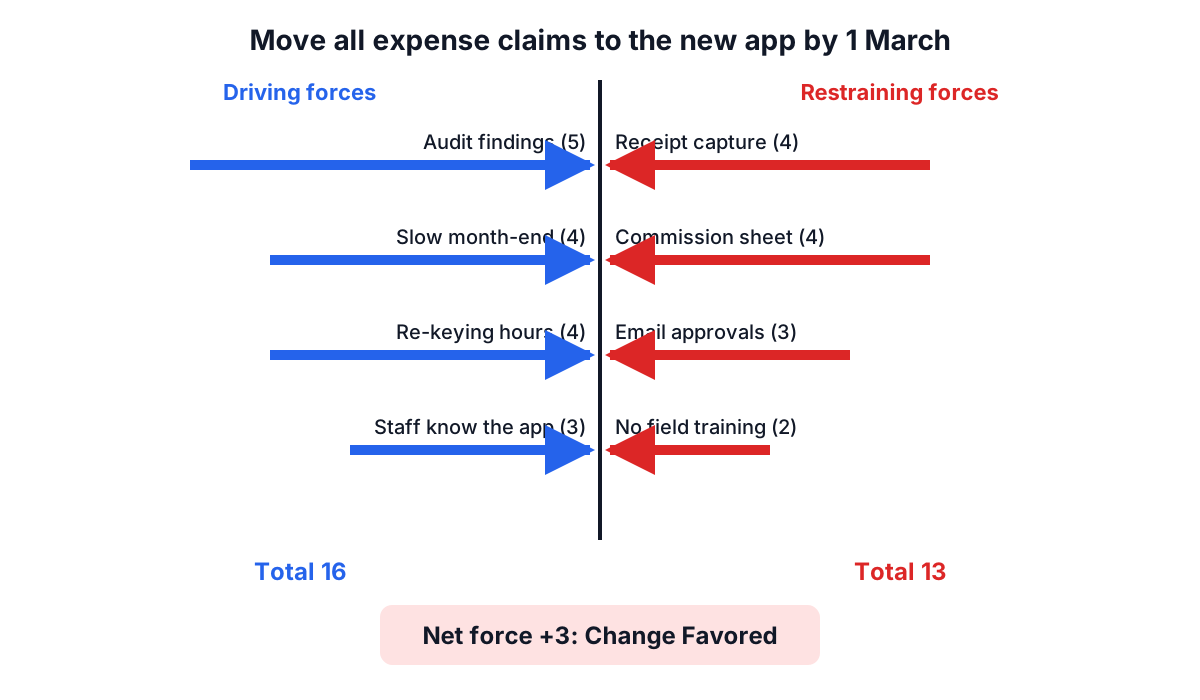
Here is the finance director's analysis as entered in the Force Field Analysis tool.
- Title: "Expense app rollout". Proposed Change: "All expense claims submitted through the new expense app from 1 March; spreadsheets no longer accepted."
- Under Driving Forces, each force typed in, the Strength slider set, then the plus button (or Enter):
| Driving force | Strength |
|---|---|
| Auditors flagged missing receipts two years running | 5 |
| Month-end close two days longer than target | 4 |
| Finance team spends about 30 hours a month re-keying claims | 4 |
| Most staff already use the app for travel bookings | 3 |
| Total | 16 |
- Under Restraining Forces, the same way:
| Restraining force | Strength |
|---|---|
| Mobile receipt capture fails on older phones | 4 |
| Sales commission process still needs the old spreadsheet | 4 |
| Managers prefer approving by email | 3 |
| No training scheduled for field staff | 2 |
| Total | 13 |
- The Force Analysis Summary shows Driving: 16, Restraining: 13, Net Force: +3 and Change Favored.
A +3 net looks like a green light. Read the columns instead. Two restraints are rated 4, and both are fixable: an app update or a supported-phone list for receipt capture, and a commission report built from app data instead of the spreadsheet. Removing just the commission restraint moves the net to +7. Removing both moves it to +11, without adding a single new driver or sending one more reminder email.
That is the output that matters: a short list of restraints to remove before the go-live date, each with an owner. The team clicked Download as Text to get a full report for the project file, Download as Image for a PNG of the summary card for the steering slide, and Export JSON to keep an editable version. The page does not autosave, so exporting before closing the tab is the habit to build.
Reading the result
| Net force | What it suggests | What to do |
|---|---|---|
| Clearly positive | The case for change outweighs resistance as scored | Still remove the strongest restraint; a positive net does not mean an easy rollout |
| Near zero | The situation is stuck | Pick one strong, cheap-to-remove restraint and plan around it |
| Negative | Resistance outweighs the case | Do not launch yet; either fix restraints or rethink the change |
Two cautions apply to every result. First, the net is not a probability of success. One force rated 5 can outweigh five forces rated 1, even though they total the same. Second, counts mislead: a column with eight forces is not stronger than a column with three. Look at the highest-rated forces on each side, not just the totals.
Common mistakes
- A vague change statement. "Modernise finance" produces vague forces. Name the decision and the date.
- Listing only the official objections. The real restraints are often unspoken: lost status, extra work for one team, a side process nobody documented. Ask the people who do the work.
- Rating by volume. The force mentioned most is not necessarily the strongest.
- Only adding drivers. Plans that respond to resistance with more communication and more pressure tend to get more resistance.
- Treating it as a one-off. Re-score after each phase of the rollout. Forces change as people see the new way working, or failing.
Where it fits
Force field analysis is a change-planning tool. It sits naturally after a gap analysis, which tells you where you need to get to, and before the implementation plan. The gap analysis guide covers that earlier step. When a restraint turns out to be a symptom of a deeper problem (why does the commission process still need a spreadsheet?), a 5 Whys analysis will find the cause. And for a broader view of internal strengths and external pressures before deciding on the change at all, start with a SWOT analysis.
Before your next rollout, spend twenty minutes listing forces with the people who will live with the change, rate them in the Force Field Analysis tool, and circle the two strongest restraints. Removing those is usually the cheapest progress you can buy.