
Free Fall With and Without Air Resistance: Fall Time and Terminal Velocity
The vacuum formulas, what drag does to them, how terminal velocity depends on mass, area and air density, and the exact tanh solution for a falling object, with worked numbers.
· 10 min read

Drop something and two questions follow: how long until it lands, and how fast is it going when it does? In a vacuum the answers depend only on the height and on gravity. In air, drag eventually balances the weight and the object stops speeding up, at its terminal velocity. This post covers both cases, from the textbook formulas to the exact solution with quadratic drag, with numbers you can reproduce in the Free Fall Calculator.
Free fall in a vacuum
With no air resistance the only force is gravity, which gives every object the same constant acceleration g, about 9.81 m/s² on Earth. Standard gravity, used as the default here, is defined as exactly 9.80665 m/s². Starting from rest:
- distance fallen: h = ½ g t²
- speed: v = g t
- speed after falling h: v = √(2 g h)
- time to fall h: t = √(2 h ÷ g)
If the object is thrown downward at v0, the distance becomes h = v0 t + ½ g t² and the speed v = v0 + g t, or √(v0² + 2 g h).
| Height | Fall time | Impact speed |
|---|---|---|
| 1 m | 0.452 s | 4.43 m/s (15.9 km/h) |
| 5 m | 1.010 s | 9.90 m/s (35.7 km/h) |
| 10 m | 1.428 s | 14.0 m/s (50.4 km/h) |
| 20 m | 2.020 s | 19.8 m/s (71.3 km/h) |
| 50 m | 3.193 s | 31.3 m/s (113 km/h) |
| 100 m | 4.516 s | 44.3 m/s (159 km/h) |
Notice the square root: four times the height only doubles the fall time and the impact speed. Mass does not appear anywhere. Galileo reasoned this out with balls rolling down inclines, and in 1971 Apollo 15 commander David Scott showed it on the airless Moon by dropping a geological hammer and a falcon feather, which landed together.
Worked example: the depth of a well
You drop a stone into a well and hear the splash after 2.5 s. Ignoring air and the travel time of sound, h = ½ × 9.80665 × 2.5² = 30.6 m. Sound takes about 30.6 ÷ 343 = 0.09 s to come back up, so the stone really fell for about 2.41 s, which gives 28.5 m. For a precise answer, guess the depth, subtract the sound time and recalculate once or twice; it converges quickly.
Why air changes everything
A moving object pushes air out of the way, and the air pushes back. At the speeds of everyday falling objects the drag force is close to:
F drag = ½ ρ Cd A v²
where ρ is the air density, A the frontal area facing the flow, v the speed and Cd the drag coefficient, a number that captures the shape. Drag grows with the square of speed, so at first it is negligible, but it keeps growing until it equals the weight. At that point the net force is zero, acceleration stops, and the object falls at a constant terminal velocity:
vt = √(2 m g ÷ (ρ Cd A))
This formula answers the old question of whether heavy things fall faster. In a vacuum they do not. In air, for objects of the same size and shape, the heavier one has the higher terminal velocity and so falls faster. A 40 mm steel ball (268 g) and a table tennis ball of the same diameter (2.7 g) feel the same drag at the same speed, but the steel ball weighs 100 times as much. Its terminal velocity is about 85 m/s, the table tennis ball's about 8.6 m/s. From 10 m the steel ball lands in 1.431 s at 13.9 m/s, almost exactly the vacuum figures (1.428 s, 14.0 m/s), while the table tennis ball takes 1.76 s and lands at 8.3 m/s.
Drag coefficients
Cd depends mainly on shape and changes slowly with the Reynolds number. Typical values for everyday sizes and speeds (Reynolds numbers of roughly 10⁴ to 10⁵) are:
| Shape | Cd |
|---|---|
| Sphere | 0.47 |
| Half sphere, round side forward | 0.42 |
| Cone, point forward | 0.50 |
| Cube, face forward | 1.05 |
| Cube, edge forward | 0.80 |
| Long cylinder, end forward | 0.82 |
| Short cylinder, end forward | 1.15 |
| Flat plate, face forward | 1.28 |
| Teardrop (aerofoil-like) body | 0.04 |
These are tabulated from wind-tunnel data in standard fluid mechanics references. A smooth sphere's Cd drops sharply, to around 0.1, above a Reynolds number of about 3 × 10⁵ (the "drag crisis"), which is why golf balls are dimpled: the dimples trigger that transition at lower speeds.
Air density
Sea-level air in the ICAO standard atmosphere (15 °C, 101.325 kPa) has a density of 1.225 kg/m³. Air is denser when cold and thinner at altitude: about 1.29 kg/m³ at 0 °C, 1.20 kg/m³ at 20 °C, and about 0.74 kg/m³ at 5,000 m. Since vt is proportional to 1 ÷ √ρ, a skydiver at 5,000 m falls about √(1.225 ÷ 0.74) = 1.29 times faster than near the ground. Felix Baumgartner's 2012 jump from 39 km exceeded the speed of sound because the air up there is well under a hundredth as dense.
The exact solution with drag
Newton's second law with quadratic drag is m dv/dt = m g − ½ ρ Cd A v². In terms of vt this is dv/dt = g (1 − v² ÷ vt²), which has a closed-form solution. From rest:
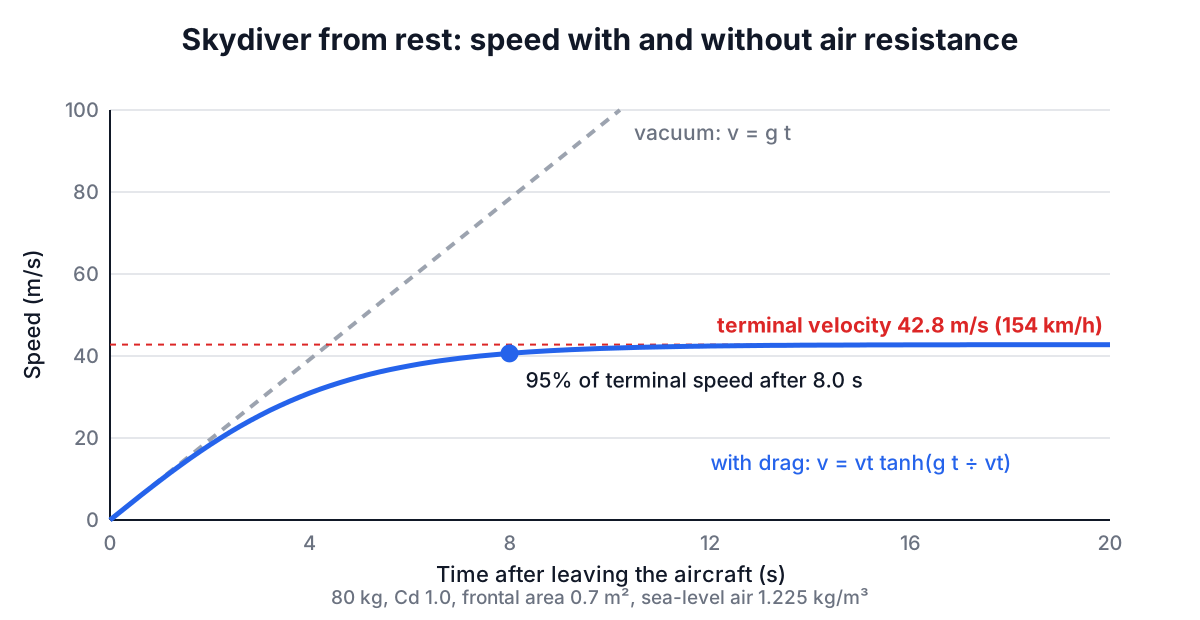
v(t) = vt × tanh(g t ÷ vt)
h(t) = (vt² ÷ g) × ln cosh(g t ÷ vt)
and, eliminating time, the speed after falling a height h is:
v = vt × √(1 − e^(−2 g h ÷ vt²))
Three useful consequences:
- Early in the fall drag hardly matters. For small t, tanh x ≈ x, so v ≈ g t, the vacuum result.
- The approach to vt is gradual. The object reaches 95% of terminal velocity after (vt ÷ g) × atanh(0.95) = 1.83 vt ÷ g seconds, and 99% after 2.65 vt ÷ g.
- Starting faster than vt (for instance a parachute opening at high speed) the object slows down towards vt instead, following a coth curve. The calculator handles an initial downward speed on either side of vt.
Worked example: a baseball dropped from 100 m
Mass 0.145 kg, diameter 74 mm so A = π × 0.037² = 0.0043 m², Cd = 0.47 (sphere), sea-level air. Then:
vt = √(2 × 0.145 × 9.80665 ÷ (1.225 × 0.47 × 0.0043)) = 33.9 m/s
From 100 m the ball lands after 5.18 s at 30.7 m/s, compared with 4.52 s and 44.3 m/s in vacuum. Drag has taken a third off the impact speed and more than half off the impact energy, which goes as v².
Worked example: a skydiver
An 80 kg skydiver falling belly to earth, modelled with Cd = 1.0 and a frontal area of 0.7 m², has a terminal velocity of √(2 × 80 × 9.80665 ÷ (1.225 × 1.0 × 0.7)) = 42.8 m/s, about 154 km/h. They reach 95% of it after 8.0 s, having fallen about 220 m, and after 12 s they have dropped 385 m. Real belly-to-earth terminal speeds are usually quoted around 50 to 55 m/s (180 to 200 km/h), which corresponds to a smaller effective Cd × A of about 0.42 m²; posture, clothing and body size vary a lot, and a head-down skydiver can exceed 70 m/s. That spread is a good reminder that Cd and A are the least certain inputs in any drag calculation.
When the simple models break down
- Very small or slow objects such as dust, mist and pollen are in the low-Reynolds-number regime, where drag is proportional to v rather than v² (Stokes' law). Quadratic drag overestimates their fall speed.
- Tumbling or flat objects like leaves and paper change their orientation, and with it Cd and A, as they fall.
- Very long falls from high altitude pass through air of changing density, so vt changes during the fall. The calculator assumes constant density.
- Buoyancy is ignored. It matters only when the object's density is not much larger than the air's, as with balloons.
Summary
| Question | Vacuum | With drag |
|---|---|---|
| Does mass matter? | No | Yes, heavier falls faster at the same size |
| Speed after time t | g t | vt tanh(g t ÷ vt) |
| Speed after height h | √(2 g h) | vt √(1 − e^(−2gh ÷ vt²)) |
| Top speed | None | vt = √(2 m g ÷ (ρ Cd A)) |
The Free Fall Calculator solves from height, time or impact speed, with or without drag, plots speed against time and compares the drag result with the vacuum answer. For the energy at impact use the Kinetic Energy Calculator, and for objects launched at an angle the Projectile Motion Calculator.
Sources
- CGPM, 3rd General Conference (1901): standard acceleration of gravity, 9.80665 m/s².
- ISO 2533:1975, Standard Atmosphere (identical to the ICAO standard atmosphere): sea-level air density 1.225 kg/m³ and density with altitude.
- F. M. White, Fluid Mechanics, chapter on flow past immersed bodies: drag coefficients and the drag crisis.
- S. F. Hoerner, Fluid-Dynamic Drag, 1965: wind-tunnel drag coefficients for basic shapes.
- NASA Glenn Research Center, "Shape Effects on Drag" and "Terminal Velocity" educational pages.
- NASA History Office, Apollo 15 Lunar Surface Journal: the hammer and feather drop, 2 August 1971.
Related searches
- free fall formula
- how long to fall 100 meters
- terminal velocity formula
- free fall with air resistance
- drag coefficient of a sphere
- skydiver terminal velocity
- depth of a well by dropping a stone
- do heavier objects fall faster