
Small Screen Breaks That Help: Confetti, Jokes, Fortunes and Calm Activities
When a five-minute break beats pushing on, how to celebrate a team win on a shared screen, why a daily fortune stays fixed, and which calm activities suit which mood.
· 7 min read
The release went out at 4:52 on a Friday, the dashboards stayed green, and nobody said anything because everyone was still staring at logs. Teams are often better at noticing problems than wins, and individuals are no different: we push through a stuck afternoon when five minutes away would have fixed it faster.
This guide covers four small tools built for those moments: a fullscreen celebration for the win, a joke for the stand-up, a daily fortune, and a set of calm activities for a real break. For each one it explains what it does, how it works underneath, and when it is the right choice.
When a short break beats pushing on
Attention is a resource that runs down. Research on attention restoration, which Rachel and Stephen Kaplan began in the 1980s, separates "directed attention", the effortful focus you use to debug or write, from "soft fascination", the easy, involuntary interest of watching water or a fire. Directed attention tires; soft fascination lets it recover. The practical lesson is that a good break is low effort and not another feed to scroll.
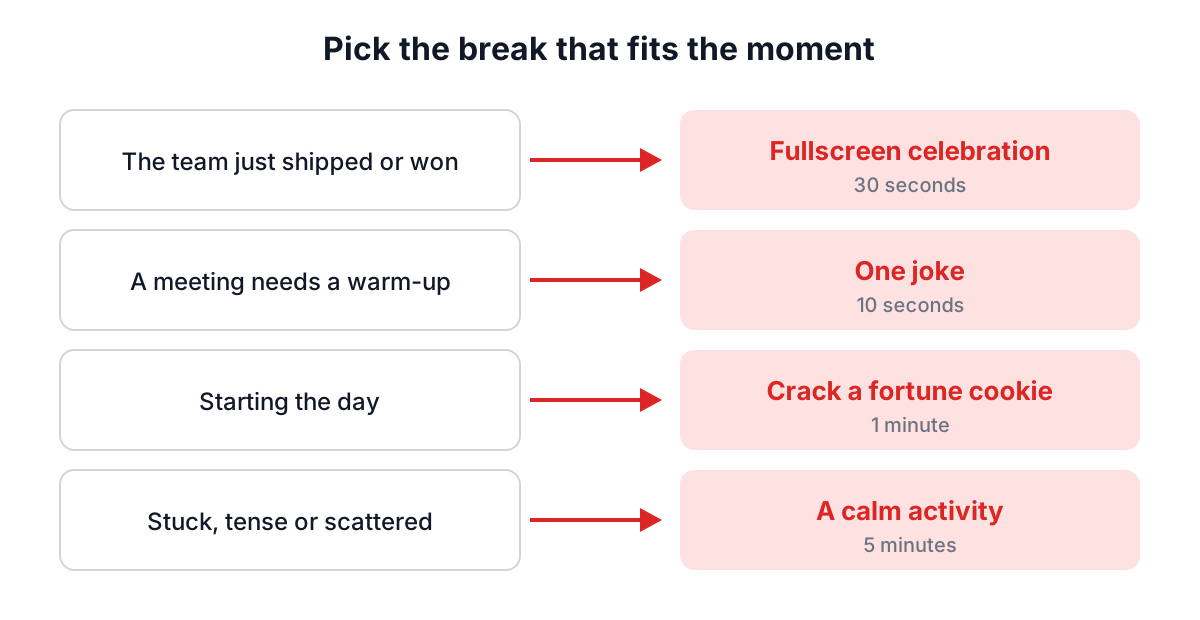
Here is a rough way to match the break to the moment:
| Moment | Try | Why |
|---|---|---|
| The team just shipped or won something | Celebration effects | Marks the moment for everyone at once |
| A meeting needs a warm-up | One joke | Ten seconds, gets people talking |
| Starting the day | Daily fortune | A small ritual with no decisions |
| Stuck, tense or scattered | A calm activity for 5 minutes | Rests directed attention |
Celebration effects: marking a win on a shared screen
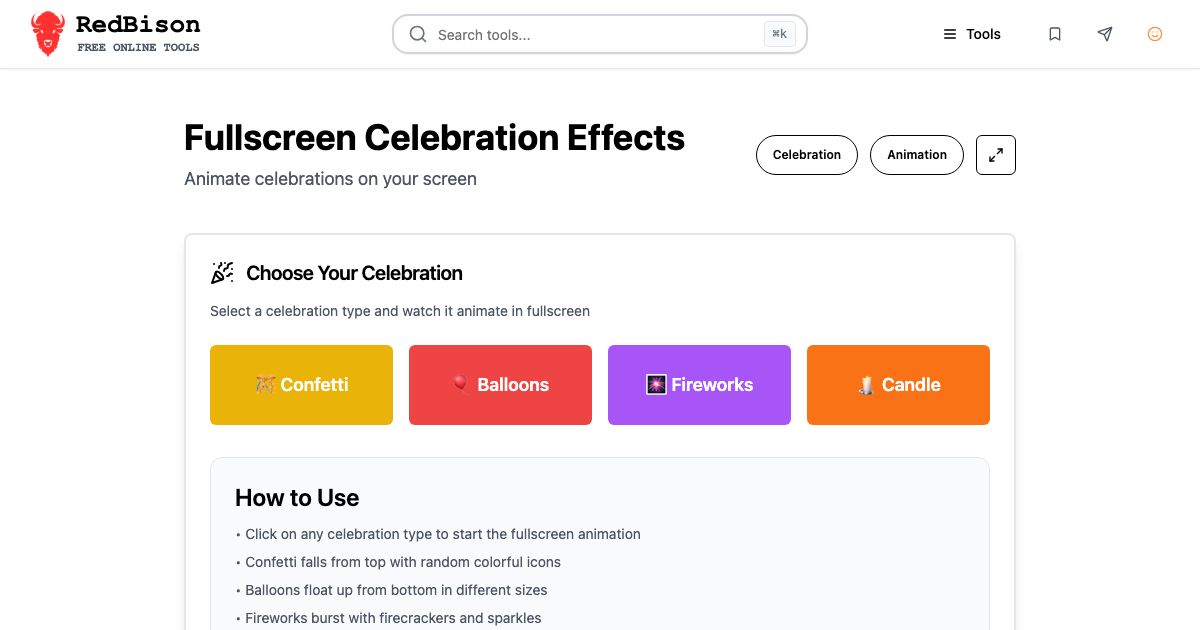
The Fullscreen Celebration Effects page has four buttons: Confetti, Balloons, Fireworks and Candle. Each one asks the browser for fullscreen and then loops until someone presses a key or taps the screen. Confetti drops 200 emoji pieces at random speeds, balloons drift up in five sizes, fireworks burst in eight rings of 30 sparks every 2.5 seconds, and the candle waits for someone to press Blow Candle before the flame fades and smoke rises.
Two details matter when you actually use it:
- Fullscreen needs a click. Browsers only grant fullscreen in response to a user gesture, which is why the effect starts from a button and not from a link. Safari on iPhone only allows video elements to go fullscreen, so there the effect fills the browser tab instead.
- Share the screen after starting. On a video call, start the effect and then share that window. Video calls compress fast motion heavily, so balloons survive the trip better than fireworks.
A worked example. A support team hits zero open tickets for the first time in a quarter. Someone opens the celebration page on the office TV, clicks Confetti, and the screen fills for half a minute while people walk over. One tap on the touch screen ends it. Total cost: under a minute.
The effects are plain CSS animations on transforms, which the GPU can animate without recalculating layout, so they run smoothly on an ordinary laptop. They do not respect the reduced-motion setting, and the fireworks flash, so pick confetti or balloons for audiences who might be sensitive to that.
Jokes: one is enough
A joke works as an icebreaker because it is short, shared and low stakes. The Random Joke Generator has two sets: Dev Joke (218 programming jokes) and Just Joke (275 clean everyday puns). Another One? draws a new one and never repeats the joke on screen, copy puts it on the clipboard, and download draws it onto an 800 by 600 PNG card.
Most of these are puns, and puns work by incongruity: the setup primes one meaning of a word, the punchline swaps in another. Programming jokes are pun-heavy because developer vocabulary borrows ordinary words, like bug, cache, class, branch and port. The best ones are technically true. "Why do programmers mix up Christmas and Halloween? Because Oct 31 == Dec 25" works because 31 in octal is 3 x 8 + 1, which is 25 in decimal.
A few practical rules:
- One joke, then the agenda. The point is the shared moment, not a comedy set.
- Match the room. Dev jokes assume vocabulary. In a mixed meeting, use Just Joke.
- Pause before the punchline. Puns need a beat of silence to land.
The joke lists ship with the page, so nothing is fetched while you use it, and they have been edited to stay workplace-safe.
Fortune cookie: why your fortune does not change all day
The Online Fortune Cookie gives you one fortune per day. Crack it, read it, copy it or save it as a card. Refresh the page and you get the same message. That is deliberate, and it is a nice small example of deterministic randomness.
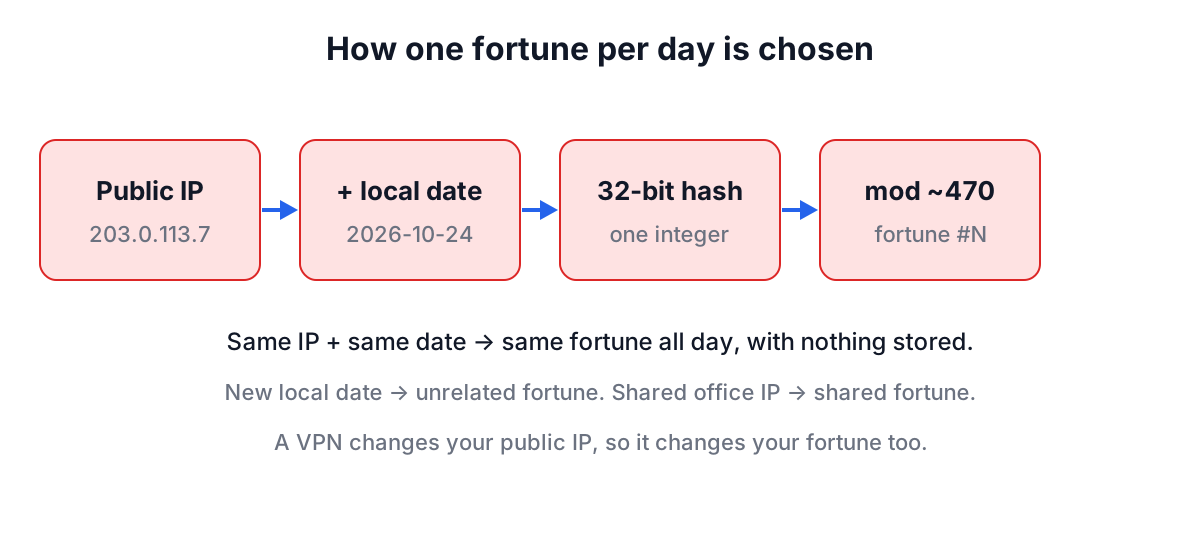
The page asks the ipify service for your public IP address, joins it with today's date in your local time zone, runs a 32-bit string hash over the result and takes the remainder when dividing by the number of fortunes (about 470). In code it looks like this:
const seed = `${ip}-${localDate}`;   // "203.0.113.7-2026-10-24"
const index = hash32(seed) % fortunes.length;
The same input always gives the same index, so the fortune is stable all day without storing anything. Tomorrow's date gives an unrelated index. Two consequences follow. People sharing an office network usually share one public IP and therefore get the same fortune, which is a fun thing to discover in a team channel. And a VPN changes your IP, so it changes your fortune. The IP is only used inside your browser to pick the message; it is not sent to analytics.
Fortune cookies themselves have a surprising history. They are usually traced to Japanese-American bakeries in California in the early 1900s, adapted from a cracker made in Kyoto, and only later became a fixture of Chinese restaurants in the United States.
Calm activities: five minutes of nothing in particular
Mindless Activities for Stress Relief is the tool for an actual break. It has thirteen activities in three groups:
| Group | Activities | Best for |
|---|---|---|
| Hands busy | Bubble Pop, Zen Circles, Color Flow, Unfreeze Earth, Star Gaze | Restless energy |
| Breathing and rhythm | Breath Sync, Pendulum Watch | Tension, racing thoughts |
| Watching | Fountain, Fish Tank, Ocean Waves, Rain, Fireplace | Winding down |
Each has a suggested session length between 6 and 20 minutes and a timer with Start, Pause and Reset. The share button copies a link that opens straight into one activity, which is handy for a team that wants a shared five-minute reset after a long incident.
Breath Sync is the simplest place to start: a circle grows and shrinks on a 4-second cycle. If that feels fast, breathe in over one full cycle and out over the next, which gives you seven or eight slow breaths a minute. Pendulum Watch defaults to a 3.2-second swing and the slider slows it down. The watching activities embed YouTube videos, so they need a connection and play sound; the other eight are silent and run in the browser.
Feeling Reflector is the odd one out. You pick one of eight words (calm, excited, peaceful, anxious, happy, sad, angry, confused) and the screen turns it into moving particles. Choosing a word for how you feel is a small but useful act; naming an emotion tends to take a little of its edge off.
A clear limit: these are breaks, not treatment. If anxiety, low mood or poor sleep go on for weeks, talk to a doctor or a licensed therapist.
Common mistakes
Making the break another screen task. A calm activity works because it asks nothing. If you find yourself trying to win Bubble Pop, switch to Breath Sync or the fireplace.
Celebrating only big wins. Small, frequent recognition does more for a team than one party a year. A thirty-second confetti moment for a closed bug backlog is enough.
Telling jokes that need explaining. If the room does not know what octal is, the Halloween joke is a lecture. Pick from the set that matches the audience.
Rerolling the fortune. It is the same all day on purpose. Read it, take what is useful, move on.
Where to start
Bookmark two of these: the celebration page for the team and one calm activity for yourself. Next time something ships, start the confetti before anyone has to ask. Next time you have read the same stack trace three times, open Breath Sync for five minutes instead. For a longer, sillier reset, the Online Laughter Yoga session takes the joke idea further, and the Breathing Exercises tool has structured patterns if Breath Sync leaves you wanting more.