
HELOC Maths: How Much Equity You Can Borrow and What It Costs
How lenders use combined loan-to-value to size a credit line, why the payment jumps when the draw period ends, and how a HELOC compares with a fixed home equity loan.
· 9 min read

A home equity line of credit (HELOC) lets you borrow against the part of your home you already own. Two questions decide whether one makes sense: how large a line a lender will give you, and what the payments look like over the full life of the line, not just the first few years. This guide works through both with the HELOC Calculator, using one example home throughout so every figure can be reproduced. It explains the arithmetic and the rules behind it; it is not lending or tax advice, and a lender's offer will depend on things no calculator sees.
How a HELOC works
A HELOC is a revolving line secured by your home, usually in second position behind the first mortgage. It has two phases:
- The draw period, typically 10 years. You can borrow, repay and borrow again up to the limit, much like a credit card. Many lenders only require interest on the balance during this phase.
- The repayment period, typically 10 to 20 years. You can no longer draw, and the balance is paid off in level monthly payments of principal and interest.
Most HELOC rates are variable: an index (in the US almost always the prime rate published by large banks, which tracks the Federal Reserve's federal funds target) plus a margin set by the lender. Regulation Z, 12 CFR 1026.40, requires lenders to disclose how the rate is set, any caps, and a historical example of how payments would have changed, and it restricts when a lender can change the terms or freeze the line.
A home equity loan is the closed-end cousin: one lump sum at a fixed rate, repaid in equal payments from the first month. The comparison between the two is covered below.
How much you can borrow: combined loan-to-value
Lenders size a HELOC with the combined loan-to-value ratio (CLTV): all the debt secured by the home divided by its appraised value. If a lender caps CLTV at 85%, the most it will lend in total against a $500,000 home is $425,000, and the first mortgage counts against that.
maximum line = home value x CLTV limit - existing mortgage and liens
Take a home worth $500,000 with a $300,000 mortgage balance:
- Equity is $500,000 - $300,000 = $200,000, and the current LTV is 60%.
- At an 85% CLTV limit: $500,000 x 0.85 - $300,000 = $125,000.
- At 80%: $400,000 - $300,000 = $100,000.
- At 90%: $450,000 - $300,000 = $150,000.
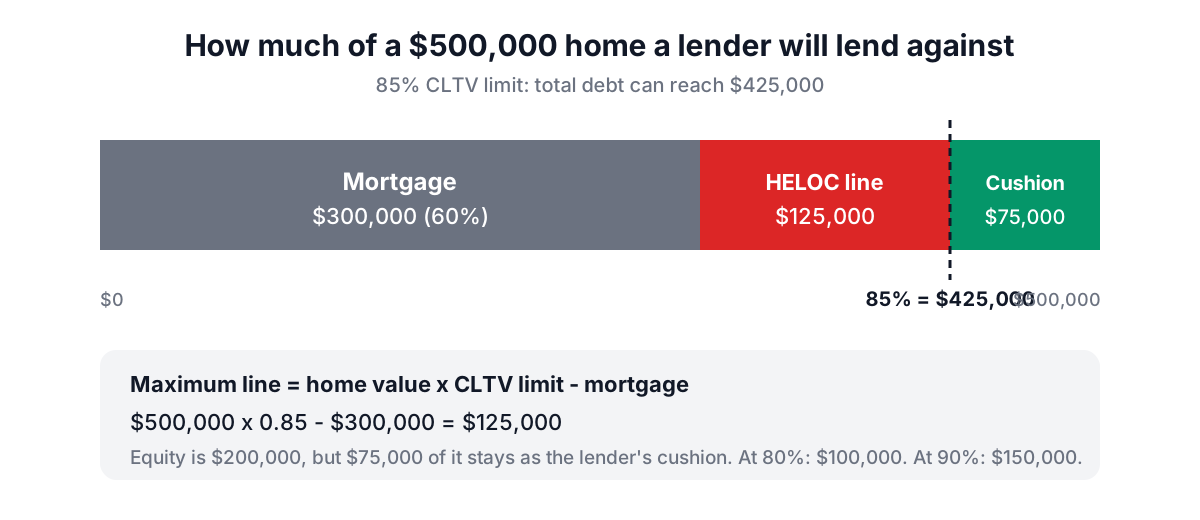
So you cannot borrow all $200,000 of equity. The part above the CLTV limit, $75,000 here, is a cushion the lender keeps in case prices fall or the home has to be sold. The calculator shows this split as bars under "Where the home's value goes", and if you type a draw larger than the line it caps the draw and says so.
| CLTV limit | Total debt allowed | Maximum line on a $500,000 home with $300,000 owed |
|---|---|---|
| 80% | $400,000 | $100,000 |
| 85% | $425,000 | $125,000 |
| 90% | $450,000 | $150,000 |
The value in the formula is the lender's appraised value, not your estimate or a website's. If the appraisal comes in at $480,000, the 85% line drops to $108,000. The lender will also check your credit score, income and debt-to-income ratio; the Debt-to-Income Calculator shows that side of the application.
The payment step when the draw period ends
The payment pattern is what catches HELOC borrowers out. Suppose you draw $60,000 of that $125,000 line at 8%, with a 10-year draw period and a 20-year repayment period:
- Draw period, interest only: $60,000 x 8% / 12 = $400 a month. The balance does not fall at all.
- Repayment period: $60,000 amortized over 240 months at 8% = $501.86 a month, an increase of $101.86.
Draw the whole $125,000 instead and the payment goes from $833.33 interest-only to $1,045.55 when repayment starts, a rise of $212.22 a month.
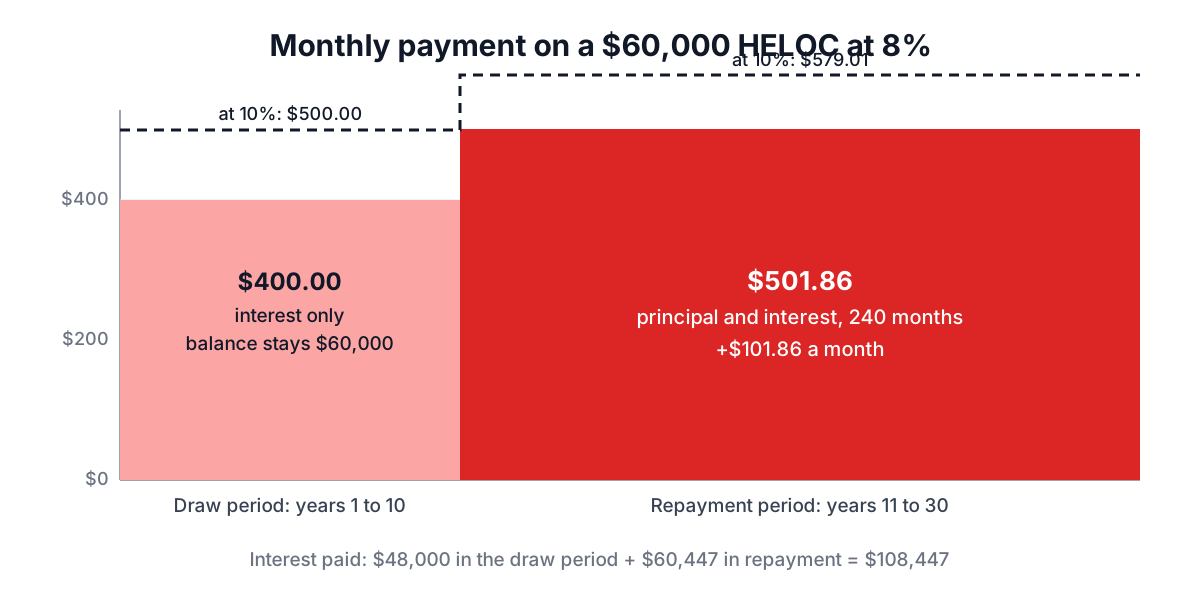
The jump is larger when the repayment period is shorter. Over 10 years instead of 20, the same $60,000 at 8% costs about $728 a month. Check the repayment term in your agreement and run it in the calculator before you decide how much to draw.
The total cost adds up as well. Ten years of interest-only payments on $60,000 is $48,000 of interest, and the 20-year repayment adds another $60,447.37, so the line costs $108,447.37 in interest on top of the $60,000 borrowed. Paying principal during the draw period, which most lenders allow, cuts both the later payment and the total.
When the rate moves
Because the rate floats with prime, the calculator includes a stress test: the same balance at a rate a few points higher. With the default 2-point rise on the $60,000 example:
| Scenario | Draw period | Repayment period |
|---|---|---|
| Rate stays at 8% | $400.00 | $501.86 |
| Rate rises to 10% | $500.00 | $579.01 |
A 2-point rise adds $100 a month to the interest-only payment and $77.15 to the repayment payment. The calculator holds whichever rate you enter for the whole life of the line; it does not model a rate path, periodic caps or a lifetime cap. Your Regulation Z disclosure states the maximum rate the line can reach, and running the calculator at that rate gives the worst case.
HELOC or fixed home equity loan?
A home equity loan gives you the full amount at once, at a fixed rate, with principal and interest from the first payment. The calculator puts one next to the HELOC. Borrowing the same $60,000 as a 15-year fixed loan at 8.25%:
| Option | Monthly payment | Total interest |
|---|---|---|
| HELOC, draw period (10 years at 8%) | $400.00 | $48,000.00 |
| HELOC, repayment (20 years at 8%) | $501.86 | $60,447.37 |
| Fixed loan, 15 years at 8.25% | $582.08 | $44,775.16 |
The fixed loan costs more each month but less than half the interest, because the balance starts falling immediately and the loan is over in 15 years instead of 30. The HELOC's advantage is flexibility: you pay interest only on what you have drawn, so for a renovation paid in stages or a cash reserve you may never touch, it can cost far less than these figures suggest. The figures above assume the full draw on day one, which is the worst case for a HELOC.
Some practical differences:
- A HELOC suits uncertain or staged costs. A fixed loan suits one known bill, such as consolidating a specific debt.
- A HELOC's payment can rise with rates; a fixed loan's cannot.
- Some lenders let you fix the rate on part of a HELOC balance, which turns that part into something like a fixed loan.
- Closing costs differ. Many HELOCs have low upfront costs but annual fees or early-closure fees; read the fee schedule.
If you are thinking about replacing the first mortgage as well, compare a cash-out refinance with the Refinance Calculator. It changes the rate on the whole mortgage, which matters if your current first mortgage rate is low.
Tax: is HELOC interest deductible?
The Tax Cuts and Jobs Act of 2017 stopped treating interest on home equity debt as deductible mortgage interest, and the One Big Beautiful Bill Act of 2025 made that change permanent along with the $750,000 limit on mortgage debt ($375,000 if married filing separately). IRS Publication 936 explains the rule that remains: interest on a HELOC or home equity loan can be deducted only if the money is used to buy, build or substantially improve the home that secures the loan, the total mortgage debt is within the limit, and you itemize.
So interest on a HELOC used for a kitchen remodel can be deductible; interest on the same HELOC used to pay off credit cards or buy a car is not. The calculator shows pre-tax costs only.
Risks to weigh
- Your home is the collateral. Missing payments can lead to foreclosure, which is a different level of risk from an unsecured personal loan.
- The line can be frozen or reduced. Regulation Z lets a lender suspend draws or cut the limit if the home's value falls significantly below the appraised value or your finances change materially. A HELOC is not a guaranteed emergency fund; build cash savings first with the Emergency Fund Calculator.
- Interest-only periods hide the real cost. Budget for the repayment payment, not the draw-period payment.
- Falling prices shrink your cushion. At 85% CLTV, a 15% fall in value leaves you with no equity on paper.
Using the calculator
- Enter the home value, everything owed against it and the lender's CLTV limit. The maximum line appears straight away.
- Enter the amount you plan to draw (leave it blank to use the full line), the rate, and the draw and repayment periods from the offer.
- Read the draw-period payment, the repayment payment and the total interest, then check the year-by-year table for the balance.
- Set a rate rise for the stress test and a fixed loan rate and term to compare.
- Copy the result or share a link with the same figures.
What it does not model: variable rates over time, rate caps, minimum draw rules, annual fees, closing costs, partial repayments during the draw period, and the lender's checks on credit, income, debt-to-income and the appraisal. Treat the maximum line as a ceiling, not an approval.
For the bigger picture, the Mortgage Calculator covers the first mortgage, the House Affordability Calculator covers how much home a budget supports, and the Net Worth Calculator shows how home equity and the debt against it fit into your overall balance sheet.
Sources
- Consumer Financial Protection Bureau, "What you should know about home equity lines of credit" (HELOC booklet).
- Regulation Z, 12 CFR 1026.40, Requirements for home equity plans (disclosures, rate terms, when a line may be frozen or reduced).
- IRS Publication 936, Home Mortgage Interest Deduction (home equity interest and the acquisition debt rule).
- Public Law 119-21 (One Big Beautiful Bill Act, 2025), section making the mortgage interest limits of IRC 163(h)(3)(F) permanent.
- Board of Governors of the Federal Reserve System, Selected Interest Rates (H.15), bank prime loan rate.
Related searches
- how much heloc can i get
- combined loan to value
- cltv calculation
- heloc interest only payment
- heloc repayment period payment
- heloc vs home equity loan
- heloc payment shock
- home equity line of credit calculator
- is heloc interest tax deductible
- heloc draw period