
How Many Rolls of Wallpaper? The Strip Method Explained
Why area division underestimates wallpaper, how pattern repeat and straight or half-drop matches set the cut length, roll sizes in Europe and the US, and a worked room.
· 9 min read

The quick way to estimate wallpaper is to divide the wall area by the area of a roll. It is also the way most people end up one or two rolls short, from a batch the shop no longer stocks. Wallpaper is hung in full-height strips that have to line up with each other, and the length of paper each strip consumes depends on the pattern, not just the wall. This guide explains the strip method decorators use, with worked numbers you can check in the Wallpaper Calculator.
Why area division falls short
Take a room with 49 feet of wall to paper (52 feet of perimeter less a 3 foot doorway) and 8 foot ceilings. The wall area is 392 square feet. An American double roll of 20.5 inches by 33 feet holds about 56 square feet, so area division says 7 rolls.
Now hang it. Each strip is 20.5 inches wide, so 49 feet of wall (588 inches) takes 29 strips. Each strip is cut to the wall height plus a trimming allowance, say 100 inches. A 33 foot roll is 396 inches long, which is three strips of 100 inches with 96 inches left over. If the paper has a 21 inch pattern repeat, every strip has to start at the same point in the pattern, so each cut is really 105 inches, and the leftover is 81 inches. Either way the roll gives three strips, and 29 strips need 10 rolls.
Area division missed three rolls because it assumed the leftover piece at the end of each roll would be used. It rarely can be: it is too short for a full drop, and the pattern on it is in the wrong place.
The strip method in four steps
- Strips (drops). Divide the width of wall you are papering by the roll width and round up. Skip the width of doors and floor-to-ceiling openings.
- Cut length. Add a trim allowance to the height, typically 4 inches or 10 cm in total (top and bottom). Then round up to whole pattern repeats if the paper has one.
- Strips per roll. Divide the roll length by the cut length and round down.
- Rolls. Divide the strips by the strips per roll and round up. Add a spare.
strips          = ceiling((wall width - openings) / roll width)
cut length      = ceiling((height + trim) / repeat) x repeat   (+ repeat / 2 for half-drop)
strips per roll = floor(roll length / cut length)
rolls           = ceiling(strips / strips per roll)
Roll sizes
Roll sizes vary by market, so read the label.
| Roll | Width | Length | Area |
|---|---|---|---|
| Standard European | 0.53 m | 10.05 m | 5.33 m² |
| Wide European | 0.70 m | 10.05 m | 7.04 m² |
| US double roll | 20.5 in | 33 ft | 56 ft² |
| US 27 in double roll | 27 in | 27 ft | 61 ft² |
American wallpaper is a common source of confusion: it is usually priced per single roll but sold only in double rolls (bolts). A "single roll" price of $40 means $80 per bolt you actually take home. The calculator counts rolls as sold, so enter the price of the roll you buy.
Pattern repeat and match
The repeat is the vertical distance before the design repeats, printed on the label along with the match type and a symbol for it.
- Free or random match. Textures, plains and some stripes. Any strip can go next to any other, so the cut length is just height plus trim. Least waste.
- Straight match. The design lines up horizontally across adjacent strips. Every strip starts at the same point in the pattern, so the cut length rounds up to whole repeats.
- Half-drop match. Each strip is shifted down by half a repeat from its neighbour, giving a diagonal effect. Alternate strips start at different points, and on average each strip costs about half a repeat more than a straight match. Some decorators cut from two rolls at once, alternating, to reduce waste.
- Offset or multiple drop. Less common; follow the manufacturer's instructions.
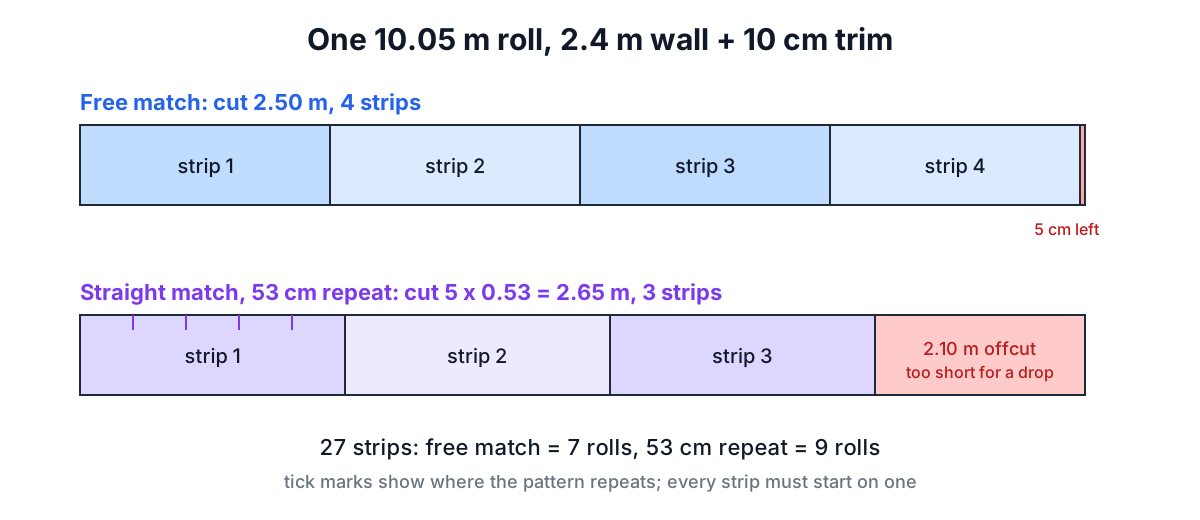
Large repeats are expensive repeats. On a 2.4 m wall with 10 cm of trim, a Euro roll gives four strips of 2.5 m with no repeat but only three when a 53 cm repeat forces each cut to 2.65 m. That one change turns 7 rolls into 9 for a typical bedroom.
| 4 x 3.5 m room, 2.4 m high, one door | Cut length | Strips per roll | Rolls |
|---|---|---|---|
| Free match | 2.50 m | 4 | 7 |
| Straight match, 53 cm repeat | 2.65 m | 3 | 9 |
| Half-drop, 53 cm repeat | 2.915 m | 3 | 9 |
| Straight match, 64 cm repeat | 2.56 m | 3 | 9 |
In this room both pattern types give three strips per roll, because 10.05 m holds three cuts of anything up to 3.35 m. Push the ceiling to 2.7 m and the half-drop cut grows to about 3.45 m, leaving only two strips per roll.
Doors, windows and odd walls
Skip doors and floor-to-ceiling openings by their width; there is no paper there. Do not skip ordinary windows. The pieces above and below a window still need most of a strip, cut from a full drop so the pattern lines up, and the offcut rarely fits elsewhere. That rule of thumb is conservative for a room full of large windows, which is fine; a spare roll costs less than a mismatched one.
For a single accent wall, enter the wall width directly. A 3.6 m wall takes 7 strips of 0.53 m paper, which is two Euro rolls with a free match.
Stair walls, sloping ceilings and alcoves are best handled by drawing each wall and counting strips per wall at its own height, then adding them up. The calculator's total-width mode works for walls of equal height.
Batches and spares
Wallpaper is printed in runs, and each run gets a batch or lot number. Colours can shift slightly between batches, visibly so on a wall. Buy every roll you need from the same batch at the same time, and buy one spare. The spare covers a miscut, a damaged strip, or a repair years later when the pattern is discontinued. Many shops accept unopened rolls back; check before you buy.
A worked example
A 14 by 12 foot bedroom with 8 foot walls, one 3 foot door, US double rolls (20.5 in x 33 ft), straight match, 21 inch repeat, 4 inch trim.
- Wall width: 2 x (14 + 12) = 52 ft, less the 3 ft door, 49 ft = 588 in. Strips = ceiling(588 / 20.5) = ceiling(28.7) = 29.
- Cut length: 96 + 4 = 100 in, rounded up to whole 21 inch repeats: 5 x 21 = 105 in.
- Strips per roll: floor(396 / 105) = 3.
- Rolls: ceiling(29 / 3) = 10. Buy 11 with a spare.
At $60 per double roll that is $660. The same room with a free-match paper still gives three 100 inch strips per roll, so the count is the same 10; the repeat only costs extra here when it pushes the cut past 132 inches (a third of the roll).
Hanging tips that affect quantity
- Start at a corner or the least visible point and use a plumb line for the first strip; walls and corners are rarely true.
- Number the strips on the back as you cut them, so the pattern order is clear.
- Keep offcuts until the job is finished. Long ones can cover the space above a door or below a window.
- Read whether the paper is paste-the-wall or paste-the-paper; it does not change the quantity but does change how much paste you buy.
Sources and further reading
- Roll dimensions and the pattern repeat and match symbols printed on manufacturers' roll labels; the 0.53 by 10.05 metre roll is the size most European papers are made to.
- The strip method as taught in decorating trade practice: count drops, then drops per roll.
Work out your own room in the Wallpaper Calculator. If you are painting the remaining walls, the Paint Calculator uses the same room measurements.
Related searches
- how many rolls of wallpaper do i need
- wallpaper pattern repeat
- half drop wallpaper
- straight match wallpaper
- standard wallpaper roll size
- us double roll wallpaper
- wallpaper strip method
- wallpaper batch number