
How Many Solar Panels Do I Need? Sizing Arrays and Batteries
Turning a utility bill into kW of panels: peak sun hours, the 14% loss allowance, panel count, off-grid battery autonomy, MPPT controller current and the design-month judgement.
· 11 min read
The number of solar panels a home or cabin needs comes from three numbers: how much energy you use, how much sun reaches the panels, and how much is lost between the panel and the plug. Get those right and the panel count is one division. Get them wrong, usually by using the wrong sun figure, and an off-grid system runs dry every winter or a grid-tied system is sold with twice the panels it needs. This guide walks through each input, the battery and charge controller sizing that off-grid systems add, and the judgement calls that matter more than the arithmetic. The Solar Panel Calculator does the sums.
Step 1: how much energy you use
Start with kWh, not watts. A year of utility bills is the best source because it captures seasonal swings; divide the annual total by 365 for a daily average. A US household using 900 kWh a month uses about 29.6 kWh a day.
For an off-grid cabin, van or boat there is no bill, so build a load list: watts × hours of use per day for each appliance, summed. A 60 W fridge compressor running 40% of the time is 0.6 kWh a day; ten 8 W LED lights for five hours is 0.4 kWh; a laptop at 50 W for six hours is 0.3 kWh. Small loads add up, and an inverter's idle draw of 10 to 30 W running all day can rival the fridge.
Cutting consumption is the cheapest part of any solar system. Every kWh a day you remove saves roughly a quarter to a third of a kilowatt of panels and, off-grid, several kWh of battery.
Step 2: peak sun hours
Panels are rated at standard test conditions: 1,000 W of sunlight per square metre with the cells at 25 °C. Real sun varies through the day and year, so the useful measure is the total solar energy falling on the tilted panel each day, in kWh/m². Because 1 kWh/m² equals one hour of 1,000 W/m² sun, the same number is called peak sun hours.
Typical annual averages for a well-tilted panel run from about 3 in cloudy northern Europe or the US Pacific Northwest to 6 or more in desert climates. Seasonal swings are large: a site averaging 4.5 may get 2 in December and 6.5 in June.
Do not guess this number. NREL's free PVWatts calculator gives monthly values for any US address and many other countries, and the European Commission's PVGIS tool covers Europe, Africa and most of Asia. Enter your tilt and orientation and read the monthly solar radiation in kWh/m²/day.
Which month to use is the key judgement:
- Grid-tied: the grid absorbs surpluses and covers deficits, so the annual average is right.
- Off-grid: the system must cope on its own in the worst month you occupy the site, usually December or January in the northern hemisphere. Designing to the average guarantees shortfalls for months.
Step 3: system losses
The panel's nameplate is not what reaches your outlets. Dust and pollen, wiring resistance, small mismatches between panels, inverter conversion, partial shading, cells running hotter than 25 °C and gradual degradation all take a share. NREL's PVWatts uses 14% total losses as its default, separate from inverter efficiency, and that is a sensible starting point. Hot, dusty or partially shaded sites run higher; a clean, well-ventilated array with module-level electronics can do better. Off-grid systems with lead-acid batteries lose more again to charging inefficiency, so 20 to 25% is a safer allowance.
Step 4: the panel count
With those inputs:
array kW = daily kWh ÷ (peak sun hours × (1 − losses))
panels = array W ÷ panel W, rounded up
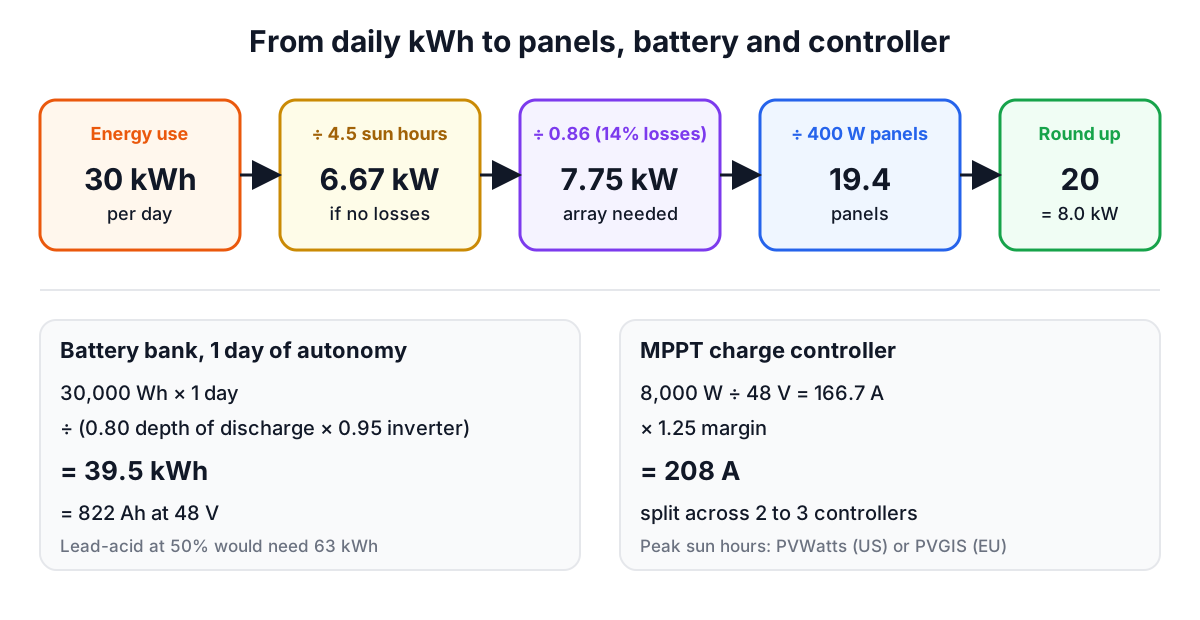
For 30 kWh a day at 4.5 sun hours and 14% losses: 30 ÷ (4.5 × 0.86) = 7.75 kW. With 400 W panels that is 19.4, so 20 panels, an 8 kW array expected to produce about 31 kWh on an average day and about 11,300 kWh a year. A grid-tied home using 900 kWh a month at 5.5 sun hours needs 6.26 kW, or 15 panels of 430 W.
The rounding matters at small scale. A cabin needing 3 kWh a day at 3 winter sun hours with 20% losses needs 1.25 kW, which is 6.25 panels of 200 W, so seven panels and 1.4 kW.
Before buying, check that the panels can be wired into strings whose voltage stays inside the inverter or charge controller window. Cold weather raises panel open-circuit voltage, so a string that is fine in summer can exceed the controller's maximum on a frosty morning. NEC 690.7 sets how to calculate that maximum voltage.
Step 5: the battery bank
An off-grid or backup system stores energy for nights and cloudy spells. The number of days it must carry the load with no sun is the days of autonomy: one to two days in sunny climates with a generator as backup, three to five where long overcast spells are common.
battery Wh = daily Wh × days ÷ (depth of discharge × inverter efficiency)
For the 30 kWh home and one day at 80% depth of discharge (LiFePO4) and 95% inverter efficiency: 30,000 ÷ (0.8 × 0.95) = 39.5 kWh, or 822 Ah at 48 V. For the cabin, three days on lead-acid at 50% and a 90% inverter: 3,000 × 3 ÷ (0.5 × 0.9) = 20 kWh, or 833 Ah at 24 V. That second example shows why lead-acid off-grid banks get large and why many builders now choose lithium. The battery runtime guide explains depth of discharge and Peukert losses in detail.
Choose the bank voltage by system size: 12 V is fine up to roughly 1 kW of inverter, 24 V to about 3 kW, and 48 V above that. Higher voltage means lower current, thinner cables and smaller fuses.
Step 6: the charge controller
An MPPT (maximum power point tracking) controller converts the array's higher voltage down to battery voltage, so its output current is the array power divided by battery voltage. Add 25% margin, in line with the NEC 690.8 practice of rating PV circuits at 125% of their maximum current and to cover cold, bright days when panels exceed their rating:
controller A = array W ÷ battery V × 1.25
The cabin's 1.4 kW array on 24 V needs 58 A, so at least a 73 A controller. The 8 kW home array on 48 V would need 208 A, which in practice means two or three controllers or a hybrid inverter with several MPPT inputs. PWM controllers are cheaper but simply connect the panels to the battery, so they only suit panels whose voltage matches the battery and are sized from panel short-circuit current instead.
Common mistakes
- Using daylight hours instead of peak sun hours. Twelve hours of daylight might be four peak sun hours.
- Designing off-grid systems to the annual average.
- Forgetting losses, which undersizes the array by about 15%.
- Ignoring shade. One shaded panel can drag down a whole string without optimisers or microinverters.
- Sizing lead-acid banks for 80% depth of discharge, which wears them out within a couple of years.
Payback and next steps
A grid-tied array's value is the kWh it produces times what you pay per kWh, which the Electricity Cost Calculator helps estimate; compare that with the installed cost using the ROI Calculator. For backup during outages, compare a battery system with a generator using the Generator Size Calculator, and size PV and battery cables with the Wire Size Calculator, since low-voltage DC runs often need larger conductors than people expect.