
How Much Does a Meeting Cost? Salaries, Overhead and Time
Turning salaries into hourly cost, why loaded labour cost is about 1.4 times pay, person-hours, the yearly cost of recurring meetings and practical ways to cut it.
· 9 min read
Meetings feel free because nobody gets an invoice for them. They are not. Every person in the room is being paid, and their employer is paying for their benefits, taxes and desk at the same time. Putting a number on a meeting is not about shaming anyone; it is about making a trade-off visible. Is this one-hour review worth the same money as a week of a contractor, or a piece of software the team keeps asking for? This guide shows how to work out the cost properly, where the overhead figure comes from, and what the totals look like for recurring meetings. The Meeting Cost Calculator does the arithmetic and has a live counter you can run during a call.
The formula
The cost of a meeting is the sum, over everyone attending, of their loaded hourly cost multiplied by the hours spent:
Meeting cost = Σ (loaded hourly rate x hours in the meeting)
For a group of people on the same pay that is simply people x rate x hours. The two inputs that need some thought are the hourly rate and the overhead that makes it "loaded".
From salary to hourly cost
Salaries are quoted per year, so divide by the paid hours in a year. The usual figure is 2,080: 52 weeks of 40 hours. That includes paid holidays and vacation, which is correct for a cost calculation, because the employer pays for those hours whether or not anyone is at work.
| Annual salary | Hourly (÷ 2,080) | Loaded x 1.3 | Loaded x 1.4 |
|---|---|---|---|
| 50,000 | 24.04 | 31.25 | 33.65 |
| 75,000 | 36.06 | 46.88 | 50.48 |
| 100,000 | 48.08 | 62.50 | 67.31 |
| 140,000 | 67.31 | 87.50 | 94.23 |
| 175,000 | 84.13 | 109.38 | 117.79 |
If you would rather know the cost per hour actually worked, use a smaller divisor. After about 30 days of vacation and public holidays, a full-time employee works roughly 1,840 hours, which raises the hourly figure by about 13%. Either is defensible; just use the same basis when you compare options.
Why loaded cost is about 1.4 times pay
Pay is only part of what an employee costs. Employers also pay for:
- Health insurance and other insurance.
- Retirement contributions such as a 401(k) match or pension.
- Employer payroll taxes: in the US, Social Security and Medicare (7.65% of wages up to the Social Security wage base), plus federal and state unemployment taxes.
- Paid leave, already inside the 2,080-hour figure, and supplemental pay such as bonuses.
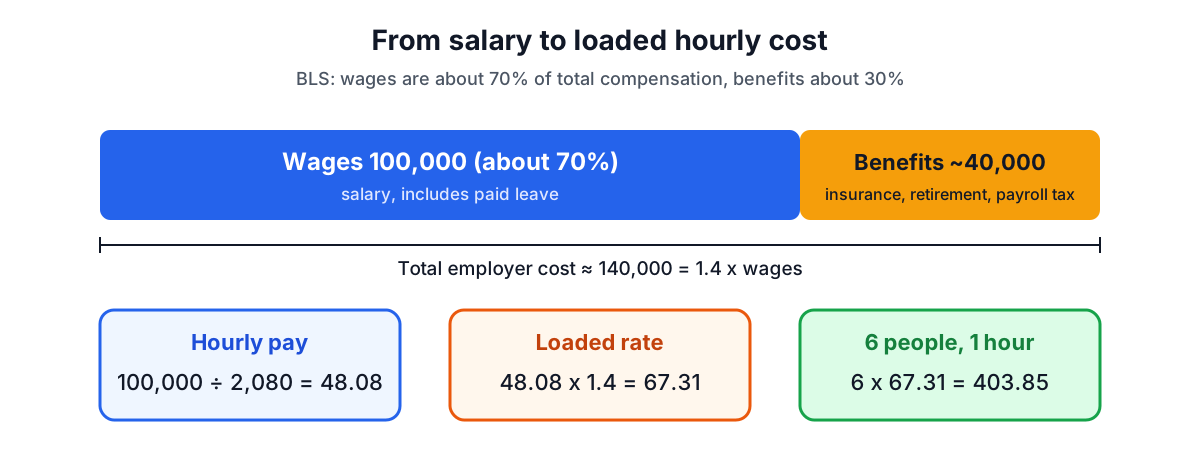
The US Bureau of Labor Statistics measures this every quarter in its Employer Costs for Employee Compensation survey. In recent releases, wages and salaries make up about 70% of total compensation for civilian workers and benefits about 30%. Total cost divided by wages is therefore about 1 / 0.70, roughly 1.4. For state and local government workers the benefit share is higher, closer to 38%, so the multiplier is larger. Outside the US the mix differs: in many European countries employer social contributions are larger and health insurance smaller, but a multiplier of 1.25 to 1.5 is common.
Finance teams often add office space, equipment and software to get a "fully loaded" rate that can reach 1.5 to 2 times pay. If your company publishes one, use it. Otherwise 1.3 is a cautious middle estimate and 1.4 matches the BLS average.
Worked examples
A one-hour meeting of six
Six people on 100,000 a year, no overhead: 100,000 / 2,080 = 48.08 an hour each. Six of them for an hour cost 288.46. With a 1.4 multiplier that becomes 403.85.
A mixed weekly meeting
Four employees at 104,000 (exactly 50.00 an hour) and two contractors billing 75 an hour meet for 30 minutes every week, 48 weeks a year, with an overhead of 1.3 on everyone:
- Room cost per hour: (4 x 50 + 2 x 75) x 1.3 = 455.00
- Per meeting: 455 x 0.5 = 227.50
- Per year: 227.50 x 48 = 10,920
- Person-hours per year: 6 x 0.5 x 48 = 144
Strictly, a contractor's day rate already includes their own overhead, so you could leave the multiplier off them. The calculator lets you set groups separately if you want that precision.
The default example in the calculator
Four engineers at 140,000 and two managers at 175,000 in a weekly one-hour meeting with a 1.3 multiplier: the engineers cost 67.31 an hour and the managers 84.13, so the room costs 437.50 an hour in pay and 568.75 loaded. Over 48 weeks that is 27,300, the price of a decent laptop for everyone in the room, or a meaningful slice of another person's salary.
Person-hours: the other unit
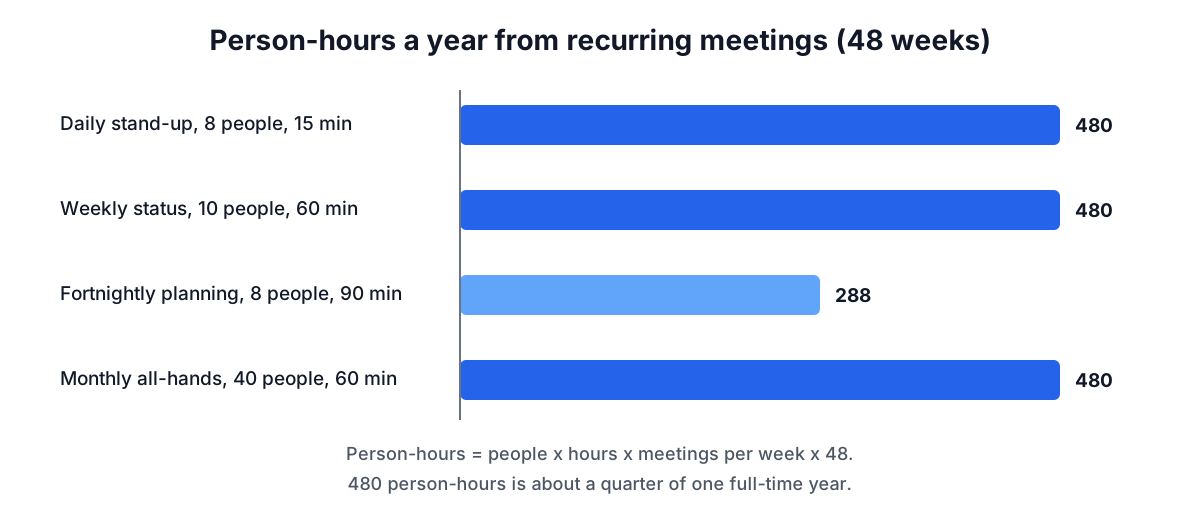
Money is one way to see the cost; time is the other. Person-hours are attendees x duration. An hour-long meeting of eight people consumes eight person-hours, a full working day of one person. A team that holds three such meetings a week spends more than half a person's working week in them.
| Meeting | People | Length | Per week | Person-hours a year (48 weeks) |
|---|---|---|---|---|
| Daily stand-up | 8 | 15 min | 5 | 480 |
| Weekly status | 10 | 60 min | 1 | 480 |
| Fortnightly planning | 8 | 90 min | 0.5 | 288 |
| Monthly all-hands | 40 | 60 min | 0.25 | 480 |
The stand-up and the weekly status cost the same 480 hours, which is a useful point when someone defends a long weekly meeting as cheaper than a short daily one.
What the number leaves out
The calculator measures direct time. Several real costs are harder to price:
- Preparation and follow-up. Reading papers, writing notes and actions.
- Switching cost. Getting back into deep work after an interruption takes time; a meeting in the middle of a morning can cost more focus than its length suggests.
- Opportunity cost. What the people would have produced instead. For a sales team or an on-call engineer, that can far exceed salary.
- The value created. A one-hour decision meeting that saves a month of rework is cheap at any price. The goal is not fewer meetings at all costs, but meetings that are worth their cost.
Ways to bring the cost down
The formula points straight at the levers: fewer people, less time, fewer repeats.
- Invite only the people who must decide or contribute. Share notes with everyone else. Removing two people from a weekly hour of eight saves a quarter of its cost.
- Default to 25 or 50 minutes. Many calendars can shorten meetings automatically, which also gives people a break between calls.
- Write first. A short document read before the meeting turns a presentation into a discussion, or removes the need for the meeting entirely.
- Review recurring meetings each quarter. Ask whether each one still has a purpose and an owner. Cancelling one weekly meeting is worth more than shaving minutes off many one-offs.
- Protect focus time. Group meetings into blocks so the rest of the day is free for work. A timer such as the Pomodoro Timer helps structure those blocks.
Handle salary data with care
Individual pay is sensitive. When you share a meeting cost, use average pay for a role or a pay band rather than named people's salaries, and say what multiplier you used. The calculator runs in your browser and does not store or send what you type.
Sources
- US Bureau of Labor Statistics, Employer Costs for Employee Compensation (quarterly news release).
- IRS, Publication 15 (Circular E), Employer's Tax Guide, for Social Security and Medicare rates.
Try your own numbers in the Meeting Cost Calculator, or turn a salary into take-home pay with the Salary Calculator.
Related searches
- cost of a meeting
- meeting cost formula
- salary to hourly cost
- fully loaded employee cost
- bls employer costs for employee compensation
- recurring meeting cost per year
- person hours
- reduce meeting time