
How Much Paint Do I Need? Coverage, Coats and Cans
Measuring wall and ceiling area, what the coverage on the can really means, when two coats and primer are needed, and how to buy gallons and quarts without waste.
· 9 min read

Running out of paint halfway along a wall is annoying; ending a job with three unopened gallons is expensive. Both happen for the same reason: the estimate skipped one of four numbers. You need the area you are painting, the number of coats, the coverage of the paint you are buying, and the sizes it is sold in. This guide walks through each one with worked numbers you can reproduce in the Paint Calculator.
Step 1: measure the area, not the room
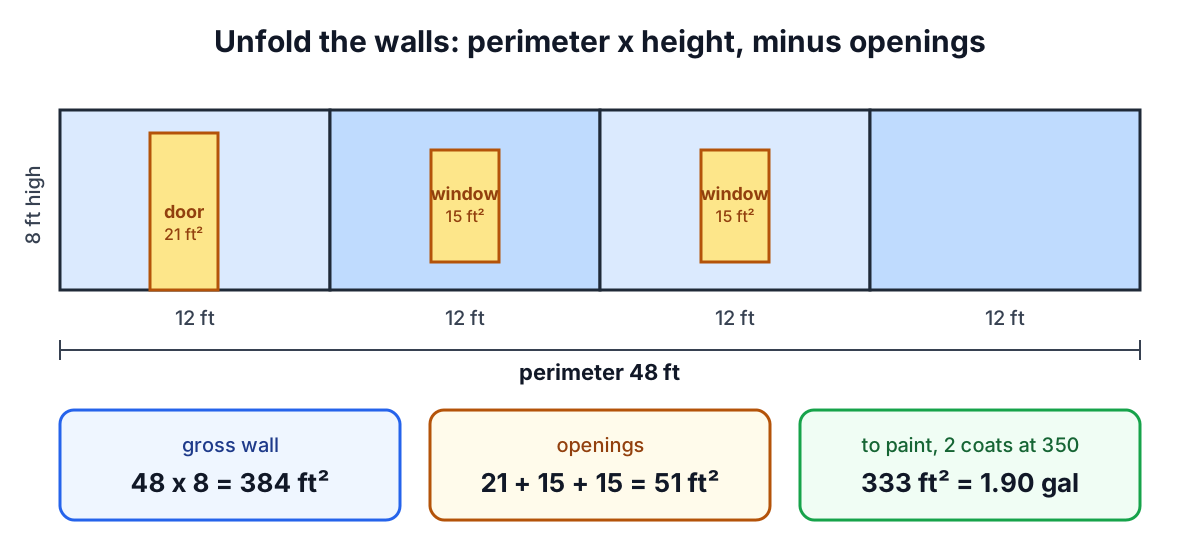
Paint covers surfaces, so start with the surfaces. For a rectangular room the four walls are one long strip folded into a box: the perimeter times the height.
wall area    = 2 x (length + width) x height
ceiling area = length x width
A 12 by 12 foot bedroom with 8 foot walls has a perimeter of 48 feet and 384 square feet of wall. The ceiling is another 144 square feet. In metric, a 5 by 4 metre living room with 2.5 metre walls has 45 square metres of wall and a 20 square metre ceiling.
Then take out what you are not painting. Doors and windows are the big ones. A standard interior door of 3 by 7 feet is 21 square feet and a typical 3 by 5 foot window is 15. In metric, a 0.9 by 2.1 metre door is about 1.9 square metres and a 1.2 metre square window about 1.44. The bedroom above, with one door and two windows, drops from 384 to 333 square feet of paintable wall. That is 13% less paint, which in a small room is the difference between one gallon and two.
Other areas worth subtracting are fireplaces, built-in shelving, a tiled splashback or a wall you are wallpapering instead. Small things such as switch plates are not worth the arithmetic.
Some painters do not subtract windows at all, on the grounds that cutting in around the frame uses extra paint. That is a reasonable margin, but it is better to be explicit about it: subtract the openings and add a percentage for touch-ups and cutting in, so you know where the extra comes from.
Step 2: decide the coats
Most wall jobs need two coats. The first coat covers most of the old colour, but it soaks in unevenly where the surface is more porous (patches of filler, bare joint compound, the edges you cut in with a brush). The second coat evens out the colour and sheen. The colour and durability figures a manufacturer quotes assume the full film thickness, which is usually two coats.
One coat can be enough when you are refreshing the same colour with a good paint, or painting a white ceiling white again. Three coats, or a primer and two coats, are common when going from a dark colour to a light one, or using some reds and yellows that hide poorly.
Primer is a separate product with its own coverage. Use it on new drywall and plaster (which absorb unevenly and can flash, showing joints through the paint), on stains, on glossy surfaces you need to key, and under big colour changes. Many "paint and primer in one" products are thicker paints that hide better, not a substitute for a real primer on bare drywall.
Step 3: read the coverage on the can
Coverage, or spreading rate, is the area one unit of paint covers in one coat at its intended thickness. For interior wall paint in the US it is usually printed as 350 to 400 square feet per gallon. Metric tins often say 10 to 14 square metres per litre for emulsions. These figures are for smooth, sealed surfaces.
The real figure on your wall depends on the surface:
| Surface | Typical real coverage per coat |
|---|---|
| Smooth, previously painted, same colour | 350 to 400 ft²/gal (10 to 12 m²/L) |
| Typical repaint with a colour change | about 350 ft²/gal (10 m²/L) |
| Light texture or a big colour change | about 300 ft²/gal (8 m²/L) |
| Bare drywall, fresh plaster, rough texture | 250 ft²/gal or less (6 m²/L) |
These are guides, not product data. The calculator uses the number you type, so if your can says 375, use 375.
Converting between the two systems is straightforward but easy to get wrong. One US gallon is 3.785 litres and one square foot is 0.0929 square metres, so 350 ft² per gallon is 350 x 0.0929 / 3.785 = 8.6 m² per litre. That is why a metric tin's "12 m²/L" sounds more generous than an American can's "400 ft²/gal" (9.8 m²/L): metric labels often quote a thinner film on an ideal surface.
Step 4: the arithmetic
With the area, the coats and the coverage, the paint is one line:
paint = (wall area x wall coats + ceiling area x ceiling coats) / coverage
For the bedroom: 333 x 2 / 350 = 1.90 gallons for the walls. Adding the ceiling with two coats is 144 x 2 / 350 = 0.82 gallons more, 2.73 gallons in total.
In metric, the 5 by 4 metre room has 45 - 1.9 - 2 x 1.44 = 40.2 square metres of wall. Two coats at 10 m² per litre is 8.04 litres.
If you are painting several rooms of the same size, multiply. If the surface is rough or you want a margin for touch-ups, add 5 to 10%.
Step 5: turn volume into cans
Paint is not sold by the decimal. In the US the common sizes are the quart (a quarter gallon), the gallon and the 5 gallon bucket. In metric markets tins come in 1, 2.5, 5 and 10 litres, sometimes with 750 ml and 2 litre sizes too.
The cheapest way to buy is usually the combination that gets closest to what you need without going under, with one exception: three quarts almost always cost more than one gallon, so once you would need a third quart you should buy a gallon instead. The calculator applies that rule. Its choices for the examples above are:
| Need | Buy | Total bought |
|---|---|---|
| 1.90 gal | 2 x 1 gal | 2.0 gal |
| 2.40 gal | 2 x 1 gal + 2 x 1 qt | 2.5 gal |
| 2.73 gal | 3 x 1 gal | 3.0 gal |
| 10.5 gal | 2 x 5 gal + 2 x 1 qt | 10.5 gal |
| 8.04 L | 5 L + 2.5 L + 1 L | 8.5 L |
For larger jobs a 5 gallon bucket is usually cheaper per gallon and guarantees that every wall comes from one batch. If you buy several gallons of a custom tint, pour them together into a bucket before you start (painters call this boxing) so small colour differences between cans do not show as a line on the wall.
A worked example from start to finish
A family room is 16 by 14 feet with 9 foot walls, two doors and three windows. You want two coats on the walls and one on the ceiling, and the walls are new drywall that needs a primer.
- Walls: 2 x (16 + 14) x 9 = 540 ft². Openings: 2 x 21 + 3 x 15 = 87 ft². Net 453 ft².
- Ceiling: 16 x 14 = 224 ft².
- Primer: one coat on 453 + 224 = 677 ft² at 300 ft² per gallon = 2.26 gallons. Buy 2 gallons and 2 quarts.
- Wall paint: 453 x 2 / 350 = 2.59 gallons. Buy 3 gallons.
- Ceiling paint: 224 / 350 = 0.64 gallons of ceiling white. Buy 1 gallon, or 3 quarts if your store prices them well (the calculator would say one gallon).
In the calculator, set walls and ceiling with the ceiling coats at 1 to get the combined figure, or run walls and ceiling separately when they are different products.
Common mistakes
- Using floor area. A 144 square foot floor has 384 square feet of wall around it at 8 feet high. Paint quantities scale with the walls, not the floor.
- Forgetting the second coat. It doubles the paint, and it is almost always needed for a colour change.
- Trusting the best-case coverage on a rough surface. Textured ceilings, block walls and bare plaster drink paint.
- Buying in odd batches. Two gallons bought a week apart may not match. Buy the whole job at once and keep the batch label.
- Including trim. Doors, frames and skirting are usually a different sheen and colour. Estimate them separately; a quart covers a surprising amount of trim.
When an estimate is not enough
For exterior work, siding profiles, stucco and masonry, coverage varies too much for a rule of thumb. Look up the product data sheet, which lists a spreading rate range and the recommended film thickness, and consider asking the store to estimate from photos. For lead paint in homes built before 1978, the US EPA Renovation, Repair and Painting Rule sets work practices for any disturbance of painted surfaces; follow it before sanding or scraping.
Sources and further reading
- Coverage figures printed on interior wall paint cans and product data sheets from major manufacturers (typically 350 to 400 ft² per gallon on smooth surfaces).
- US EPA, Lead Renovation, Repair and Painting Program, for older homes.
- Unit definitions: 1 US gallon = 3.785411784 L (NIST Handbook 44), 1 ft = 0.3048 m exactly.
Try your own room in the Paint Calculator. If you are papering one wall instead, the Wallpaper Calculator uses the same measurements, and the Square Footage Calculator helps with odd-shaped rooms.
Related searches
- how much paint do i need
- paint coverage per gallon
- how much paint for a 12x12 room
- one coat or two coats of paint
- how much primer for drywall
- quarts vs gallon paint
- paint litres per square metre
- subtract doors and windows paint