
How to Estimate Fence Posts, Pickets, Rails and Concrete
The fence-post counting rule, how gates and corners change it, picket and rail counts for privacy and spaced fences, and how much concrete each post hole takes.
· 10 min read
A fence looks like simple multiplication, and the first number most people get wrong is the posts. Divide 100 feet by 8 and you get 12.5, round up to 13, and you are already one post short, because a line of 13 sections has 14 posts. Then a gate and a couple of corners change the count again. This guide works through the post count, the rails and pickets, panels, and the concrete in every hole, using the same rules as the Fence Calculator.
The fence-post rule
A straight run divided into sections always has one more post than sections, the same reason a 10 metre row of trees planted every metre has 11 trees, not 10. Mathematicians call it the fencepost problem, and it is the origin of countless off-by-one errors in code as well as in yards.
Sections come from the maximum post spacing. Wood privacy fences are usually built with posts 6 to 8 feet on centre (about 1.8 to 2.4 metres), because 8 foot boards are a stock rail length and a longer span lets the rails sag. If a run does not divide evenly, you do not build a stub section at the end; you round the number of sections up and space the posts evenly:
sections = ceiling(run length / maximum spacing)
section length = run length / sections
posts = sections + 1
A 50 foot run at 8 foot maximum spacing is ceiling(6.25) = 7 sections of 7.14 feet, with 8 posts.
Gates add a post
A gate opening splits a run into two pieces of fence with the gate between them. Each piece needs posts at both ends, and the two posts either side of the gate are separate posts, so a gate adds exactly one post compared with an unbroken run of the same total.
Take 100 feet with one 4 foot gate. The fence itself is 96 feet. Spread evenly, that is two 48 foot pieces of six 8 foot sections each: 12 sections. Posts are 12 sections plus 1 for the run plus 1 for the gate, 14 in total. Without the gate the same 100 feet would be 13 sections and also 14 posts; the gate replaced one section of fence.
Where the gate sits matters a little. If it is off-centre, say 50 feet from one end, the pieces are 50 and 46 feet, which round up to 7 and 6 sections: 13 sections and 15 posts. The calculator assumes gates are spaced evenly, which gives the fewest posts, and shows each run's sections so you can check your plan.
Corners are shared
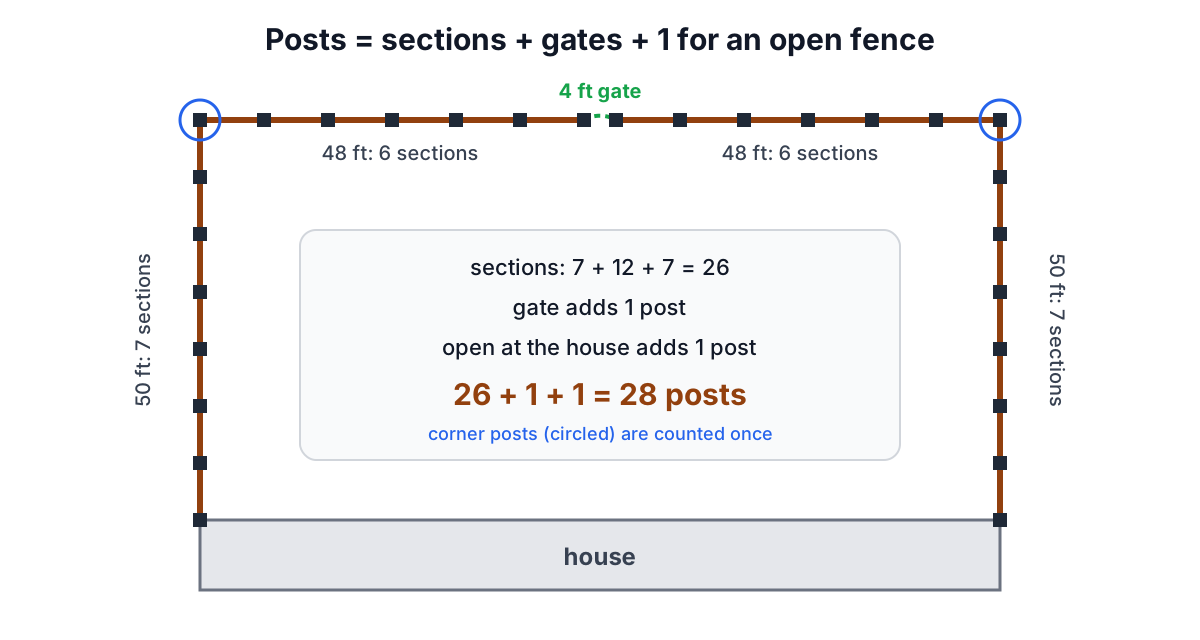
A corner post finishes one run and starts the next, so it is counted once. For a fence that starts at the house, goes round three sides of a yard and ends at the house again, the post count is the sum of every run's sections plus one. For a fence that closes on itself, like a dog run, the last run finishes at the first post and the count is just the sum of the sections.
| Layout | Runs | Sections | Posts |
|---|---|---|---|
| Straight 64 ft | 64 | 8 | 9 |
| Straight 100 ft, one 4 ft gate | 100 (1 gate) | 12 | 14 |
| Three sides, open at the house | 50, 100, 50 | 7 + 13 + 7 = 27 | 28 |
| Same, 4 ft gate in the back | 50, 100 (1 gate), 50 | 7 + 12 + 7 = 26 | 28 |
| Closed square | 4 x 50 | 28 | 28 |
All at 8 foot maximum spacing. Corners only add posts indirectly, because each run is rounded up to whole sections on its own.
Rails and pickets
A stick-built fence has horizontal rails between the posts and vertical pickets (boards) nailed to the rails. Two rails are typical up to about 4 feet high and three for a 6 foot privacy fence; very tall or heavy fences sometimes get four. Rails = sections x rails per section.
Pickets depend on the board width and the gap between boards. A 1x6 board is 5.5 inches wide in reality, and a 1x4 is 3.5. For each section:
pickets per section = ceiling(section length / (picket width + gap))
A privacy fence with 5.5 inch boards butted together needs 96 / 5.5 = 17.45, so 18 boards per 8 foot section. A picket fence of 3.5 inch boards with 2.5 inch gaps has a 6 inch pitch, so 16 per section. Shadowbox and board-on-board styles overlap the boards on both sides of the rails; count them as two layers of spaced pickets.
Lumber is not perfect. Boards split when nailed near the ends and some arrive warped, so add a few percent. For the 100 foot privacy fence with one gate, 3 rails and 5% extra the list is 38 rails and 227 pickets.
Panels
Prefabricated panels, in wood, vinyl or metal, fix the spacing for you. Each section is one panel, so panels = sections, and the post spacing is the panel width measured between post centres. Check the manufacturer's figure: a nominal 8 foot wood panel is usually set on 8 foot centres, while many vinyl systems are 6 feet wide and slot into routed posts with their own spacing. Gates are usually sold separately in matching styles.
Post length and hole depth
Posts must go deep enough to resist wind on a solid fence and to sit below the frost line, where freezing soil cannot heave them. A common rule from post and concrete manufacturers is a hole depth of a third to a half of the post height above ground, so 2 to 3 feet for a 6 foot fence, and deeper where your local frost depth is greater. Gate posts, which are pushed sideways by the swinging gate, benefit from the deeper end and from a larger post.
The post length is the fence height plus the hole depth. A 6 foot fence with 2 foot holes needs 8 foot posts, a stock length. With 3 foot holes you need 9 foot posts, which usually means buying 10 footers.
Concrete per post
The concrete fills the hole around the post. The usual rule for the hole is a diameter about three times the post width, so roughly 10 to 12 inches for a 4x4 (which is 3.5 inches square). The volume is a cylinder minus the post:
concrete = pi x (hole diameter / 2)^2 x depth - post width^2 x depth
For a 10 inch hole 24 inches deep around a 4x4: the cylinder is pi x 5^2 x 24 = 1,885 cubic inches, the post takes 3.5 x 3.5 x 24 = 294, leaving 1,591 cubic inches, or 0.92 cubic feet.
Bags are sold by weight but should be counted by yield. The QUIKRETE and Sakrete data sheets give about 0.60 cubic feet for an 80 lb bag of concrete mix, 0.45 for 60 lb and 0.30 for 40 lb. Fast-setting post mix in a 50 lb bag yields about 0.375 cubic feet.
| Hole | Concrete per post | 80 lb bags | 50 lb fast-setting |
|---|---|---|---|
| 10 in x 24 in, 4x4 post | 0.92 ft³ | 2 | 3 |
| 12 in x 24 in, 4x4 post | 1.40 ft³ | 3 | 4 |
| 12 in x 36 in, 4x4 post | 2.10 ft³ | 4 | 6 |
| 14 in x 36 in, 6x6 post | 2.58 ft³ | 5 | 7 |
The bag count per post is rounded up for each post; when you mix in a wheelbarrow, you can share bags between holes, so the calculator also gives a total for the whole fence. For 14 posts in 10 inch holes that is 12.9 cubic feet, or 22 bags of 80 lb rather than 28.
Many installers put a few inches of gravel in the bottom of each hole for drainage before setting the post. That reduces the concrete slightly; leave it out of the estimate as a margin.
A worked materials list
A 6 foot privacy fence round three sides of a yard: 50, 100 and 50 feet, a 4 foot gate in the back run, posts on 8 foot centres, 3 rails, 1x6 pickets, 4x4 posts in 10 inch holes 24 inches deep.
- Sections: 7 + 12 + 7 = 26. Posts: 26 + 1 (gate) + 1 (open run) = 28. The gate took the place of one section, so the count matches the same yard without a gate.
- Posts 8 feet long (6 ft + 2 ft).
- Rails: 26 x 3 = 78, plus 5% = 82.
- Pickets: the 50 foot runs have 7.14 foot sections at ceiling(85.7 / 5.5) = 16 boards, and the back run 8 foot sections at 18 boards. 7 x 16 + 12 x 18 + 7 x 16 = 440, plus 5% = 462.
- Concrete: 28 posts x 0.92 ft³ = 25.8 ft³, about 43 bags of 80 lb.
Plus the gate itself, hinges, a latch, and fasteners: about two nails or screws per picket per rail.
Before you dig
- Call 811 in the US (or your local utility locating service) a few days before digging.
- Check property lines; a survey or the plat map avoids a fence on the neighbour's land.
- Check height limits and permit rules with your local building department or homeowners association. Front-yard fences are often limited to 3 or 4 feet.
- Set the end, corner and gate posts first, stretch a string line between them, then set the line posts to the string.
Sources and further reading
- QUIKRETE Concrete Mix and Fast-Setting Concrete Mix product data (yields per bag).
- Sakrete Concrete Mix product data (0.6 cubic feet per 80 lb bag).
- Local building codes and frost depth maps for post depth.
Run your own layout in the Fence Calculator. For larger concrete jobs see the Concrete Calculator, and for lumber pricing the Board Foot Calculator.
Related searches
- how many fence posts do i need
- fence post spacing
- how many pickets per section
- concrete per fence post
- fence post depth
- fence post hole diameter
- fence materials list
- fence gate posts