
ISO Week Numbers Explained: Week 1, Week 53 and the US System
Why 29 December can be in week 1, which years have 53 ISO weeks, how US and Excel week numbers differ from ISO 8601, and how to compute each by hand or in code.
· 9 min read

Ask three people what week number 29 October 2026 falls in and you can get two different answers, both correct. A European project plan says week 44. A US payroll report says week 44 too, but a C program printing %U says 43. On 1 January 2027 the gap is wider: the ISO calendar says week 53 of 2026, while the US system says week 1 of 2027. Week numbers are not a single standard but a family of conventions that agree most of the year and disagree at the edges. This guide explains the ISO 8601 rule, the US and Excel rules, the strftime rules used by programmers, and how to tell which one a document is using. Every date below was checked with the Week Number Calculator, which shows all of these systems side by side.
The ISO 8601 rule in one sentence
ISO 8601, the international standard for writing dates and times, defines the week this way: weeks start on Monday, and week 1 of a year is the week that contains that year's first Thursday. Two equivalent ways of saying the same thing are "week 1 is the week containing 4 January" and "week 1 is the first week with at least four days in the new year".
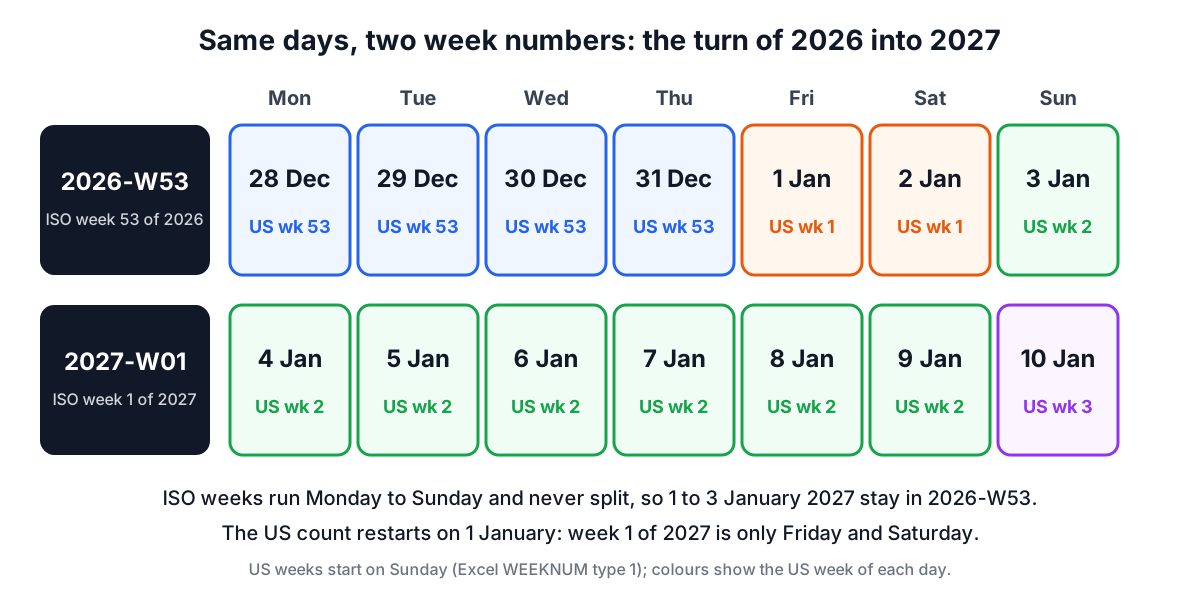
The consequences follow directly. Because weeks never split, every ISO week has exactly seven days. Because the year boundary moves to a Monday, the first few days of January can belong to the last week of the previous year, and the last few days of December can belong to week 1 of the next. That is why ISO 8601 has the idea of a week-numbering year, which can differ from the calendar year for up to three days at each end.
The full ISO week date is written YYYY-Www-D, where YYYY is the week-numbering year, ww the week and D the weekday from 1 (Monday) to 7 (Sunday). So Thursday 29 October 2026 is 2026-W44-4, and Friday 1 January 2027 is 2026-W53-5.
Why some years have 53 ISO weeks
A common year has 365 days, which is 52 weeks and one day; a leap year has 52 weeks and two days. Those leftover days accumulate until a year needs a 53rd week. Under the ISO rule this happens when 1 January is a Thursday, or when it is a Wednesday in a leap year. In both cases the year contains 53 Thursdays, and each ISO week is owned by the year of its Thursday.
The calculator's own check is simpler: 28 December always falls in the last ISO week of its year, so the week number of 28 December is the number of weeks in the year.
| Year | 1 January | ISO weeks | Note |
|---|---|---|---|
| 2025 | Wednesday | 52 | Common year, so a Wednesday start is not enough |
| 2026 | Thursday | 53 | Week 53 runs 28 Dec 2026 to 3 Jan 2027 |
| 2027 | Friday | 52 | 1 to 3 January 2027 belong to 2026-W53 |
| 2028 | Saturday | 52 | Leap year, but starts on a Saturday |
| 2032 | Thursday | 53 | Next long ISO year after 2026 |
Long years arrive 71 times in each 400-year cycle of the Gregorian calendar, roughly every five or six years. If you run quarterly reports on 13-week quarters, the 53rd week has to go somewhere, usually into the final quarter, and that quarter is then a week longer than the year before.
How to calculate the ISO week by hand
The method the calculator uses is short enough to do on paper:
- Find the weekday of your date as a number from 1 (Monday) to 7 (Sunday).
- Move to the Thursday of the same week: subtract the weekday number and add 4.
- The year of that Thursday is the ISO year.
- Take the Thursday's day of the year (1 for 1 January), subtract 1, divide by 7, drop the remainder and add 1. That is the week number.
Worked example for 29 October 2026, a Thursday. The weekday number is 4, so the Thursday is the date itself. It is day 302 of 2026. (302 minus 1) divided by 7 is 43 with remainder 0, plus 1 gives week 44. The ISO week date is 2026-W44-4.
Worked example for Sunday 3 January 2021. The weekday number is 7, so the Thursday of that week is 3 January minus 7 plus 4, which is 31 December 2020. The ISO year is therefore 2020, and 31 December 2020 is day 366 of a leap year. (366 minus 1) divided by 7 is 52 remainder 1, plus 1 gives week 53. The answer is 2020-W53-7, which is why software that prints a plain "week 53" on a January date is usually correct, not broken.
The US convention and Excel's WEEKNUM
In the United States and Canada, calendars and many business systems start the week on Sunday and call the week containing 1 January "week 1", however short it is. Excel's WEEKNUM(date, 1), the default, follows this rule, and so does the "US week" line in the calculator. WEEKNUM(date, 2) is the same idea with Monday as the first day.
Because the year always restarts on 1 January, the US system never borrows days from a neighbouring year. The price is that the first and last weeks are often partial, and a year usually has 53 week numbers, occasionally 54 (a leap year starting on Saturday reaches 54 when weeks begin on Sunday). In 2026, US week 1 is Thursday 1 January to Saturday 3 January, just three days, and week 53 is Sunday 27 December to Thursday 31 December.
Excel also has ISOWEEKNUM(date) and WEEKNUM(date, 21), both of which return the ISO week. If a spreadsheet and a European colleague disagree, check which function the sheet uses.
strftime: week 0 and the %U, %W and %V codes
Programmers meet a third family through the C library function strftime and its descendants in Python, PHP, Ruby and the Unix date command:
%Ucounts weeks starting on Sunday. Days before the year's first Sunday are in week 0.%Wis the same with Monday. Days before the first Monday are in week 0.%Vis the ISO week number, and it must be paired with%G, the ISO week-numbering year, not%Y.
The week 0 rule explains the off-by-one result in the introduction. 2026 starts on a Thursday, so 1 to 3 January are week 0 under %U, and every later week is one lower than the US week number: 29 October 2026 is %U 43 but US week 44.
The classic bug is formatting %Y-W%V. On 3 January 2021 that prints 2021-W53, a week that does not exist, because the calendar year is 2021 but the ISO week belongs to 2020. The correct format is %G-W%V, which gives 2020-W53.
The same dates under every system
| Date | ISO 8601 | US / WEEKNUM(,1) | WEEKNUM(,2) | %U | %W |
|---|---|---|---|---|---|
| Thu 1 Jan 2026 | 2026-W01-4 | 1 | 1 | 0 | 0 |
| Mon 29 Dec 2025 | 2026-W01-1 | 53 | 53 | 52 | 52 |
| Thu 29 Oct 2026 | 2026-W44-4 | 44 | 44 | 43 | 43 |
| Thu 31 Dec 2026 | 2026-W53-4 | 53 | 53 | 52 | 52 |
| Fri 1 Jan 2027 | 2026-W53-5 | 1 | 1 | 0 | 0 |
| Sun 3 Jan 2027 | 2026-W53-7 | 2 | 1 | 1 | 0 |
| Mon 30 Dec 2024 | 2025-W01-1 | 53 | 53 | 52 | 53 |
Read down the ISO column and the week runs smoothly across New Year. Read down the others and the count resets on 1 January. Monday 29 December 2025 is the cleanest example of a calendar-year mismatch: it is the first day of ISO week 1 of 2026, while every other system still places it at the end of 2025.
Which system should you use?
Use ISO 8601 when weeks cross borders or systems: European business, manufacturing and logistics, academic timetables in many countries, and any data interchange where a week label must mean exactly one Monday-to-Sunday span. Most of Europe prints ISO week numbers on wall calendars, and planning tools that say "KW 44" (German Kalenderwoche) or "v.44" (Swedish vecka) mean the ISO week.
Use the US convention when the audience is North American and the week is a payroll or retail period that must not straddle a year end. If you are not sure what a report means by "week 1", the fastest test is to ask which week 1 January belongs to in a year where it falls on Friday, Saturday or Sunday. If the answer is week 1, it is a US-style count; if it is week 52 or 53 of the previous year, it is ISO.
Three practical tips:
- Always write the year with the week. "Week 1" is ambiguous;
2026-W01is not. - When you see a date in the first or last week of a year, check the ISO year separately from the calendar year.
- When a fiscal year starts in another month, neither system applies directly; the 4-4-5 calendars used in retail are their own convention.
Using the calculator
The Week Number Calculator opens on today's date and shows the ISO week, the full ISO week date with its Monday and Sunday, the US week with its (possibly partial) start and end, the Excel Monday-start week, %U and %W, the day of the year and the quarter. When a date belongs to a different ISO year from its calendar year it says so in plain words.
Underneath, "Dates in a week" works the other way round: type an ISO year and week, or a US year and week, and it lists the seven dates (or fewer for a partial US week). The week calendar at the bottom lists every week of the year with its start and end, with the selected week highlighted, which is handy for printing a planning sheet. Everything runs in the browser using whole-day arithmetic, so time zones and daylight-saving changes cannot shift a result.
For the weekday of a date far in the past or future, and the hand methods behind it, read how to find the day of the week for any date. To add or subtract weeks from a date, the Date Arithmetic tool does that directly, and Date Difference counts the days or weeks between two dates.
Sources
- ISO 8601-1:2019, Date and time: Representations for information interchange, Part 1: Basic rules (calendar week and week date representations).
- Microsoft Support, "WEEKNUM function" and "ISOWEEKNUM function" (return types 1, 2 and 21).
- Python documentation,
datetimemodule, "strftime() and strptime() Format Codes" (%U,%W,%G,%V), anddate.isocalendar(). - The Open Group Base Specifications, Issue 7,
strftime(definitions of%U,%W,%Vand%G).
Related searches
- iso week number
- what week number is it
- which years have 53 weeks
- iso 8601 week date format
- excel weeknum vs isoweeknum
- us week number sunday start
- strftime %u %w %v difference
- week 1 of the year rule