
Kinetic Energy: ½mv², Speed Squared and Where the Energy Goes
Why kinetic energy grows with the square of speed, how it trades with potential energy mgh, momentum versus energy in crashes, unit conversions and when relativity matters.
· 9 min read

Kinetic energy is the energy an object has because it is moving. It is the work you must do to bring a mass from rest up to a speed, and exactly the work it will do on whatever stops it. The formula is short, KE = ½mv², but the square on the speed has consequences that show up everywhere from braking distances to bullet design. This post explains where the formula comes from, how it connects to potential energy, how it differs from momentum, and how to convert between the many units energy is quoted in. Every number below can be checked in the Kinetic Energy Calculator.
Where ½mv² comes from
Push a mass m with a constant net force F over a distance d. Newton's second law says it accelerates at a = F ÷ m, and the kinematics of constant acceleration give v² = 2ad for a start from rest. The work done, force times distance, is therefore:
W = F × d = (m a) × (v² ÷ 2a) = ½ m v²
That work has not disappeared; it is stored in the motion, and we call it kinetic energy. The derivation does not depend on the force being constant, which is why the result holds for any way of getting up to speed. The modern form, with the factor of a half, was set out by the French engineer Gaspard-Gustave Coriolis in 1829, who also gave "work" its technical meaning.
The SI unit is the joule: one newton acting over one metre, or equivalently one kilogram moving at about 1.41 m/s. Use kilograms and metres per second in the formula and the answer comes out in joules with no further conversion.
Worked example: a family car
A 1,500 kg car at 50 km/h. First convert the speed: 50 ÷ 3.6 = 13.889 m/s. Then:
KE = ½ × 1,500 × 13.889² = 750 × 192.9 = 144,676 J, or about 145 kJ.
Run it backwards and you can find the speed behind a given energy, v = √(2 KE ÷ m), or the mass, m = 2 KE ÷ v². A 2 kg object carrying 100 J is moving at √(200 ÷ 2) = 10 m/s.
Speed squared: why small increases matter
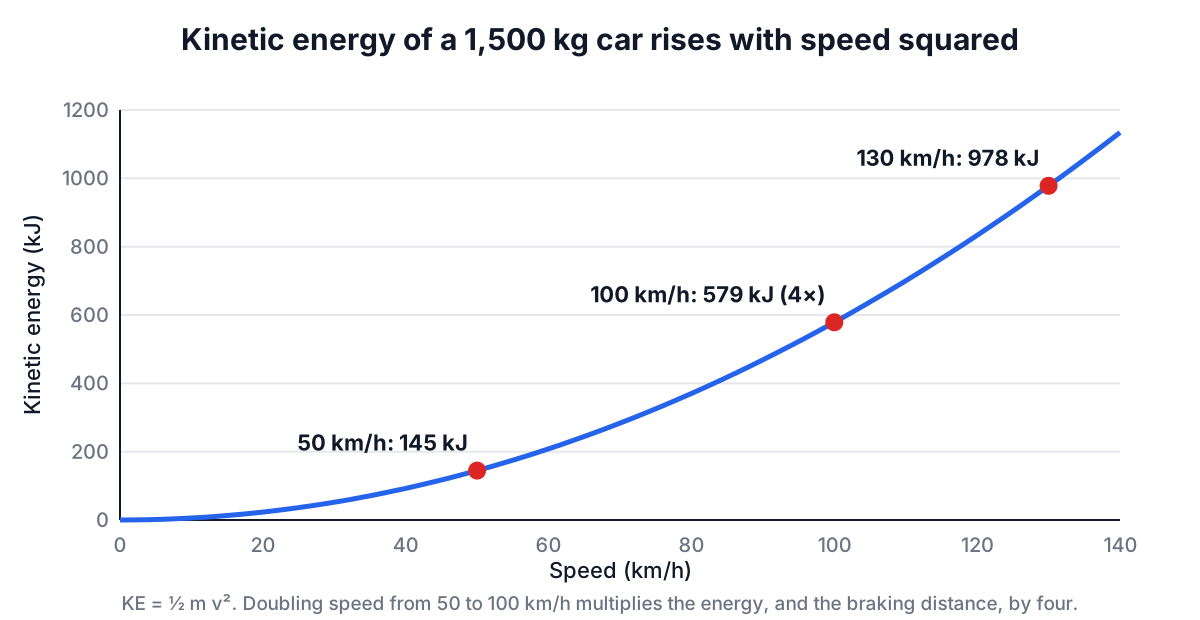
Because speed is squared, energy grows much faster than speed. The chart shows the same 1,500 kg car from standstill to 140 km/h.
| Speed | m/s | Kinetic energy | Same as a fall from |
|---|---|---|---|
| 30 km/h | 8.33 | 52.1 kJ | 3.5 m |
| 50 km/h | 13.89 | 144.7 kJ | 9.8 m |
| 80 km/h | 22.22 | 370.4 kJ | 25.2 m |
| 100 km/h | 27.78 | 578.7 kJ | 39.3 m |
| 130 km/h | 36.11 | 978.0 kJ | 66.5 m |
Doubling the speed from 50 to 100 km/h quadruples the energy. The brakes have to remove all of it as heat, and if the tyres can decelerate the car at a fixed rate, the braking distance (v² ÷ 2a) also quadruples: at 7 m/s², roughly a good dry road, 13.8 m from 50 km/h becomes 55.1 m from 100 km/h, before adding the distance covered during the driver's reaction time.
The last column is the height the car would have to be dropped from to hit the ground at that speed, v² ÷ 2g. It is a vivid way to explain crash energy: a 50 km/h impact carries the energy of falling from a third-floor window.
Potential energy and the energy exchange
Lift a mass m through a height h near the Earth's surface and you do work m × g × h against gravity. That energy is stored as gravitational potential energy, PE = mgh, and it comes back as kinetic energy when the object falls. With no air resistance:
m g h = ½ m v², so v = √(2 g h)
The mass cancels, which is the energy-based version of Galileo's observation that objects fall at the same rate. Ten kilograms raised 5 m stores 10 × 9.80665 × 5 = 490.3 J, and if dropped it lands at √(2 × 9.80665 × 5) = 9.90 m/s.
Two practical notes. First, only height differences matter; you can put zero at the floor, the table or sea level, as long as you are consistent. Second, mgh assumes g is constant. Gravity weakens with height as (R ÷ (R + h))², so the error stays under 0.1% for heights below about 3 km. For satellites and rockets, use the full form −GMm ÷ r.
On other worlds g changes and so does the energy. The same 10 kg lifted 5 m on the Moon (g = 1.62 m/s²) stores only 81 J. The calculator's potential energy tab has presets for the Moon, Mars, Venus, Mercury and Jupiter, with values from the NASA planetary fact sheets.
Kinetic energy versus momentum
Momentum, p = mv, and kinetic energy, ½mv², are both built from mass and velocity, and students often mix them up. They answer different questions.
- Momentum is always conserved in a collision between two objects, as long as no outside force acts. It tells you how fast the wreckage moves afterwards.
- Kinetic energy is conserved only in perfectly elastic collisions. In real crashes much of it becomes heat, sound and bent metal.
Take the 1,500 kg car at 50 km/h running into an identical stationary car, with the two locking together. Momentum before is 1,500 × 13.889 = 20,833 kg·m/s; afterwards 3,000 kg share it, so they move at 6.944 m/s (25 km/h). The kinetic energy afterwards is ½ × 3,000 × 6.944² = 72.3 kJ, exactly half of the original 144.7 kJ. The missing 72.3 kJ went into crumpling both cars.
The distinction also explains recoil. An 8 g bullet at 360 m/s has 518 J of kinetic energy but only 2.88 kg·m/s of momentum. A 1 kg pistol receives the same momentum in the opposite direction, which gives it a speed of 2.88 m/s and an energy of only 4.1 J. Same momentum, very different energies, because the lighter object takes the larger share of the energy.
Units of energy
Energy shows up in many units depending on the field. The calculator converts between all of these:
| Unit | In joules | Where you see it |
|---|---|---|
| joule (J) | 1 | Physics, engineering |
| kilowatt-hour (kWh) | 3,600,000 | Electricity bills, batteries |
| kilocalorie (kcal, food Calorie) | 4,184 | Food labels |
| calorie (thermochemical) | 4.184 | Chemistry |
| British thermal unit (BTU, IT) | 1,055.06 | Heating, air conditioning |
| foot-pound-force (ft·lbf) | 1.3558 | US mechanics, firearms |
| electronvolt (eV) | 1.602176634 × 10⁻¹⁹ | Atomic and particle physics |
The kilocalorie line gives a useful sense of scale. The car at 50 km/h carries 145 kJ, which is only about 35 kcal, the energy in a small biscuit. Food is remarkably energy-dense; the reason a car can do damage is that it releases its energy in a fraction of a second.
Rotation adds energy too
½mv² counts the energy of an object's centre of mass moving in a straight line. A spinning object has rotational kinetic energy as well, ½Iω², where I is the moment of inertia and ω the angular speed. A solid ball rolling without slipping has I = (2/5)mr² and ω = v ÷ r, so its rotational energy is 0.4 × ½mv²: 40% more energy than the same ball sliding at the same speed. That is why a ball rolling down a ramp is slower at the bottom than a frictionless block released from the same height; some of the potential energy went into spin.
When relativity matters
½mv² is the low-speed approximation of Einstein's result, KE = (γ − 1)mc², where γ = 1 ÷ √(1 − v² ÷ c²). For small speeds the two agree almost perfectly:
| Speed | ½mv² underestimates by |
|---|---|
| 300 km/s (0.1% of c) | 0.00008% |
| 3,000 km/s (1% of c) | 0.0075% |
| 0.1 c | 0.76% |
| 0.5 c | 23.8% |
Even the fastest spacecraft so far travel well below 1% of the speed of light, so for anything outside a particle accelerator the classical formula is exact for practical purposes. The calculator computes the relativistic value with a series expansion at low speeds, so it does not suffer from rounding, and warns you once you pass 1% of c.
Common mistakes
- Forgetting to convert km/h or mph to m/s. Divide km/h by 3.6 and multiply mph by 0.44704. Leaving the speed in km/h inflates the answer by a factor of 13.
- Using grams. The joule is built on kilograms; 8 g is 0.008 kg.
- Dropping the half. mv² is twice the kinetic energy.
- Using weight instead of mass. A "70 kg" person has a mass of 70 kg, not 686 N.
- Adding kinetic energies of objects moving towards each other. Each object's energy depends on its own speed in the frame you choose. Closing speed matters for the collision, not for the energy of either car on its own.
Putting it to use
The Kinetic Energy Calculator solves for energy, mass or speed in any of the units above, shows momentum and the equivalent drop height, and has a potential energy tab with planet presets. For a falling object with air resistance, the Free Fall Calculator works out the real impact speed; for an object thrown at an angle, use the Projectile Motion Calculator; and the Force Calculator handles the F = ma side of the same problems.
Sources
- BIPM, The International System of Units (SI Brochure), 9th edition, 2019: definitions of the joule and the exact value of the elementary charge used for the electronvolt.
- CGPM, 3rd General Conference (1901): standard acceleration of gravity, 9.80665 m/s².
- NASA Goddard Space Flight Center, Planetary Fact Sheet: surface gravity of the Moon and planets.
- NIST Special Publication 811, Guide for the Use of the International System of Units: conversion factors for the calorie, BTU and foot-pound-force.
- G.-G. Coriolis, Du calcul de l'effet des machines, 1829.
Related searches
- kinetic energy formula
- how to calculate kinetic energy
- velocity from kinetic energy
- kinetic energy of a car
- potential energy mgh
- kinetic energy vs momentum
- joules to kwh
- relativistic kinetic energy