
Morse Code: The Alphabet, Timing Rules and How to Learn It
International Morse from the telegraph to ITU-R M.1677-1, the dot-dash-gap timing, why PARIS sets the speed, Farnsworth spacing worked out, prosigns like SOS, and a learning plan.
· 11 min read
Morse code is older than the telephone and still in daily use by radio amateurs, in aviation navigation beacons that identify themselves in Morse, and by anyone who has tapped out SOS. It is also a neat piece of information design: frequent letters are short, rare ones are long, and the whole system is defined by a few timing rules. This guide covers the alphabet, the timing standard, how speed is measured, Farnsworth spacing with the arithmetic worked out, prosigns, and a realistic way to learn it. You can try every example in the Morse Code Translator, which plays the code as sound and light.
From telegraph to ITU standard
Samuel Morse and his collaborator Alfred Vail built their code for the electric telegraph in the late 1830s. On 24 May 1844 Morse sent "What hath God wrought" over the first long-distance line, from Washington to Baltimore. That original American Morse code used dots, dashes of two lengths and internal spaces inside some letters, which made it awkward on radio and undersea cables.
In 1848 Friedrich Clemens Gerke simplified it for German telegraph lines, removing the internal spaces and the long dash. His version was adopted across Europe and, from the 1865 International Telegraph Conference in Paris, became International Morse code. Today it is defined by the International Telecommunication Union in Recommendation ITU-R M.1677-1. The newest addition is the @ sign, .--.-., added in 2004 so email addresses could be sent; it combines A and C (.- and -.-.) run together.
Morse's role has shrunk. The maritime Global Maritime Distress and Safety System replaced Morse for distress at sea in 1999, and licensing bodies dropped the Morse test for amateur radio over the following decade (the ITU removed the requirement in 2003 and the US FCC in 2007). Yet many hams still use it by choice, because a narrow Morse signal gets through noise that defeats voice.
The alphabet
Morse assigned short codes to common letters, judged partly by the amount of type in a printer's case. E, the most common letter in English, is a single dot; T is a single dash. Q, J, X, Y and Z are four symbols long.
| Letter | Code | Letter | Code | Digit | Code |
|---|---|---|---|---|---|
| A | .- | N | -. | 1 | .---- |
| B | -... | O | --- | 2 | ..--- |
| C | -.-. | P | .--. | 3 | ...-- |
| D | -.. | Q | --.- | 4 | ....- |
| E | . | R | .-. | 5 | ..... |
| F | ..-. | S | ... | 6 | -.... |
| G | --. | T | - | 7 | --... |
| H | .... | U | ..- | 8 | ---.. |
| I | .. | V | ...- | 9 | ----. |
| J | .--- | W | .-- | 0 | ----- |
| K | -.- | X | -..- | ||
| L | .-.. | Y | -.-- | ||
| M | -- | Z | --.. |
Digits follow a pattern: five symbols, with dots turning into dashes from the left for 1 to 5 and dashes turning into dots for 6 to 0. Punctuation in the ITU recommendation includes full stop .-.-.-, comma --..--, colon ---..., question mark ..--.., apostrophe .----., hyphen -....-, slash -..-., brackets -.--. and -.--.-, quotation mark .-..-., equals or break -...-, plus .-.-. and @ .--.-.. The exclamation mark -.-.-- is widely used but not in the ITU list, which is why the translator marks it as an extra.
The timing rules
International Morse is defined in units of time, not just as dots and dashes:
- a dot lasts 1 unit
- a dash lasts 3 units
- the gap between the dots and dashes of one letter is 1 unit
- the gap between letters is 3 units
- the gap between words is 7 units
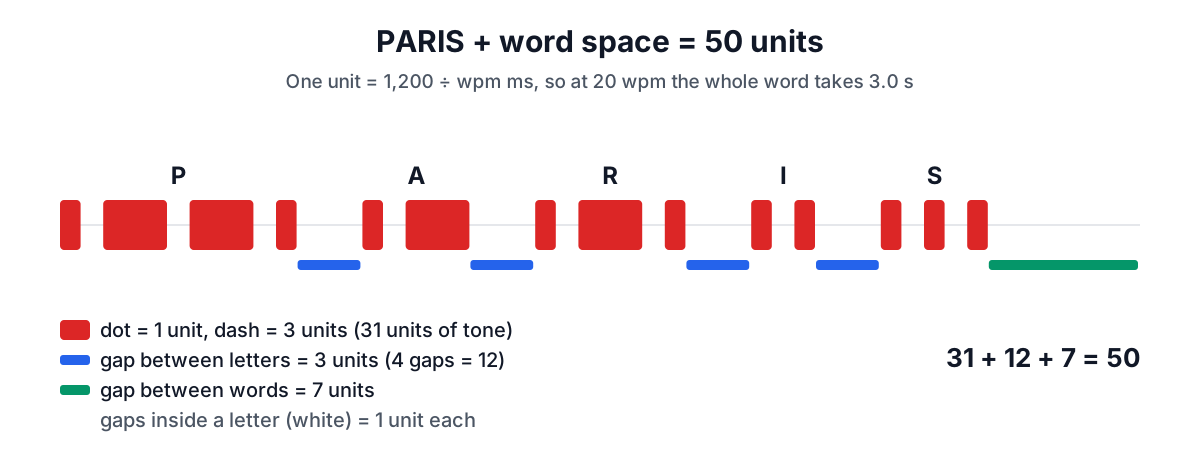
Those ratios are what make Morse readable by ear. A listener recognises a letter as a rhythm; if the gaps inside letters are stretched, .- starts to sound like E followed by T.
How speed is measured: PARIS
Speed is quoted in words per minute, but words vary in length, so the convention uses a standard word, PARIS. Counting units:
- P
.--.: 1 + 1 + 3 + 1 + 3 + 1 + 1 = 11 - A
.-: 1 + 1 + 3 = 5 - R
.-.: 1 + 1 + 3 + 1 + 1 = 7 - I
..: 1 + 1 + 1 = 3 - S
...: 1 + 1 + 1 + 1 + 1 = 5 - four letter gaps of 3 = 12, and one word gap of 7
That totals 31 + 12 + 7 = 50 units. Sending PARIS w times a minute means 50w units per minute, so one unit lasts 60 ÷ (50w) seconds, or:
unit (ms) = 1,200 ÷ wpm
At 20 wpm a dot is 60 ms and a dash 180 ms, and PARIS with its trailing space takes exactly 3 seconds. At 5 wpm the dot is 240 ms. (A second standard word, CODEX, is 60 units long and is sometimes used for code groups; it gives speeds about 17% lower for the same unit length.)
Farnsworth spacing, worked out
Learners who start at 5 wpm with full-length letters tend to count dots, which becomes a dead end around 10 wpm. Farnsworth spacing, named after the amateur Donald R. Farnsworth, fixes this by sending each letter at a fast character speed c while stretching only the gaps between letters and words so the overall speed s is lower.
The formula used by the ARRL comes from Jon Bloom's 1990 article in QEX. The total extra delay per standard word is:
ta = (60c − 37.2s) ÷ (s × c) seconds
Of that, 3/19 goes into each gap between letters and 7/19 into the gap between words (PARIS has four letter gaps of 3 units and one word gap of 7 units, which is 19 gap units).
Worked example: letters at 18 wpm, overall 5 wpm.
- Dot length: 1,200 ÷ 18 = 66.7 ms. The letters sound exactly as they would at 18 wpm.
- ta = (60 × 18 − 37.2 × 5) ÷ (5 × 18) = (1,080 − 186) ÷ 90 = 9.93 s
- Gap between letters: 3 × 9.93 ÷ 19 = 1.57 s (instead of 0.2 s)
- Gap between words: 7 × 9.93 ÷ 19 = 3.66 s (instead of 0.47 s)
- PARIS: 31 units of letters at 66.7 ms = 2.07 s, plus 4 × 1.57 s + 3.66 s = 9.93 s, total 12.0 s, which is 60 ÷ 5 as it should be.
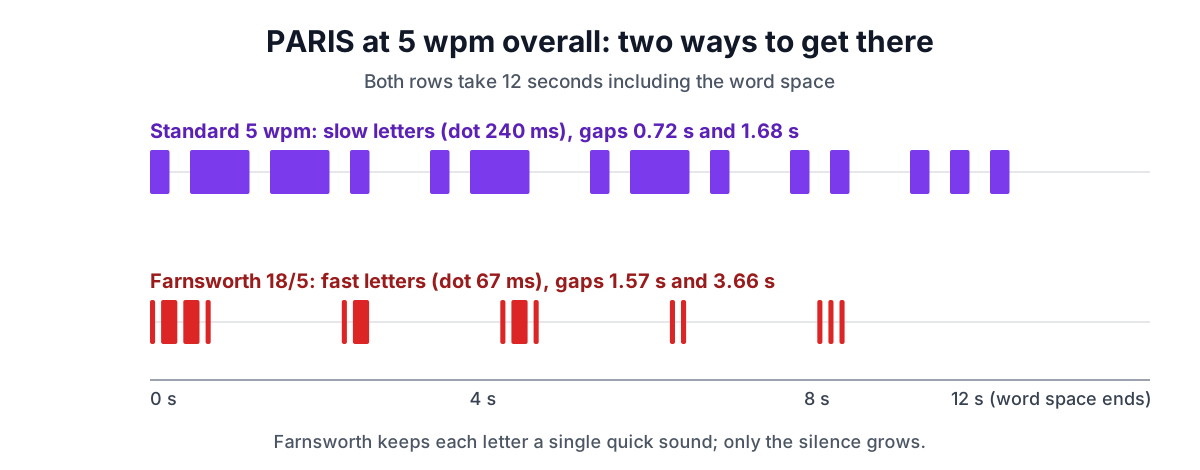
The Morse Code Translator applies exactly this when you turn on Farnsworth spacing, and the ARRL's own practice transmissions below 18 wpm are sent this way.
Prosigns and SOS
Procedural signals, or prosigns, are sequences sent as one character with no letter gap. They are written as letters with a bar over them, or in angle brackets:
| Prosign | Code | Meaning |
|---|---|---|
<SOS> | ...---... | Distress |
<AR> | .-.-. | End of message (same as +) |
<SK> | ...-.- | End of contact |
<BT> | -...- | Break or new paragraph (same as =) |
<KN> | -.--. | Go ahead, named station only |
<AS> | .-... | Wait |
<HH> | ........ | Error |
SOS was adopted as the international distress signal at the 1906 Berlin Radiotelegraph Convention. It does not stand for "save our souls" or anything else; it was chosen because three dots, three dashes, three dots is unmistakable and easy to send under stress. In the translator, typing <SOS> produces the run-together prosign while typing SOS produces three separate letters.
How to learn Morse
The methods that work treat Morse as a sound language rather than a table to memorise:
- Learn by ear, not by chart. Visual dot-dash charts make you translate twice. Listen to the letter's rhythm: "di-dah" for A, "dah-di-di-dit" for B.
- Use a fast character speed from the start. 15 to 20 wpm characters with Farnsworth spacing, so each letter is a single sound.
- Add letters gradually. The Koch method, developed by the German psychologist Ludwig Koch in the 1930s, starts with two letters at full speed and adds one each time you copy 90% correctly.
- Practise little and often. Fifteen to thirty minutes a day beats a weekly marathon.
- Copy real words, then short conversations, once you know all the letters.
You can generate practice audio with the translator: type a list of words, set the speeds, and download a WAV to play on your phone.
Quick reference
- Unit length: 1,200 ÷ wpm milliseconds.
- PARIS is 50 units; 20 wpm means a 60 ms dot.
- Gaps: 1 unit inside a letter, 3 between letters, 7 between words.
- Farnsworth: ta = (60c − 37.2s) ÷ (sc), split 3/19 per letter gap, 7/19 per word gap.
Encode, decode, play and download any message with the Morse Code Translator. For spelling things out by voice instead, see the NATO Phonetic Alphabet Converter.
Sources
- ITU-R Recommendation M.1677-1 (2009), International Morse code.
- Bloom, J. (1990). A Standard for Morse Timing Using the Farnsworth Technique. QEX, ARRL.
- ARRL, Code practice transmissions and Morse learning resources.
- Smithsonian National Museum of American History, Morse telegraph collection notes on the 1844 Washington to Baltimore message.
Related searches
- morse code alphabet
- morse code timing rules
- paris standard words per minute
- farnsworth timing formula
- what does sos mean in morse
- how to learn morse code fast
- koch method morse
- morse code prosigns list
- itu-r m.1677