
The NATO Phonetic Alphabet: Words, Numbers and Why Alfa
The ICAO spelling alphabet from Alfa to Zulu, how it was chosen in the 1950s, why it is Alfa, Juliett and Niner, how to say numbers and symbols, and spelling passwords safely.
· 9 min read
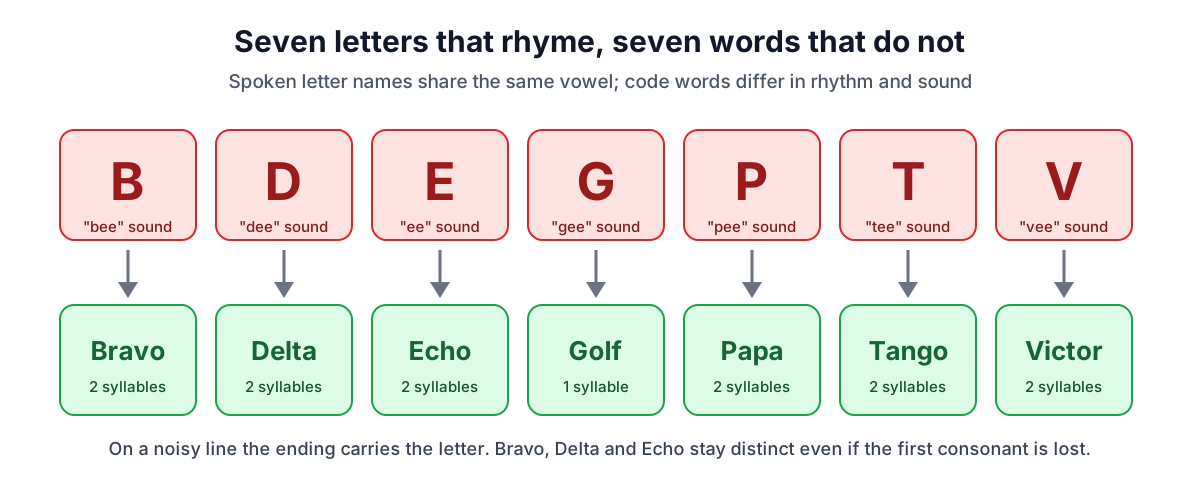
Say "B" over a bad phone line and the listener may hear D, E, G, P, T or V. The international radiotelephony spelling alphabet, usually called the NATO phonetic alphabet, solves this with 26 code words that are hard to confuse with each other even through static and accents: Alfa, Bravo, Charlie and so on to Zulu. This guide lists the words and the official pronunciations, explains how they were chosen and why a few look misspelled, covers numbers and symbols, and gives practical advice for spelling names, references and passwords. The NATO Phonetic Alphabet Converter spells any text and reads it aloud.
The alphabet and its pronunciation
The words and the pronunciation guides below are the ones published by the International Civil Aviation Organization (ICAO) in Annex 10, Volume II. The respellings are written so that speakers of English, French and Spanish can all read them.
| Letter | Code word | ICAO pronunciation | Letter | Code word | ICAO pronunciation |
|---|---|---|---|---|---|
| A | Alfa | AL FAH | N | November | NO VEM BER |
| B | Bravo | BRAH VOH | O | Oscar | OSS CAH |
| C | Charlie | CHAR LEE or SHAR LEE | P | Papa | PAH PAH |
| D | Delta | DELL TAH | Q | Quebec | KEH BECK |
| E | Echo | ECK OH | R | Romeo | ROW ME OH |
| F | Foxtrot | FOKS TROT | S | Sierra | SEE AIR RAH |
| G | Golf | GOLF | T | Tango | TANG GO |
| H | Hotel | HOH TELL | U | Uniform | YOU NEE FORM or OO NEE FORM |
| I | India | IN DEE AH | V | Victor | VIK TAH |
| J | Juliett | JEW LEE ETT | W | Whiskey | WISS KEY |
| K | Kilo | KEY LOH | X | X-ray | ECKS RAY |
| L | Lima | LEE MAH | Y | Yankee | YANG KEY |
| M | Mike | MIKE | Z | Zulu | ZOO LOO |
Note a few details. Quebec is said "keh-BECK", not "kwuh-BECK". Papa stresses the second syllable. Oscar ends in "cah" without a strong r. Lima is "LEE-mah", like the Peruvian city, not the bean.
How the words were chosen
Before the 1950s each service and country had its own list. British and American forces in the Second World War used Able, Baker, Charlie, Dog, Easy, Fox and so on. These worked for native English speakers but not for an international airline industry where pilots and controllers spoke dozens of languages.
ICAO asked a team led by the linguist Jean-Paul Vinay at the Université de Montréal to design a replacement. The team tested candidate words with speakers of many languages and for confusability under noise. The rules were roughly: every word should be a real word in English, French and Spanish or easy to say in all three, the words should sound clearly different from each other, and they should survive poor radio conditions. A first version introduced in 1951 was revised after field experience; Coca, Metro, Nectar, Union and Extra were replaced by Charlie, Mike, November, Uniform and X-ray. The final alphabet came into use in 1956 and was soon adopted by NATO, the International Telecommunication Union and maritime services, which is why the same words are heard in an airliner cockpit, on a warship and in a ham radio contest.
Why Alfa and Juliett are spelled that way
The official spellings are deliberate. In many languages "ph" is not read as an f sound, so ICAO writes Alfa rather than Alpha. French speakers might read a single final t in "Juliet" as silent, so the official word is Juliett with two t's. The pronunciation is the same as the familiar English spellings. In everyday English writing, Alpha and Juliet are common and perfectly understood; the converter lets you choose either style.
Whiskey and X-ray are the official forms too, though you will see Whisky and Xray. The converter's decoder accepts all of these variants.
Numbers: Tree, Fower, Fife and Niner
ICAO radiotelephony also specifies how digits are spoken:
| Digit | Spoken | Pronunciation |
|---|---|---|
| 0 | Zero | ZE RO |
| 1 | One | WUN |
| 2 | Two | TOO |
| 3 | Three | TREE |
| 4 | Four | FOW ER |
| 5 | Five | FIFE |
| 6 | Six | SIX |
| 7 | Seven | SEV EN |
| 8 | Eight | AIT |
| 9 | Nine | NIN ER |
The changed forms keep similar-sounding numbers apart. "Fife" and "niner" are easy to tell apart where "five" and "nine" share a long i, "tree" avoids the "th" sound that many speakers do not have, and "niner" also cannot be mistaken for the German "nein". A decimal point is said DAY SEE MAL, and in aviation numbers are usually read digit by digit, so flight level 350 is "flight level tree fife zero".
Outside aviation and the military, most people use plain numbers when spelling a booking reference, and that is fine; the converter offers both.
Symbols, case and accents
The ICAO alphabet covers only letters and digits. For everything else, use plain names and confirm them:
-dash or hyphen,_underscore,/slash,.dot,@at sign#hash,&ersand,+plus,:colon
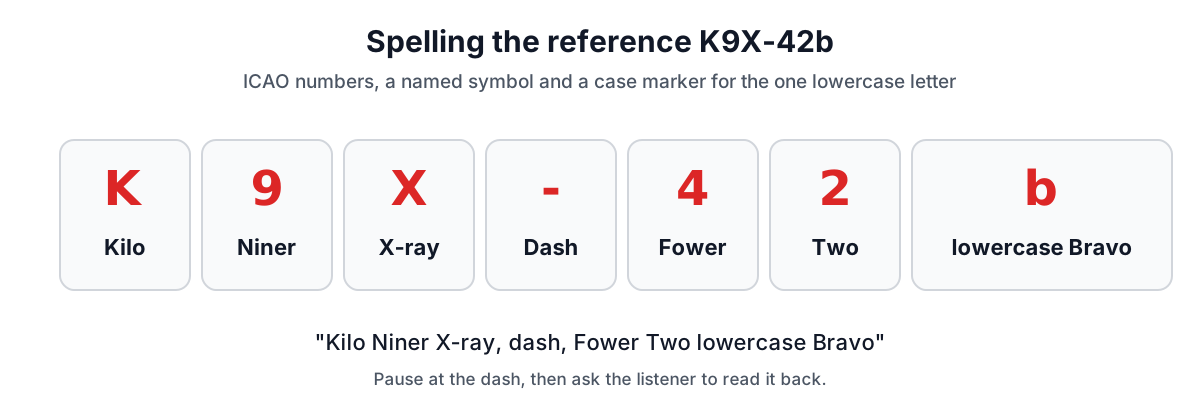
Case is not part of the alphabet either. When case matters, as in passwords, Wi-Fi keys or some file names, say "capital" or "lowercase" before the letter. For example pX7q becomes "lowercase Papa, capital X-ray, Seven, lowercase Quebec". The converter's Capital / Lowercase option does this automatically.
Accented letters are spelled with their base letter, and the accent is said separately if it matters: "Echo with acute accent".
Practical tips for spelling over the phone
- Group the characters. Pause between groups of three or four, the way the text is written: "Kilo Niner X-ray, dash, Fower Two Bravo".
- Say the word, then spell it. "Sean, that's Sierra Echo Alfa November." The listener knows when the spelling starts and ends.
- Read it back. Ask the other person to read the spelling back to you. Pilots and controllers do this for every instruction.
- Use the official words. Improvised words ("S as in sugar", "N as in Nancy") are exactly what the alphabet was designed to replace; sugar can sound like shoe and Nancy like Mancy.
- Be careful with secrets. Spelling a password clearly does not make the phone line secure. Prefer a password manager or a secure link, and change a password that had to be read aloud.
Using the converter
Type the text into the NATO Phonetic Alphabet Converter, choose ICAO or common spellings and radio or plain numbers, and press Read aloud to hear it. The reverse tab turns code words you were given back into text. For a different way of sending letters clearly, the Morse Code Translator covers International Morse, the other alphabet every radio operator learns.
Sources
- ICAO Annex 10 to the Convention on International Civil Aviation, Volume II, Communication Procedures (radiotelephony spelling alphabet and number pronunciation).
- ITU Radio Regulations, Appendix 14, Phonetic alphabet and figure code.
- NATO, history of the phonetic alphabet (nato.int).
Related searches
- nato phonetic alphabet
- icao spelling alphabet
- why alfa not alpha
- why pilots say niner
- tree fower fife niner
- how to spell over the phone
- phonetic alphabet history
- juliett with two ts
- spell password phonetically