
ND Filters for Long Exposure: Stops, ND Numbers and Density
Reading ND1000, 3.0 and 10-stop on a filter, working out the new shutter speed, stacking filters, choosing the strength for water, clouds and video, and correcting for film reciprocity.
· 10 min read

A neutral density (ND) filter is grey glass or resin that cuts the light reaching the lens without changing its colour. It lets you use a slower shutter speed or a wider aperture than the scene would otherwise allow: thirty seconds at midday to turn a busy sea into mist, or f/1.8 in sunshine for video. The only sums involved are multiplications by powers of two, but filter makers label their products in three different ways, which is where most confusion comes from. The ND Filter Calculator converts between them and gives the new shutter speed; this article explains what it is doing.
Three ways to label the same filter
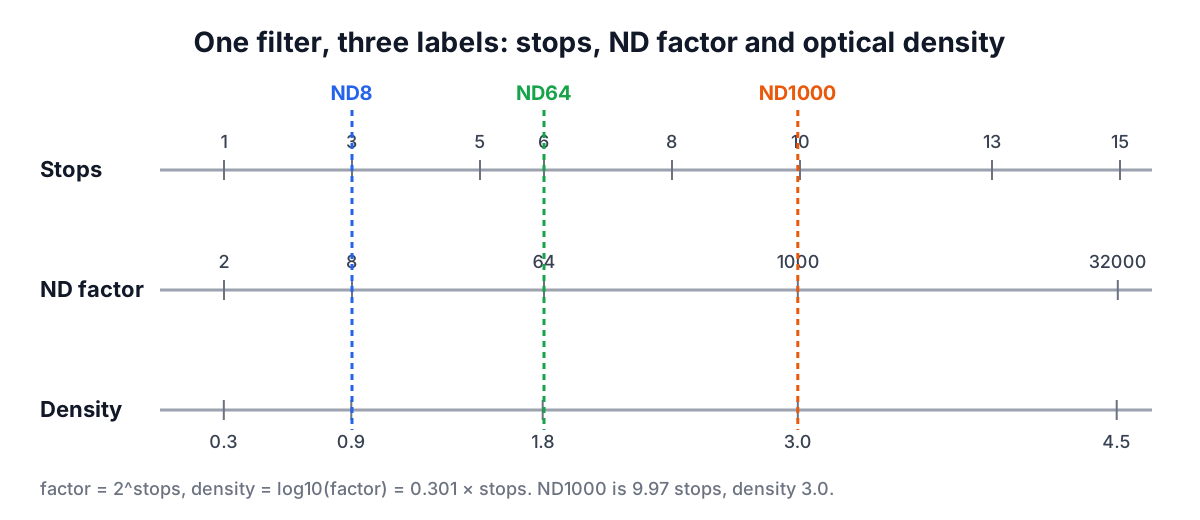
The strength of an ND filter can be written as:
- Stops. Each stop halves the light. A 10-stop filter passes 1/1024 of it.
- ND factor (filter factor). The number the exposure time must be multiplied by. "ND8" means eight times longer, which is three stops.
- Optical density. The base-10 logarithm of the factor, printed as "0.9" or "3.0". Density 0.3 is one stop because log₁₀(2) = 0.301.
The relationships are exact:
- factor = 2^stops
- stops = log₂(factor)
- density = log₁₀(factor) = stops × 0.301
| Label | Stops | Optical density | Light passed |
|---|---|---|---|
| ND2 | 1 | 0.3 | 50% |
| ND4 | 2 | 0.6 | 25% |
| ND8 | 3 | 0.9 | 12.5% |
| ND16 | 4 | 1.2 | 6.25% |
| ND64 | 6 | 1.8 | 1.56% |
| ND500 | 8.97 | 2.7 | 0.2% |
| ND1000 | 9.97 | 3.0 | 0.1% |
| ND32000 | 14.97 | 4.5 | 0.0031% |
Notice the rounding in the large filters. A filter sold as "ND1000, 10 stops, 3.0" really has a factor of 1,000, which is 9.97 stops. A true 10-stop filter would be factor 1,024 and density 3.01. The difference, 0.03 stop, is far smaller than the tolerance of real filters, so either figure is fine. The calculator uses the factor when you pick a filter by name and the exact power of two when you type stops.
Working out the new shutter speed
Meter the scene without the filter (or take a test shot), then multiply the shutter time by the filter factor:
new time = metered time × factor
Some examples worked by the calculator:
| Metered time | Filter | Time with filter |
|---|---|---|
| 1/125 s | ND1000 | 8 s |
| 1/60 s | ND1000 | 17 s (16.7 s) |
| 1/15 s | ND1000 | 1 min 7 s |
| 1/2 s | ND1000 | 8 min 20 s |
| 1/250 s | ND64 | 1/3.9 s |
| 1/30 s | ND8 | 1/3.8 s |
Above 30 seconds most cameras need Bulb mode and a remote release, and you time the exposure yourself. The calculator includes a countdown timer for that.
Why meter first? Many camera meters, and especially autofocus systems, struggle through a 10-stop filter because the viewfinder or screen goes almost black. The usual workflow is: compose and focus without the filter, switch the lens to manual focus, meter, screw the filter on, cover the optical viewfinder eyepiece if your camera has one (light leaking in from behind can fog a long exposure), then set the computed time.
Stacking filters
When you combine filters, their stops add, their densities add and their factors multiply. A 10-stop and a 3-stop filter together are 13 stops, factor 8,192, density 3.9. At a metered 1/30 s that is 8,192 ÷ 30 = 273 s, or 4 minutes 33 seconds. A 10-stop plus a 6-stop on a metered 1/125 s gives 16 stops and 8 minutes 44 seconds.
Stacking has costs. Every extra glass surface adds a chance of flare and reflections, two screw-in filters on a wide-angle lens can vignette the corners, and cheap filters can add a colour cast that compounds when stacked. Strong single filters (15 stops, density 4.5) exist for exactly this reason.
Choosing a strength
Work backwards from the shutter speed you want. The calculator's "Which filter do I need?" panel does this: stops = log₂(target time ÷ metered time).
| Subject | Typical target time | Typical filter at a daylight 1/125 to 1/30 s |
|---|---|---|
| Waterfall with silky texture | 1/4 to 1 s | 3 to 6 stops |
| Waves smoothed to mist | 15 to 60 s | 10 stops |
| Clouds streaking across the sky | 1 to 4 min | 10 to 15 stops |
| People removed from a busy square | several minutes | 15 stops or stacked filters |
Two worked cases:
- Metered 1/30 s, want 30 s. The light must drop by a factor of 900, which is 9.81 stops. The nearest stock filter is ND1000; with it the exposure is 33 s.
- Metered 1/250 s, want 2 minutes. That is a factor of 30,000, or 14.87 stops. The nearest stock filter is ND32000 (15 stops), giving 128 s.
ND filters for video
Video has a different goal. To make motion look natural, cinematographers keep the shutter at about half the frame interval, the "180-degree rule": 1/50 s at 25 fps, 1/60 s at 30 fps. In sunshine that forces a small aperture unless an ND filter takes the light away. If your camera wants 1/400 s at f/2.8 and you need 1/50 s, you need 3 stops, an ND8. If it wants 1/1000 s, you need 4.32 stops; the nearest single filter is ND16 (4 stops), and you can close the aperture a third of a stop to make up the rest. Variable ND filters are popular for video because you can dial the strength while recording, but at their strongest settings they often show a dark cross pattern.
Film and reciprocity failure
Digital sensors respond in direct proportion to light, so the multiplication above is all you need. Film does not. At long exposures a film emulsion becomes less sensitive than its ISO rating suggests, an effect called reciprocity failure (the "reciprocity law" is the rule that halving the light and doubling the time gives the same result, and at long times it breaks down).
Manufacturers publish corrections. Ilford gives a power law on its black-and-white data sheets:
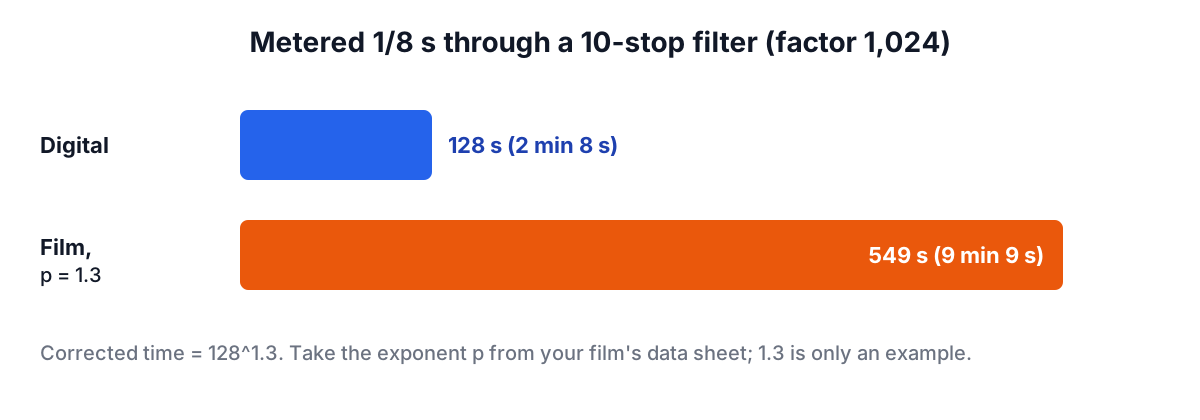
corrected time = metered time ^ p
where p is a film-specific exponent and the correction applies to metered times over about one second. The calculator accepts p and applies it only above one second. As an illustration, with p = 1.3 a computed 8 s becomes 8^1.3 = 15 s, and a computed 128 s becomes about 9 minutes 9 seconds. Always take p from the current data sheet for your film; colour films also shift colour at long exposures, which a time correction cannot fix.
Practical problems and fixes
- Colour casts. Inexpensive strong filters often add a warm or magenta tint, and many pass infrared, which some sensors record as a red cast on foliage. Shoot raw and correct white balance, or buy filters with IR coatings.
- Light leaks. Cover the eyepiece on DSLRs and avoid gaps around square filter holders.
- Long-exposure noise. Exposures of minutes heat the sensor. In-camera long-exposure noise reduction takes a dark frame of the same length afterwards, doubling the wait.
- Wind and vibration. A heavy tripod, the self-timer or a remote, and electronic first-curtain shutter all help.
- Changing light. At sunset the light can fall by a stop or more during a four-minute exposure. Meter again between frames, and consider adding a third of a stop.
If you would rather open the aperture than lengthen the shutter, for example for shallow depth of field in sunshine, the Exposure Calculator finds the equivalent setting, and the Depth of Field Calculator shows what the wider aperture does to the sharp zone.
Sources
- Wikipedia, "Neutral-density filter" (optical density, filter factor and stop relationships).
- Ilford Photo, black-and-white film technical data sheets, "Reciprocity law failure" section (the power-law correction Tc = Tm^p).
- Sidney F. Ray, Applied Photographic Optics, Focal Press (filter factors and optical density).
Plug in your own metered time and filters with the ND Filter Calculator.
Related searches
- nd filter calculator
- nd1000 shutter speed chart
- 10 stop nd filter exposure time
- nd number vs optical density
- stacking nd filters
- which nd filter for waterfalls
- nd filter for video 180 degree rule
- reciprocity failure long exposure film
- nd8 vs nd64