
Newton's Second Law, Weight and Friction: Solving Force Problems
F = ma with net force done properly, mass versus weight, newtons versus pounds-force and kilograms-force, static and kinetic friction, and blocks on slopes with the angle of repose.
· 10 min read

Most mechanics problems come down to the same three steps: find every force on the object, add them up, and apply F = ma. This post walks through that process for the cases people search for most: Newton's second law on its own, weight on Earth and other planets, and friction on a flat floor and on a slope. It also untangles the force units that cause the most confusion, newtons, pounds-force and kilograms-force. The Force Calculator solves each case with the working shown.
Newton's second law
Newton published his laws of motion in the Principia in 1687. The second law says the net force on a body equals the rate of change of its momentum. For a body of constant mass that becomes the familiar:
F = m × a
The SI unit of force is defined from it. One newton (N) is the force that accelerates one kilogram at one metre per second squared, so 1 N = 1 kg·m/s². Rearranged, the law gives the acceleration a force produces, a = F ÷ m, or the mass of an object from the force and acceleration, m = F ÷ a.
The single most important word is net. F is the vector sum of every force acting, not just the one you are pushing with. If you push a 50 kg crate with 200 N and friction resists with 147 N, the net force is 53 N and the crate accelerates at 53 ÷ 50 = 1.06 m/s².
Worked example: a car pulling away
A 1,200 kg car accelerates at a steady 3 m/s². The net force on it is 1,200 × 3 = 3,600 N, about 809 lbf. At that rate it would reach 100 km/h (27.78 m/s) in 27.78 ÷ 3 = 9.26 s. The force at the driven wheels has to be larger than 3,600 N, because rolling resistance and aerodynamic drag both push back, and drag grows with the square of speed. That is why acceleration falls off as a car gets faster even in a low gear.
Mass, weight and the units that mix them up
Mass is the amount of matter in an object, measured in kilograms, and it is the same everywhere. Weight is the force gravity exerts on that mass:
W = m × g
On Earth g is close to 9.81 m/s², and the standard value 9.80665 m/s² was fixed by the General Conference on Weights and Measures in 1901. Real gravity at sea level varies from about 9.780 m/s² at the equator to 9.832 m/s² at the poles, because the Earth spins and bulges at the equator, so a precise scale reads about 0.5% more at the poles.
Two older force units are defined from standard gravity, which is why people say things like "it weighs 70 kilos":
| Unit | Exact value in newtons | What it means |
|---|---|---|
| kilogram-force (kgf) | 9.80665 N | Weight of 1 kg under standard gravity |
| pound-force (lbf) | 4.4482216152605 N | Weight of 1 lb (0.45359237 kg) under standard gravity |
| kilonewton (kN) | 1,000 N | Common in structural engineering |
| dyne | 0.00001 N | CGS unit, 1 g·cm/s² |
So a 70 kg person weighs 70 × 9.80665 = 686.5 N, which is 70 kgf or 154.3 lbf. A bathroom scale measures that force and divides by g to display kilograms. On other bodies the same person has the same mass but a different weight:
| Body | g (m/s²) | Weight of 70 kg |
|---|---|---|
| Earth | 9.80665 | 686.5 N |
| Moon | 1.62 | 113.4 N |
| Mars | 3.71 | 259.7 N |
| Venus | 8.87 | 620.9 N |
| Jupiter | 24.79 | 1,735 N |
Friction
Friction is the force that resists two surfaces sliding over each other. The simple model taught in physics courses, often called the Amontons-Coulomb law after the two French scientists who described it around 1700 and 1785, says:
F friction = μ × N
where N is the normal force pressing the surfaces together and μ (mu) is the coefficient of friction for that pair of materials. The model has two surprising predictions that hold reasonably well in practice: friction does not depend on the contact area, and kinetic friction hardly depends on sliding speed.
There are two coefficients:
- Static, μs. Before anything moves, friction matches whatever sideways force you apply, up to a maximum of μs × N. Push harder than that and the object breaks free.
- Kinetic, μk. Once sliding, friction drops to μk × N, which is usually smaller.
That difference is why a heavy box needs a big shove to get going and then moves more easily, and why anti-lock brakes work: a tyre that is still rolling uses static friction, which is greater than the kinetic friction of a locked, skidding wheel.
Typical coefficients
| Surfaces | μs | μk |
|---|---|---|
| Rubber on dry concrete | 1.0 | 0.8 |
| Steel on steel | 0.74 | 0.57 |
| Aluminium on steel | 0.61 | 0.47 |
| Glass on glass | 0.94 | 0.4 |
| Copper on steel | 0.53 | 0.36 |
| Wood on wood | 0.25 to 0.5 | 0.2 |
| Waxed wood on wet snow | 0.14 | 0.1 |
| Metal on metal, lubricated | 0.15 | 0.06 |
| Teflon on Teflon | 0.04 | 0.04 |
| Ice on ice | 0.1 | 0.03 |
These are the textbook values from Serway and Jewett's Physics for Scientists and Engineers. Treat them as rough: surface finish, dirt, moisture, temperature and contact pressure can move them by half or more. Coefficients above 1 are perfectly possible for soft rubber and other grippy materials.
Worked example: pushing a crate
A 50 kg crate sits on a level floor with μs = 0.5 and μk = 0.3. The normal force is the weight, 50 × 9.80665 = 490.3 N. To start it moving you need more than 0.5 × 490.3 = 245.2 N; to keep it moving at constant speed, 0.3 × 490.3 = 147.1 N. Push with 200 N after it is moving and the net force is 52.9 N, giving an acceleration of 1.06 m/s².
Blocks on slopes
On a ramp tilted at angle θ, the weight splits into two components: one pressing into the surface and one pulling down the slope.
- Normal force: N = m g cos θ
- Pull down the slope: m g sin θ
- Maximum static friction: μs m g cos θ
- Kinetic friction once sliding: μk m g cos θ
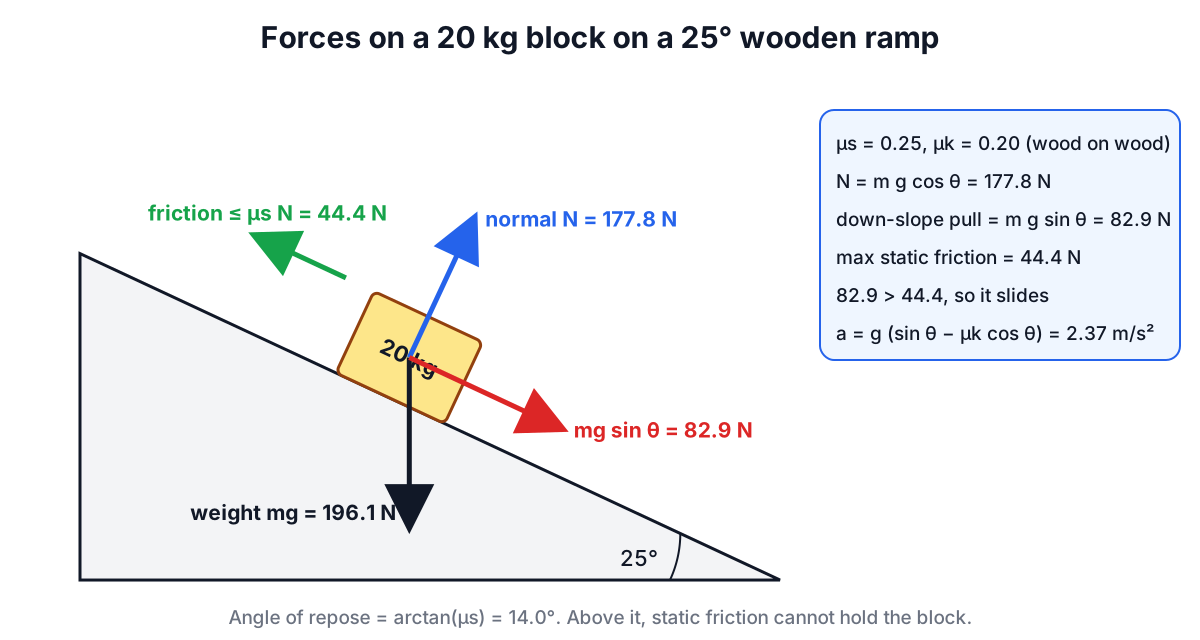
The block stays put as long as the down-slope pull is no more than the maximum static friction, m g sin θ ≤ μs m g cos θ. Dividing through, the mass and g cancel and the condition becomes:
tan θ ≤ μs
The angle where tan θ = μs is the angle of repose. For wood on wood with μs = 0.25 it is arctan(0.25) = 14.0°; for steel on steel with μs = 0.74 it is 36.5°. This is also a practical way to measure μs: tilt a board with the object on it until it just starts to slide, and take the tangent of that angle.
Once sliding, Newton's second law along the slope gives the acceleration:
a = g (sin θ − μk cos θ)
Worked example: a block on a 25° wooden ramp
A 20 kg block on a 25° ramp, wood on wood (μs = 0.25, μk = 0.2):
- Weight: 196.1 N; normal force: 196.1 × cos 25° = 177.8 N
- Pull down the slope: 196.1 × sin 25° = 82.9 N
- Maximum static friction: 0.25 × 177.8 = 44.4 N
Since 82.9 N is more than 44.4 N, the block slides on its own; equivalently, tan 25° = 0.466 is above 0.25. Once moving, it accelerates at 9.80665 × (sin 25° − 0.2 × cos 25°) = 2.37 m/s². To push it up the ramp at constant speed you would need 82.9 + 0.2 × 177.8 = 118.4 N along the surface, and to start it moving upward from rest, 82.9 + 44.4 = 127.3 N.
A method that works every time
- Draw a free-body diagram. Sketch the object alone and draw every force: weight, normal force, friction, applied pushes and pulls, tension, drag.
- Pick axes that suit the problem. On a slope, use axes along and perpendicular to the surface so that only the weight has to be split.
- Balance the perpendicular direction to find the normal force. Nothing accelerates into or out of the surface.
- Apply F = ma along the direction of motion, with friction opposing the motion (or the tendency to move).
- Check the units and signs. Mass in kg, acceleration in m/s², force in N. A negative acceleration means the object slows down or moves the other way.
The most common mistakes are using N = mg on a slope (it is mg cos θ), using the applied force instead of the net force in F = ma, mixing kilograms of mass with kilograms-force, and assuming friction always equals μN even when the object is not moving (static friction is only as large as it needs to be).
Use the calculator
The Force Calculator has three tabs: F = ma for force, mass or acceleration in N, kN, lbf, kgf or dynes; weight on six bodies or custom gravity; and friction on a flat surface or slope with the textbook coefficient table, the angle of repose and a verdict on whether the object slides. For energy rather than force, try the Kinetic Energy Calculator; for rotating machinery, the Torque and Power Calculator.
Sources
- I. Newton, Philosophiae Naturalis Principia Mathematica, 1687, Axioms or Laws of Motion.
- BIPM, The International System of Units (SI Brochure), 9th edition, 2019: definition of the newton.
- CGPM, 3rd General Conference (1901): standard acceleration of gravity, 9.80665 m/s².
- NIST Special Publication 811, Appendix B: exact conversion factors for the pound-force and kilogram-force.
- R. A. Serway and J. W. Jewett, Physics for Scientists and Engineers, Table 5.1: coefficients of friction.
- NASA Goddard Space Flight Center, Planetary Fact Sheet: surface gravity of the Moon and planets.
Related searches
- newtons second law formula
- how to calculate force
- mass vs weight
- newtons to pounds force
- coefficient of friction table
- friction on an inclined plane
- angle of repose
- static vs kinetic friction