
NOVA Food Classification: How to Tell If a Food Is Ultra-Processed
The four NOVA groups, the label markers that make a product ultra-processed, why additives that preserve do not count, what the research shows, and where NOVA falls short.
· 10 min read
"Ultra-processed" has become one of the most used phrases in food news, and most of the time it means something specific: a product that falls into group 4 of the NOVA food classification. NOVA does not count calories, grams of sugar or vitamins. It asks a different question: how was this food made, and why? This post explains the four NOVA groups, the ingredients on a label that put a product in group 4, why some additives do not count, what the research says, and where the system is criticised. The NOVA Food Classifier applies the same rules to any ingredient list you paste in.
Where NOVA comes from
NOVA was created by Carlos Monteiro and his colleagues at the Center for Epidemiological Research in Nutrition and Health (NUPENS) at the University of São Paulo, first published around 2009 and refined in later papers. The name is not an acronym; nova is Portuguese for "new". The researchers' starting point was that nutrient-based advice had not slowed the rise of obesity and diet-related disease, while the kinds of food people bought had changed a great deal: fewer raw ingredients cooked at home, more ready-to-eat products made by industry.
The system went from research tool to public policy quickly. Brazil's 2014 dietary guidelines are built on it, with the advice to make minimally processed foods the basis of the diet and to avoid ultra-processed products. In 2019 the Food and Agriculture Organization of the United Nations published a report by the NOVA authors on using the classification in research and policy. Today almost every study about "ultra-processed food" uses NOVA to decide which foods count.
The four groups
NOVA sorts every food and drink into one of four groups by the extent and purpose of the processing it went through.
Group 1: unprocessed or minimally processed foods. Edible parts of plants and animals, fungi and water, either as they are or after processes that do not add anything: washing, removing inedible parts, drying, grinding, freezing, pasteurising, fermenting without alcohol, or packing. Fresh and frozen vegetables, fruit, dried beans and lentils, grains and flours, pasta made from flour and water, milk, plain yoghurt, eggs, fresh meat and fish, and unsalted nuts all belong here.
Group 2: processed culinary ingredients. Substances taken from group 1 foods or from nature by pressing, refining, milling or drying, and used to prepare and season food rather than eaten on their own: oils, butter, lard, sugar, honey, maple syrup, salt, starches and vinegar.
Group 3: processed foods. Group 1 foods with group 2 ingredients added, usually to make them last longer or taste better: vegetables and beans canned in salted water, fruit in syrup, salted nuts, cured and smoked meats, canned fish, cheese, and bread made from flour, water, salt and yeast. Most have two or three ingredients and you could make a version at home.
Group 4: ultra-processed foods. Formulations made mostly or entirely from substances extracted from foods or made in a lab, put together by a sequence of industrial processes, and usually finished with additives that change their taste, colour or texture. Soft drinks, packaged snacks and sweets, sweetened breakfast cereals, instant noodles, chicken nuggets, most ready meals and many sliced breads, yoghurts and plant-based meat alternatives fall here.
How to spot group 4 on a label
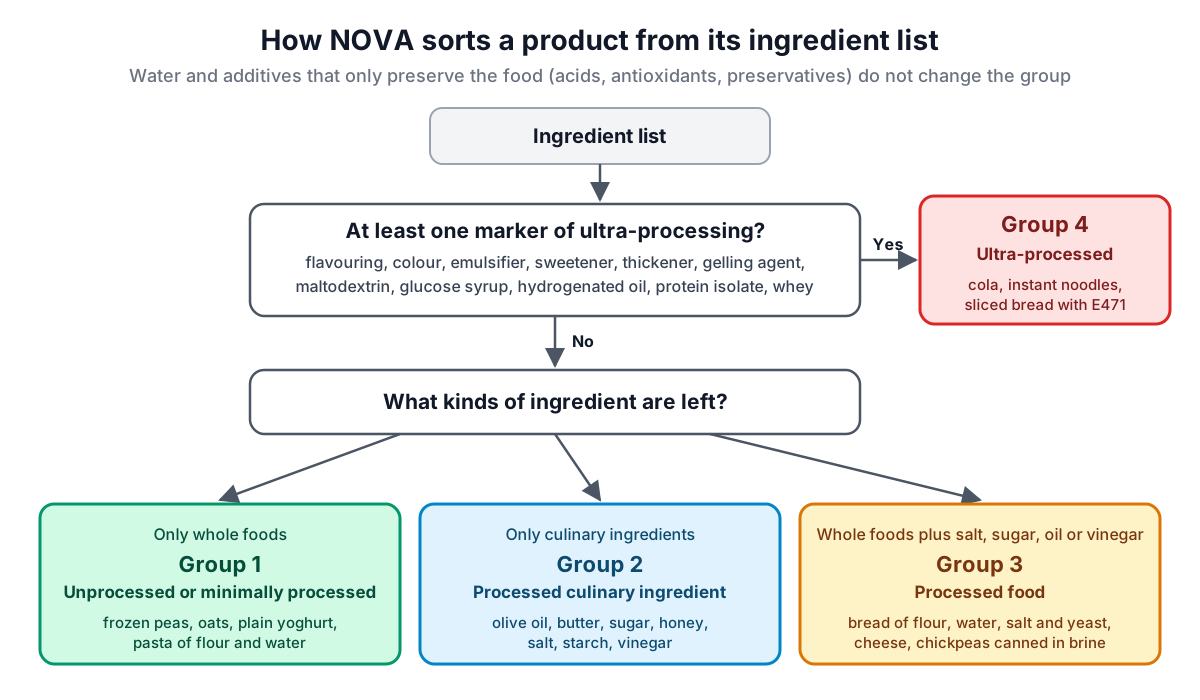
Shoppers cannot see how a food was made, so the NOVA authors published a practical test in 2019 (Monteiro and colleagues, Public Health Nutrition). Read the ingredient list and look for at least one marker of ultra-processing. There are two kinds.
The first is a food substance of no or rare culinary use: something you would not find in a home kitchen. The paper lists varieties of sugar such as high-fructose corn syrup, invert sugar, maltodextrin, dextrose, lactose and fruit juice concentrates; modified oils, meaning hydrogenated and interesterified fats; protein sources such as hydrolysed protein, soy protein isolate, gluten, casein, whey and mechanically separated meat; and added fibres.
The second is a cosmetic additive: a class of additive whose job is to make the product more palatable or appealing. The listed classes are flavours, flavour enhancers, colours, emulsifiers, emulsifying salts, sweeteners, thickeners, and anti-foaming, bulking, carbonating, foaming, gelling and glazing agents.
One marker is enough. The diagram below shows the whole decision.
On European labels many additives appear as E-numbers, and their number tells you their class. Colours are E100 to E199, so E150d (sulphite ammonia caramel) in a cola is a colour. Most of the E400 range are thickeners, gelling agents and emulsifiers, such as E415 xanthan gum and E471 mono- and diglycerides of fatty acids. Flavour enhancers sit between E620 and E640, with E621 monosodium glutamate the best known, and the intense sweeteners are mostly E950 to E969.
Additives that do not count
Not every additive is a marker. NOVA allows additives whose purpose is to preserve the original food, and these appear in groups 1 to 3 as well as in group 4: preservatives such as sorbates and sodium nitrite, antioxidants such as ascorbic acid (E300), acids such as citric acid (E330), firming agents such as calcium chloride in canned vegetables, and raising agents in baked goods. Vitamins and minerals added to flour or milk are not markers either.
That is why bacon cured with salt and sodium nitrite is group 3, while a ham with smoke flavouring and carrageenan is group 4. A tin of chickpeas in water, salt and calcium chloride is group 3. Hummus made from chickpeas, tahini, oil, lemon juice, garlic and salt is group 3 even with a preservative added, but the same hummus with a thickener or flavouring is group 4.
Some markers surprise people because the food seems simple. Many supermarket loaves contain emulsifiers such as E471 or E481, which put them in group 4, while a bakery loaf of flour, water, salt and yeast is group 3. Many jams contain pectin, a gelling agent, and many chocolate bars contain lecithin, an emulsifier, so by the letter of the 2019 test both are ultra-processed. Some researchers treat such borderline cases differently, which is one reason studies do not always agree.
What the research shows
Ultra-processed foods make up a large share of what people in rich countries eat: about 57% of adults' calories in the United States in 2017 to 2018, and a similar share in the United Kingdom. Large observational studies have linked higher intakes to higher risks of many conditions. A 2024 umbrella review in The BMJ (Lane and colleagues), which pooled 45 meta-analyses covering almost 10 million people, found associations with 32 health outcomes, with the strongest evidence for death from cardiovascular disease, type 2 diabetes, and anxiety and common mental disorders.
Observational studies show association, not cause, so the most cited piece of evidence is a small controlled trial. In 2019 Kevin Hall and colleagues at the US National Institutes of Health housed 20 adults in a metabolic ward for four weeks. For two weeks they were offered an ultra-processed diet and for two weeks an unprocessed one, matched for calories, sugar, fat, fibre and salt on the plate, and told to eat as much as they liked. On the ultra-processed diet they ate about 500 more calories a day and gained about 0.9 kg; on the unprocessed diet they lost about 0.9 kg.
Where NOVA falls short
NOVA has critics, including nutrition scientists who agree that diets heavy in ultra-processed food are a problem. The main criticisms are worth knowing before you apply it to your shopping.
- It is about processing, not nutrition. Wholemeal bread with an emulsifier and a sugary soft drink share group 4, while sugar and olive oil share group 2. Some group 4 products, such as fortified cereals or soy drinks with added calcium, can be useful parts of a diet.
- Classification can be inconsistent. When researchers asked food and nutrition specialists to classify the same list of foods (Braesco and colleagues, 2022), agreement between them was low, especially for group 3 versus group 4. Studies that classify differently are hard to compare.
- The mechanism is not settled. It is still debated whether harm comes from processing itself, from additives, from texture and speed of eating, or simply from the higher energy density, salt, sugar and fat that many ultra-processed products have. The UK's Scientific Advisory Committee on Nutrition said in 2023 that the associations are concerning but that the evidence has important limitations.
None of this makes the classification useless. It is a quick way to see how far a product is from food you could cook yourself, and it adds information that a nutrition table does not show.
Using NOVA when you shop
A practical approach uses NOVA and the nutrition label together rather than either one alone.
- Read the ingredient list first. If it has no markers and you recognise every ingredient, the product is in group 1 to 3 and can be part of everyday eating.
- If it has markers, ask whether there is a group 1 to 3 version of the same food: a loaf without emulsifiers, plain yoghurt with your own fruit, oats instead of sweetened cereal.
- Then read the nutrition table. UK traffic lights mark a food as high in sugar above 22.5 g per 100 g and high in salt above 1.5 g per 100 g, whatever its NOVA group, and a group 3 cheese or bacon can be high in salt.
The NOVA Food Classifier does steps 1 and 3 in one place: paste the list, add the per-100 g values if you have them, and it shows the group, the markers it found and the traffic lights. For the meaning of claims like "organic" or "no added sugar" on the same pack, see the Food Labeling Guide, and for daily targets the Macro Calculator.