
NPF Rule vs 500 Rule: Sharp Stars Without a Tracker
Why stars trail, how fast they cross a sensor, why the 500 rule fails on high-resolution cameras, the NPF rule with pixel pitch and aperture, and how declination buys extra seconds.
· 10 min read

On a fixed tripod the sky keeps moving. The Earth turns once relative to the stars every 23 hours 56 minutes, and every second the shutter stays open each star slides a little further across the sensor. Leave it open too long and the points become short dashes. For Milky Way and nightscape photography you want the longest exposure that keeps stars looking like points, because every extra second collects more faint light. Two rules of thumb answer that question: the old 500 rule and the newer NPF rule. The Star Trail Calculator computes both, together with the actual trail length in pixels, so you can see how much each one allows.
How fast stars move on the sensor
The sky rotates 360° in one sidereal day of 86,164 seconds, an angular speed of 2π ÷ 86,164 = 7.29 × 10⁻⁵ radians per second (about 15 arcseconds per second). A star at the celestial equator moves at that full rate. A star at declination δ moves along a smaller circle, so its speed is multiplied by cos δ. Polaris, almost at the pole, hardly moves at all.
On the sensor, an angle θ becomes a distance f × θ for a lens of focal length f. So the drift speed of a star image is:
drift = f × 7.29 × 10⁻⁵ × cos δ
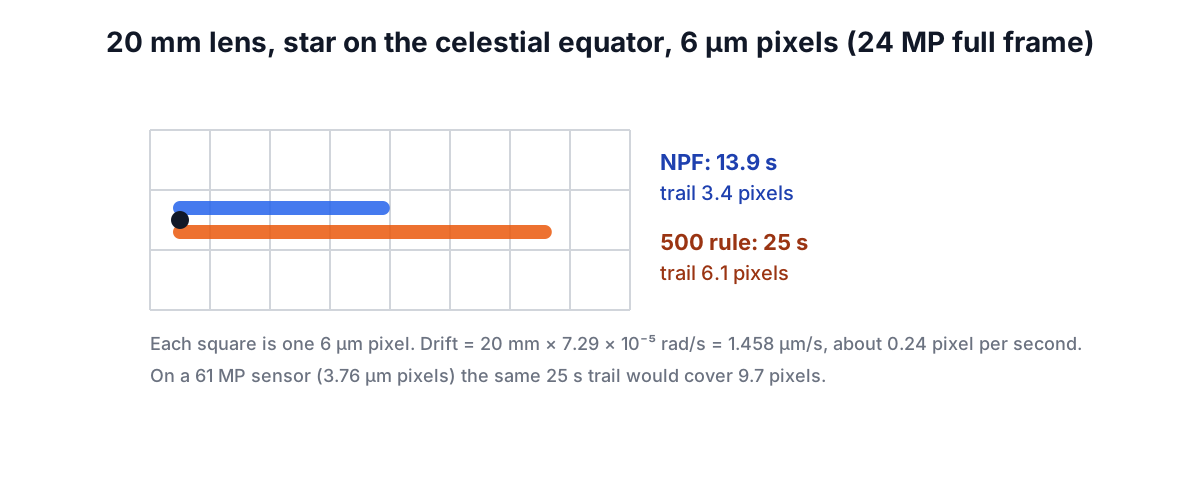
For a 20 mm lens and a star on the equator that is 20,000 µm × 7.29 × 10⁻⁵ = 1.458 µm per second. A typical 24-megapixel full-frame sensor has pixels about 6 µm across (√(36 × 24 mm² ÷ 24 million)), so a star crosses a quarter of a pixel each second. This drift figure is exact geometry; the rules below are judgements about how much drift is acceptable.
The 500 rule
The 500 rule says the longest exposure in seconds is 500 divided by the full-frame equivalent focal length:
t = 500 ÷ (f × crop factor)
On full frame, a 20 mm lens gives 25 s; on an APS-C body with a 1.53 crop factor, a 16 mm lens gives 500 ÷ (16 × 1.53) = 20.4 s.
The rule dates from film and from prints viewed at normal size, where a small elongation is invisible. It has two weaknesses on modern cameras:
- It ignores pixel size. A 24 MP and a 61 MP full-frame camera get the same answer, but the 61 MP sensor's pixels are smaller, so the same drift covers more of them. At 20 mm and 25 s the trail is 6.1 pixels long on a 24 MP sensor and 9.7 pixels on a 61 MP sensor.
- It ignores aperture. A lens at f/1.4 makes a smaller star image than at f/4, so the trail becomes visible sooner.
Photographers who view their images at 100% often use the stricter 400 or 300 rule instead. The calculator offers all three constants.
The NPF rule
The NPF rule is credited to Frédéric Michaud of the Société Astronomique du Havre. It adds aperture (N) and pixel pitch (P) to the focal length (F). The simplified form used by the calculator and most apps is:
t = (35 × N + 30 × p) ÷ f
with N the f-number, p the pixel pitch in micrometres and f the actual focal length in millimetres. A larger f-number or larger pixels allow a longer time; a longer lens allows less.
Worked example: 24 MP full frame, 20 mm at f/2.8
- Pixel pitch: √(36 × 24 ÷ 24) µm = 6.00 µm.
- NPF: (35 × 2.8 + 30 × 6.00) ÷ 20 = (98 + 180) ÷ 20 = 13.9 s.
- 500 rule: 500 ÷ 20 = 25 s.
- Trail length at 13.9 s: 1.458 µm/s × 13.9 s ÷ 6.00 µm = 3.4 pixels. At 25 s: 6.1 pixels.
So the NPF rule accepts a trail of a few pixels, which at 100% still looks round to most people once the star's own blur is included, while the 500 rule nearly doubles it.
How the two rules compare
The table uses a 24 MP full-frame camera at f/2.8, with the NPF result for a 45 MP body alongside:
| Focal length | 500 rule | NPF, 24 MP | NPF, 45 MP |
|---|---|---|---|
| 14 mm | 35.7 s | 19.9 s | 16.4 s |
| 20 mm | 25.0 s | 13.9 s | 11.5 s |
| 24 mm | 20.8 s | 11.6 s | 9.6 s |
| 35 mm | 14.3 s | 7.9 s | 6.6 s |
| 50 mm | 10.0 s | 5.6 s | 4.6 s |
Higher resolution always shortens the NPF time; the 500 rule does not notice. Other sensor sizes behave similarly: an APS-C 24 MP camera (3.91 µm pixels) with a 16 mm lens at f/2 gets 11.7 s by NPF against 20.4 s by the 500 rule, and a 20 MP Micro Four Thirds camera (3.35 µm) with a 12 mm lens at f/1.4 gets 12.5 s against 20.8 s.
Declination: more time near the poles
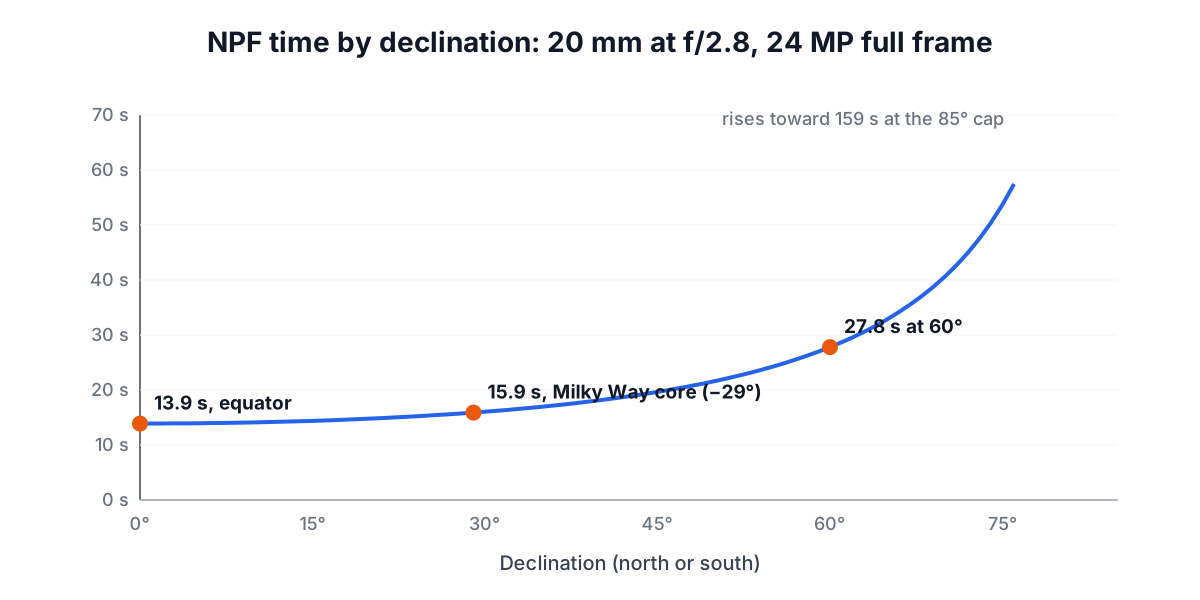
Both rules as stated assume the worst case, stars on the celestial equator. Stars at higher declinations move more slowly by the factor cos δ, so the safe time grows by 1 ÷ cos δ. The calculator applies that to the NPF result (with δ capped at 85°, because near the pole the factor grows without bound and other limits take over).
For the same 20 mm f/2.8 setup:
| Target | Declination | NPF time | Drift on sensor |
|---|---|---|---|
| Celestial equator, Orion's belt | 0° | 13.9 s | 1.458 µm/s |
| Milky Way core (Sagittarius) | about −29° | 15.9 s | 1.276 µm/s |
| Northern sky, e.g. Cassiopeia | about +60° | 27.8 s | 0.729 µm/s |
| Near Polaris | +89° (capped at 85°) | 159 s | 0.025 µm/s |
A wide-angle frame contains a range of declinations, so the time that keeps the whole frame sharp is set by the stars closest to the equator in it. Use the declination of the part of the sky that matters most, or leave it at 0° to be safe.
What to do with the extra or missing seconds
A sharp-star exposure is usually underexposed. The Milky Way core is around EV −10 at ISO 100, which at f/2.8 and ISO 3200 would need over four minutes. The Exposure Calculator shows the gap. Practical ways to close it:
- Widen the aperture. f/1.8 instead of f/2.8 is 1.3 stops more light. The NPF time drops slightly (35 × N gets smaller), but the light gain is far larger.
- Raise ISO. Modern sensors are close to ISO-invariant above a base value, so ISO 3200 to 6400 is typical.
- Use a wider lens. Halving the focal length doubles the allowed time.
- Stack frames. Averaging ten 13-second frames in stacking software cuts random noise by about √10 (roughly 3.3 times), close to what a single 130-second exposure would collect, without the trails.
- Track. A star tracker turns the camera with the sky and removes the limit for the stars, although the foreground then blurs.
Focus matters as much as time. Use live view magnified on a bright star and focus manually; a slightly soft focus makes stars bigger and hides the trail, but also loses faint stars. The Depth of Field Calculator helps when you want a foreground in the frame too.
Common mistakes
- Entering the equivalent focal length into NPF. NPF uses the actual focal length and the real pixel pitch. Only the 500 rule uses the crop factor.
- Expecting zero trailing. Both rules allow some movement; they differ in how much. If you print large or crop, choose shorter times.
- Ignoring corners. Wide-angle lenses stretch stars at the edges (coma and projection), which can look like trailing even at short times.
- Using one time for the whole night. As you swing from Polaris toward the south, the safe time drops.
Sources
- Société Astronomique du Havre, NPF rule by Frédéric Michaud (the simplified formula t = (35N + 30p) ÷ f is the form widely published from that work).
- International Earth Rotation and Reference Systems Service (IERS), length of the sidereal day, 86,164.09 s.
- Wikipedia, "Sidereal time" and "Declination" (sky rotation rate and the cos δ dependence).
Check your own camera and lens in the Star Trail Calculator.
Related searches
- npf rule calculator
- 500 rule astrophotography
- npf rule formula
- max shutter speed for stars
- milky way shutter speed 20mm
- pixel pitch calculator
- star trails declination
- 500 rule vs npf rule
- how long can i expose stars without trails