
Payback Period Formula: Simple, Discounted and Uneven Cash Flows
How to calculate payback with even and uneven cash flows, the interpolation step, discounted payback with present values, what payback misses and how it relates to NPV.
· 10 min read
The payback period answers one plain question about an investment: how long until I get my money back? It is the first number many owners and managers look at when deciding whether to buy a machine, fit solar panels or fund a project, because it is easy to calculate and easy to explain. It also has blind spots that can lead to poor decisions. This guide covers the formula for even and uneven cash flows, the interpolation step that trips people up, the discounted version that fixes one of the blind spots, and how payback fits alongside NPV and IRR. The Payback Period Calculator does both versions and draws the cumulative cash curve.
Payback with even cash flows
If an investment returns the same amount every year, payback is a single division:
Payback period = initial investment / annual cash flow
A 50,000 machine that saves 12,500 a year in labour and scrap pays back in 50,000 / 12,500 = 4 years. A 6,000 heat pump upgrade that saves 900 a year on energy takes 6.67 years, or 6 years and 8 months.
"Cash flow" means the net cash the investment adds each period: extra revenue or savings minus any extra running costs it creates (maintenance, consumables, licences). Use after-tax figures if you want an after-tax payback.
Payback with uneven cash flows
Most real projects do not return the same amount every year. Sales ramp up, savings grow as a process beds in, or a big contract lands in year two. Then you build a running total.
- Start with the investment as a negative balance.
- Add each year's cash flow in turn.
- Find the year in which the balance first reaches zero or more. That is the recovery year.
- Interpolate within that year: payback = years before the recovery year + unrecovered amount at its start / cash flow in the recovery year.
Worked example
An investment of 100,000 returns 30,000, 40,000, 50,000 and 20,000 over four years.
| Year | Cash flow | Cumulative |
|---|---|---|
| 0 | -100,000 | -100,000 |
| 1 | 30,000 | -70,000 |
| 2 | 40,000 | -30,000 |
| 3 | 50,000 | +20,000 |
| 4 | 20,000 | +40,000 |
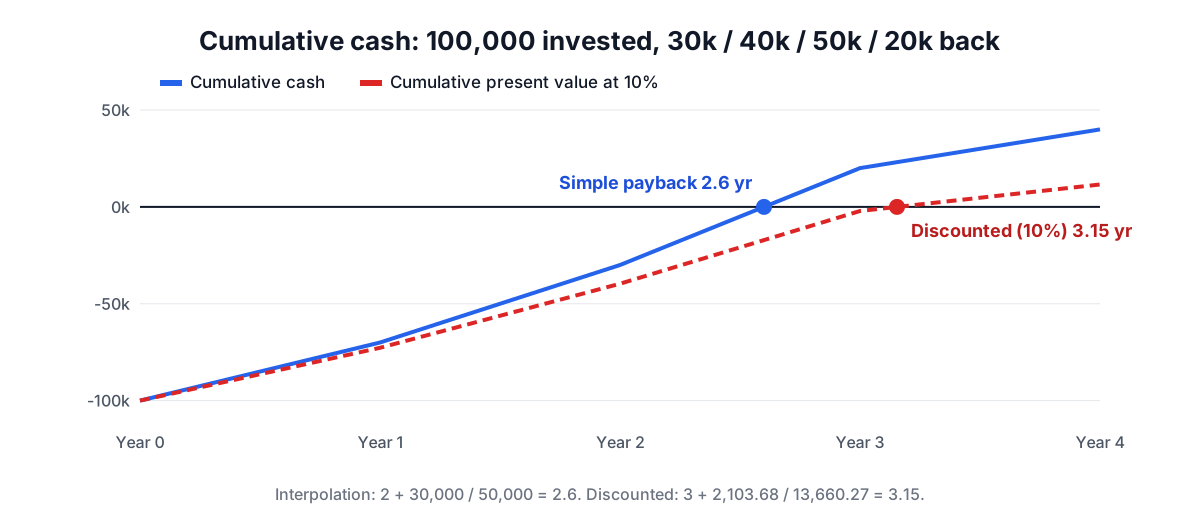
The balance crosses zero during year 3. At the start of year 3, 30,000 is still to be recovered, and year 3 brings 50,000. Payback = 2 + 30,000 / 50,000 = 2.6 years. In years and months, 0.6 x 12 = 7.2, so about 2 years 7 months.
The interpolation assumes the year's cash arrives evenly through the year. That is the standard textbook convention and is reasonable for steady sales or savings. If cash arrives in a lump (a single annual contract payment), the honest answer is "during year 3", and the calculator lets you switch to monthly periods for a finer answer.
Discounted payback
Simple payback treats 1,000 received in year four as worth the same as 1,000 today. It is not: money today can be invested or used to pay down debt. Discounted payback fixes that by converting each cash flow to its present value before adding it up:
Present value of year t = cash flow / (1 + r)^t
where r is the discount rate per period, usually your cost of capital or the return you require from projects of this risk.
Same example at 10%
| Year | Cash flow | Discount factor | Present value | Cumulative PV |
|---|---|---|---|---|
| 0 | -100,000 | 1.0000 | -100,000.00 | -100,000.00 |
| 1 | 30,000 | 0.9091 | 27,272.73 | -72,727.27 |
| 2 | 40,000 | 0.8264 | 33,057.85 | -39,669.42 |
| 3 | 50,000 | 0.7513 | 37,565.74 | -2,103.68 |
| 4 | 20,000 | 0.6830 | 13,660.27 | +11,556.59 |
After three years the discounted balance is still 2,103.68 short. Year 4 is worth 13,660.27 today, so discounted payback = 3 + 2,103.68 / 13,660.27 = 3.15 years. The final cumulative figure, 11,556.59, is the project's net present value over the four years.
Three things always hold when the rate is positive and the flows are positive:
- Discounted payback is longer than simple payback.
- Some projects that pay back on a simple basis never pay back once discounted.
- If the discounted payback falls within the project's life, the NPV over that life is positive.
What payback leaves out
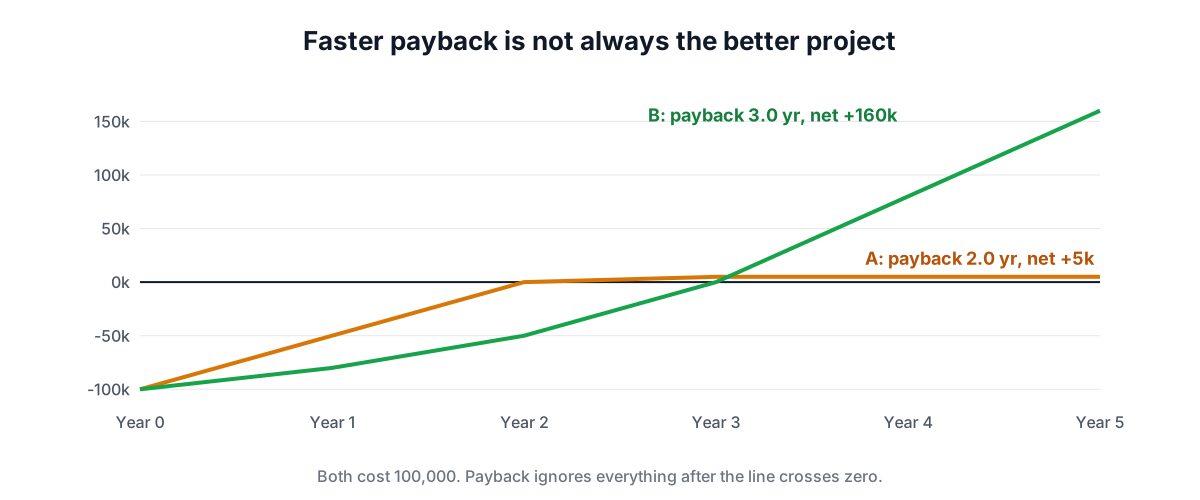
Payback is popular because it measures something managers care about, how long capital is at risk, and because it is easy to explain. But it ignores everything after the payback date.
Consider two projects that both cost 100,000:
| Year | Project A | Project B |
|---|---|---|
| 1 | 50,000 | 20,000 |
| 2 | 50,000 | 30,000 |
| 3 | 5,000 | 50,000 |
| 4 | 0 | 80,000 |
| 5 | 0 | 80,000 |
| Simple payback | 2.0 years | 3.0 years |
| Net cash | +5,000 | +160,000 |
A strict "payback under 2.5 years" rule picks A, which barely makes money, over B, which returns 2.6 times its cost. That is why finance texts recommend payback as a screen for liquidity and risk, used with net present value or internal rate of return rather than instead of them. The NPV and IRR Calculator gives those figures for the same cash flows.
When payback is the right tool
- Cash is tight. A small business that needs its money back to fund the next order should care how quickly it returns.
- The future is uncertain. Technology that may be obsolete in three years, a lease with an uncertain renewal, or a market that may close. Cash beyond a few years is speculative anyway.
- Many small decisions. Energy-saving fittings, tooling, software subscriptions: a payback rule (for example, under two years) lets people decide without a full financial model.
- Communicating. "It pays for itself in 18 months" is understood by everyone in the room.
What is a good payback period?
There is no universal answer. Compare the payback with the life of the asset and with what the business can afford to tie up. Practical habits:
- Equipment and process improvements are often expected to pay back in two to three years.
- Energy efficiency upgrades are often accepted at five to ten years because the savings are reliable and the equipment lasts longer. Solar installations have their own detailed model in the Solar Payback Calculator.
- Buildings and infrastructure can have payback periods of a decade or more and are judged mainly on NPV.
A payback longer than the asset's useful life is a clear no: the investment wears out before it has returned its cost.
Practical points
Match the rate to the period. With monthly cash flows, use a monthly rate. A 12% annual rate is about 0.95% a month compounded ((1.12)^(1/12) - 1), or 1% as a simple approximation.
Include later outflows. A machine that needs a 20,000 overhaul in year 5 should show -20,000 in that year. If the running total falls back below zero after payback, the calculator warns you, because payback alone would then overstate how safe the project is.
Do not double-count depreciation. Payback uses cash. Depreciation is an accounting charge, not a cash outflow, though it affects tax and therefore after-tax cash flow. The Depreciation Calculator helps with the tax side.
Watch the timing convention. The formulas here assume each period's cash arrives at the end of the period for discounting and evenly within the period for interpolation, which is the convention most textbooks and spreadsheets use.
Summary of formulas
- Even flows: payback = investment / cash flow per period.
- Uneven flows: payback = years before recovery + unrecovered amount / cash flow in the recovery year.
- Discounted: apply the same steps to cash flow / (1 + r)^t.
- NPV over the horizon = the final cumulative discounted balance.
Run your own figures in the Payback Period Calculator, and check the overall return with the ROI Calculator.
Sources
- Brealey, Myers and Allen, Principles of Corporate Finance, chapter on NPV and other investment criteria (payback and discounted payback).
- CFA Institute curriculum, capital budgeting: payback period and discounted payback period.
Related searches
- payback period formula
- payback period uneven cash flows
- discounted payback period
- payback period interpolation
- payback period vs npv
- payback period in years and months
- what is a good payback period
- payback period example