
Percentages, Fractions and Ratios: How the Arithmetic Fits Together
Why percent change is not symmetric, how GCF and LCM drive every fraction sum, why some decimals repeat, and how prime factors explain all three.
· 9 min read
A shop raises a price from 80 to 100 and calls it a 25% increase. A month later it cuts the price back to 80 and advertises 20% off. Both numbers are correct, and the customer who expected "25% off" is not wrong to feel puzzled. Most everyday arithmetic trouble comes from moments like this, where the same quantity is divided by a different base, or where two fractions are added before anyone has agreed on a common denominator.
This guide connects the pieces: percentages, fractions, ratios, the greatest common factor and least common multiple, prime factors, and long division. They are one topic seen from several angles. Every example can be reproduced in the Percentage Calculator, Fraction Calculator, Ratio Calculator, GCF and LCM Calculator, Prime Factorization Calculator and Long Division Calculator.
Percentages are fractions with a fixed denominator
Per cent means per hundred, so 20% is 20/100 and 0.2 is the same number again. Almost every percent question is one equation, part = rate × whole, with one of the three quantities missing:
part  = rate × whole         20% of 150       = 0.20 × 150 = 30
rate  = part / whole         30 out of 150    = 0.20 = 20%
whole = part / rate          30 is 20% of ... = 30 / 0.20 = 150
The skill is spotting which number is the whole. "30 is what percent of 150" puts 150 on the bottom. "150 is what percent of 30" gives 500%. Read the sentence, find the word "of", and the number after it is usually the whole.
Change versus difference
Percent change has a starting point. It divides the movement by the old value: (new − old) / |old| × 100. That is why the round trip from 80 to 100 and back is +25% then −20%: the 20-unit move is measured against 80 the first time and against 100 the second.
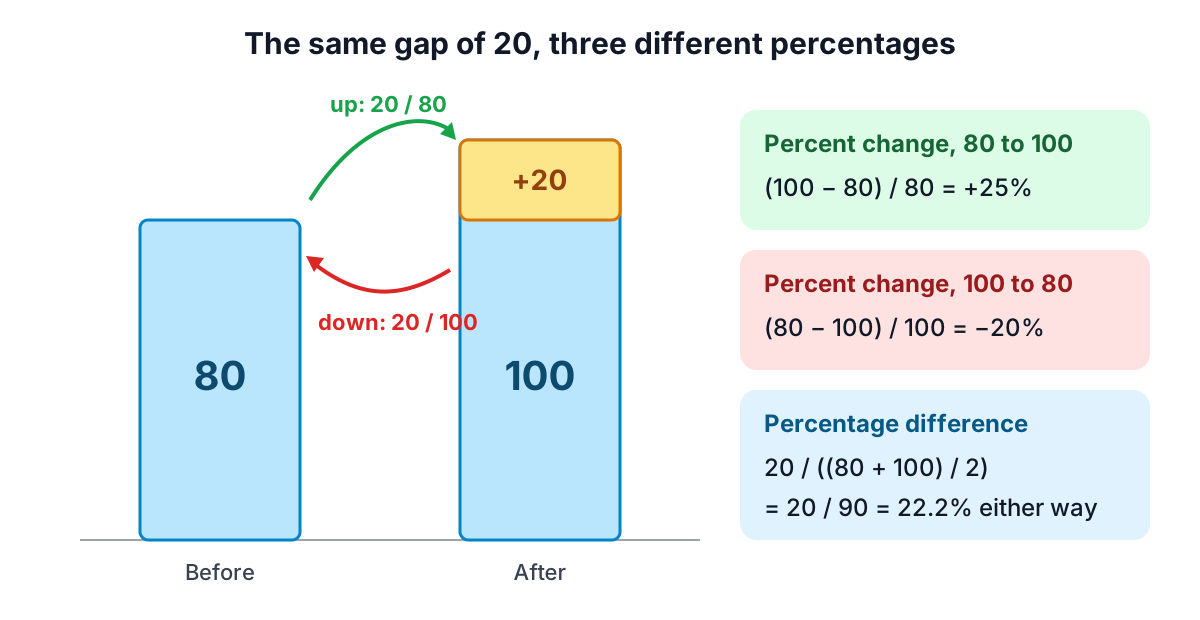
Percentage difference has no starting point. It divides the gap by the average of the two values, so 80 and 100 differ by 20 / 90 = 22.2% whichever you list first. Use it to compare two measurements, two quotes or two lab methods where neither is the reference. Use percent change for growth, discounts and anything with a before and after.
Two more traps sit nearby. Successive changes multiply: +10% then +10% is ×1.1 × 1.1 = ×1.21, a 21% rise, and −50% followed by +50% leaves you at 75%. And percentage points are not percent: an interest rate moving from 4% to 5% rose one point, which is a 25% relative increase.
Fractions run on GCF and LCM
Adding fractions needs a shared denominator. Any common multiple works, but the least common multiple keeps the numbers small and saves a big simplification at the end. For 1/4 + 1/6, the LCM of 4 and 6 is 12, so the sum is 3/12 + 2/12 = 5/12. Multiplying is easier, tops times tops and bottoms times bottoms, and dividing is multiplying by the reciprocal: 1/2 ÷ 3/4 = 1/2 × 4/3 = 2/3.
Simplifying a fraction is dividing top and bottom by their greatest common factor. 18/24 has GCF 6, so it is 3/4. The GCF is so central that its oldest algorithm is still the best one. Euclid wrote it down around 300 BC: divide the larger number by the smaller, keep the remainder, repeat.
1071 = 2 × 462 + 147
 462 = 3 × 147 + 21
 147 = 7 × 21  + 0      → GCF(1071, 462) = 21
It works because anything that divides both numbers also divides the remainder, and it needs only a handful of steps even for numbers with dozens of digits. For two numbers the LCM follows directly: LCM = a × b / GCF, so LCM(1071, 462) = 23,562. For three or more numbers, combine them a pair at a time, and do not use the product shortcut, which only holds for two.
The prime factor view
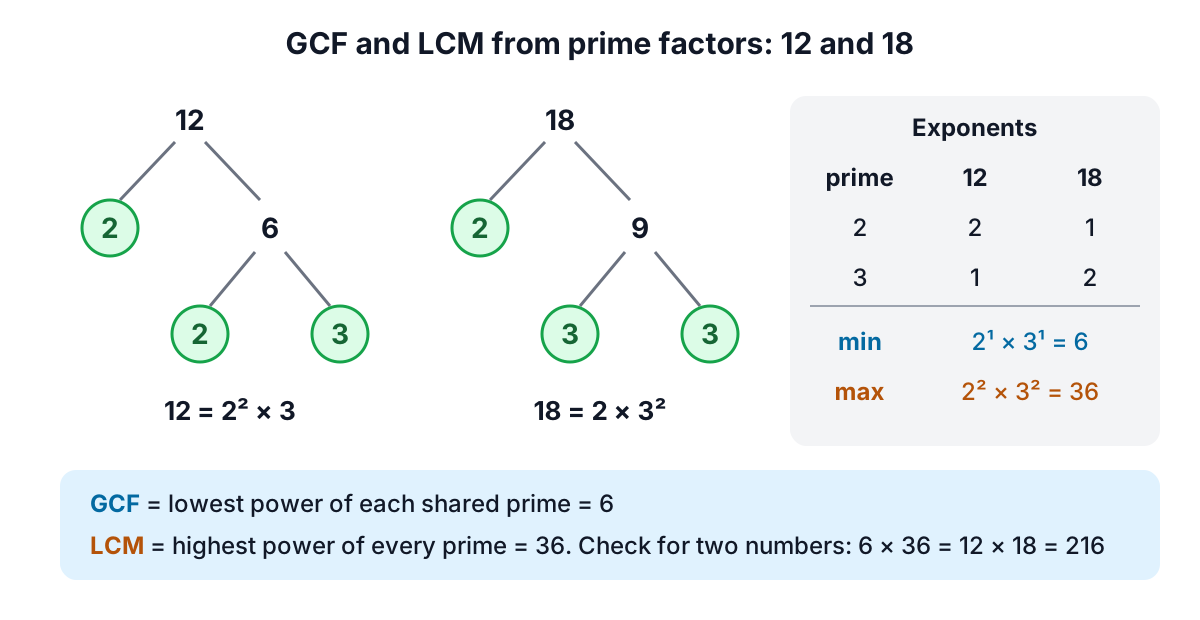
Every whole number above 1 has exactly one prime factorization. 12 = 2² × 3 and 18 = 2 × 3². Lay the exponents side by side and both GCF and LCM fall out: the GCF takes the lowest power of each shared prime (2 × 3 = 6) and the LCM takes the highest power of every prime present (2² × 3² = 36). This is slower than Euclid for big numbers, but it shows why the answers are what they are.
Exponents answer other questions too. A number p^a × q^b has (a + 1)(b + 1) divisors, so 360 = 2³ × 3² × 5 has 4 × 3 × 2 = 24. That is part of why 360 degrees, 60 minutes and 12 inches stuck: numbers with many divisors split evenly in many ways.
Factoring gets hard quickly, though. Small factors are found by trial division; larger ones need Pollard's rho method, which finds a factor in roughly the square root of that factor's size steps. A number made of two 20-digit primes is out of reach for a web page, and numbers made of two 300-digit primes are out of reach for everyone, which is the basis of RSA encryption.
Ratios: the same idea without a whole
A ratio compares parts to each other rather than to a whole. 2 : 3 means two parts of one thing for every three of another, which is 2/5 = 40% and 3/5 = 60% of the total. Ratios simplify exactly like fractions, by dividing every term by the GCF, so 24 : 36 becomes 2 : 3. Decimal terms need one extra step: multiply all terms by a power of ten first, so 1.5 : 2.25 becomes 150 : 225 and then 2 : 3.
A proportion sets two ratios equal, A : B = C : D, and cross-multiplying turns it into A × D = B × C. This "rule of three" solves scaling problems everywhere: if 3 cups of flour need 4 eggs, 9 cups need 9 × 4 / 3 = 12. Aspect ratios are the same arithmetic. A 1920-pixel-wide 16 : 9 frame is 1920 × 9 / 16 = 1080 high. Watch for sizes that are only close: 1366 × 768 reduces to 683 : 384, which is about 1.779 : 1 rather than 16 : 9's 1.778 : 1.
Long division and why decimals repeat
Long division is one loop: divide, multiply, subtract, bring down. Working 7452 ÷ 13, 13 goes into 74 five times (65, remainder 9), into 95 seven times (91, remainder 4), into 42 three times (39, remainder 3). The answer is 573 remainder 3, which can also be written 573 3/13. The check is quotient × divisor + remainder = 573 × 13 + 3 = 7452.
Keep going past the decimal point and something useful happens. Every remainder is smaller than the divisor, so with divisor 13 there are only 12 possible non-zero remainders. Sooner or later one comes back, and from then on the digits repeat. 3/13 = 0.230769230769…, written 0.(230769). The same argument proves that every fraction is a decimal that either ends or repeats, and that the repeating block of n/d is at most d − 1 digits. 1/7 hits that limit with six digits, 142857.
Which fractions end? Exactly those whose denominator, in lowest terms, has no prime factors except 2 and 5, because those are the factors of 10. 3/8 = 0.375 ends; 1/6 = 0.1(6) and 1/12 = 0.08(3) repeat. So the prime factorization of the denominator tells you what the decimal will look like before you start dividing.
Judgment calls that the formulas do not make for you
- Which base? For percent change, decide what "before" means. For comparisons with no reference, use percentage difference and say so.
- When to round. Keep fractions exact through a calculation and round once at the end. Rounding 1/3 to 0.33 three times and adding gives 0.99, not 1.
- Exact or decimal? Measurements in inches, recipes and probability often read better as fractions. Money and engineering usually want decimals. The calculators show both so you can choose.
- Counting things. A ratio share of 33.33 people is not a person. Decide how to round and who gets the remainder before you publish the split.
The arithmetic is small, but the decisions around it are where most mistakes come from. Pick the base, keep values exact for as long as you can, and check the answer a second way: multiply back, add the parts up, or confirm that the GCF divides every number in the list.