
The Pomodoro Technique: How to Use 25-Minute Focus Sessions
Francesco Cirillo's method step by step: the 25/5 rhythm, long breaks, estimating tasks in pomodoros, handling interruptions, variations such as 50/10, and when it does not fit.
· 9 min read
The Pomodoro Technique is the simplest focus method there is: set a timer for 25 minutes, work on one thing until it rings, take a short break, repeat. It works for many people precisely because it asks so little. You do not need to plan your whole day or change your tools; you only need to protect the next 25 minutes. This guide explains where the method comes from, the full rhythm including long breaks, how to plan and estimate in pomodoros, how to deal with interruptions, the common variations, and when it is the wrong tool. The Pomodoro Timer runs the cycle for you with a task list and a daily tally.
Where the technique comes from
Francesco Cirillo developed the method as a university student in Italy in the late 1980s, while trying to study with fewer distractions. He used a kitchen timer shaped like a tomato, and pomodoro is Italian for tomato. Each 25-minute work interval is called a pomodoro, and the plural is pomodoros (or pomodori, in Italian). Cirillo later wrote the method up and has taught it to teams and companies ever since.
The core idea is to treat time as a series of short, fixed intervals rather than a long stretch to be filled. A 25-minute interval is short enough to start without fuss and long enough to make real progress. The break that follows is not a reward to skip but part of the method: it keeps attention fresh for the next interval.
The basic rhythm
- Choose one task.
- Set the timer for 25 minutes and work only on that task.
- When the timer rings, stop and mark one pomodoro done.
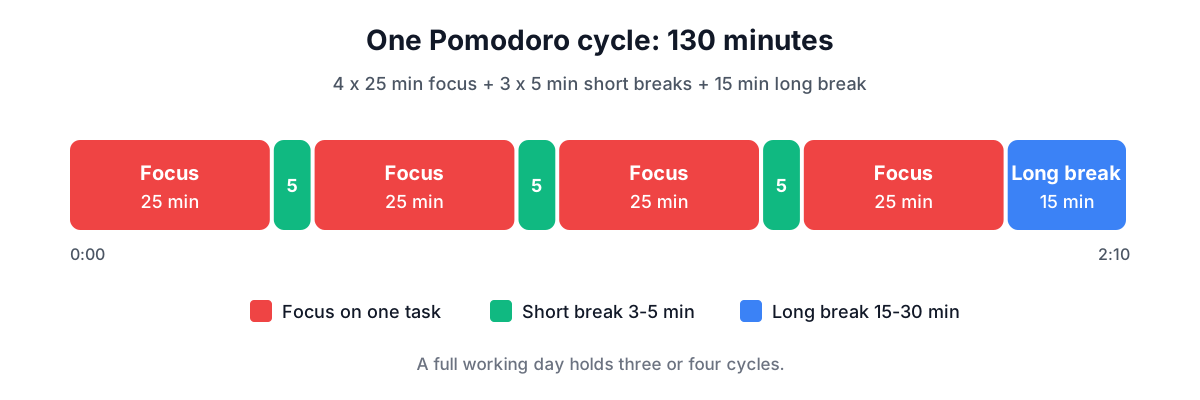
- Take a short break of 3 to 5 minutes.
- After four pomodoros, take a longer break of 15 to 30 minutes.
One full cycle of four 25-minute pomodoros, three 5-minute breaks and a 15-minute long break takes 130 minutes, a little over two hours. A typical working day holds three or four cycles.
Rules that make it work
- A pomodoro is indivisible. There is no such thing as half a pomodoro. If you abandon one for something else, it does not count; start a new one later.
- If you finish early, use the remaining minutes to review or improve what you did, rather than starting a new task mid-pomodoro.
- Take the breaks. Get up, look away from the screen, drink water. Do not use the break to check email; that is work by another name.
Planning and estimating in pomodoros
The timer is only half of the method. The other half is planning and recording, which turns the technique into a way of learning how long your work really takes.
In the morning, list the tasks for the day and estimate each in pomodoros. A task estimated at more than five to seven pomodoros is too big; split it. Tasks that take less than one can be grouped into a single pomodoro (answering several short emails, for example).
During the day, mark each completed pomodoro against its task. In the timer, select the active task and each finished focus session is counted automatically.
At the end of the day, compare estimates with actuals. Over a few weeks most people get noticeably better at estimating, which is useful for planning, for quoting work and for saying no to things that will not fit.
Converting time to pomodoros
| Focused work needed | 25-minute pomodoros | 50-minute sessions |
|---|---|---|
| 30 minutes | 2 | 1 |
| 1 hour | 3 | 2 |
| 2 hours | 5 | 3 |
| 4 hours | 10 | 5 |
Round up: a task needing 70 minutes of focused work is three pomodoros (70 / 25 = 2.8).
Handling interruptions
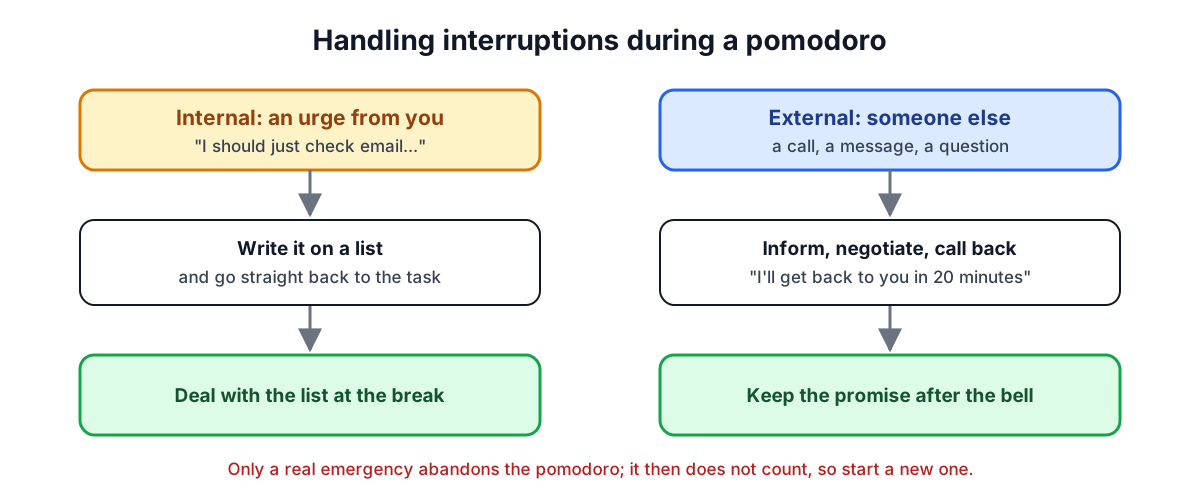
Interruptions are the reason the method exists. Cirillo separates them into two kinds.
Internal interruptions come from you: the urge to check a message, look something up or start a different task. When one appears, write it down on a list and go back to the task. Deal with the list in the break or plan it as a later pomodoro. Just noting the urge is often enough to let it go.
External interruptions come from other people: a call, a colleague, a notification. Cirillo's approach is summarised as inform, negotiate, call back: tell the person you are in the middle of something, agree when you will get back to them, and do so. Most things can wait 20 minutes. If something truly cannot, abandon the pomodoro and start a new one afterwards.
Practical ways to reduce interruptions before they happen:
- Silence phone and desktop notifications during focus sessions.
- Close chat and email tabs, or set a status that says when you will reply.
- Agree with your team that a visible timer means "ask me at the break".
Variations
The 25/5 rhythm is a starting point, not a law. Common variations, all available as presets or custom settings in the timer:
| Variation | Focus | Short break | Long break | Good for |
|---|---|---|---|---|
| Classic | 25 min | 5 min | 15 min after 4 | Getting started, study, admin |
| Longer recovery | 25 min | 5 min | 30 min after 4 | Long days, tiring work |
| Deep work | 50 min | 10 min | 30 min after 3 | Writing, programming, design |
| Warm-up | 15 min | 3 min | 15 min after 4 | Hard-to-start tasks, low energy |
Longer sessions suit work with a long ramp-up, where 25 minutes ends just as you get going. Shorter ones help when a task feels so unpleasant that starting is the hardest part. Whatever lengths you choose, keep the structure: fixed focus, real breaks, a longer rest after several rounds.
Using it for study
Students are the method's original users. A few adaptations help:
- Plan the session by topic, not by time: "two pomodoros on chapter 4 problems, one on flash cards".
- Use active recall in the pomodoro (practice questions, explaining aloud) rather than rereading.
- Use the short break to move, not to scroll.
- Count pomodoros as a measure of study, which is more honest than hours at a desk.
When it does not fit
The technique is not for every kind of work.
- Flow states. If you are deep in a problem when the bell rings, many people stretch the session or switch to a longer preset. Cirillo's rule is to stop; in practice, pick lengths that rarely interrupt you mid-thought.
- Reactive roles. Support, on-call or reception work is interruption by design. Use pomodoros for the blocks of planned work around it.
- Meetings and collaboration. The timer is for individual focus. Group work needs other structures, although protecting pomodoro blocks is a good argument for fewer and shorter meetings; the Meeting Cost Calculator puts a number on them.
Making the timer work for you
The Pomodoro Timer keeps the cycle running with a few practical details:
- It shows the countdown in the browser tab so you can see it from another window.
- It counts down from the moment the session will end, so it stays accurate in a background tab even when the browser slows timers down.
- It can play a short chime and show a desktop notification when a phase ends, and can start the next phase automatically.
- Tasks, settings and the daily tally are stored in your browser only.
Browsers block sound until you interact with a page, so press Start or Test sound once before relying on the chime.
Sources
- Francesco Cirillo, The Pomodoro Technique (Cirillo Company), description of the 25-minute pomodoro, 3 to 5 minute breaks and 15 to 30 minute long breaks after four pomodoros, and the handling of internal and external interruptions.
Start a session now with the Pomodoro Timer, or use the simple Countdown Timer for one-off intervals.
Related searches
- pomodoro technique
- how to use pomodoro technique
- pomodoro long break
- pomodoro for studying
- francesco cirillo pomodoro
- 50 10 pomodoro
- pomodoro interruptions
- how many pomodoros a day