
Product Manager Interviews: Product Sense, Metrics and Estimation
The question types in a PM loop, a structure for product sense, a worked metrics drop diagnosis, estimation done right, and a four-week preparation plan.
· 6 min read
"Design a product for elderly people." Within thirty seconds the candidate had proposed a large-button phone, a medication reminder, a fall detector and a video calling app. All reasonable ideas. None of them chosen, none of them tied to a specific person with a specific problem, and no way to tell which would matter. The interviewer's feedback was short: lots of ideas, no product judgement.
Product manager interviews test whether you make good decisions with incomplete information, and whether you can show your reasoning while you do it. This guide covers the main question types, a structure for each, a worked metrics example, and a preparation plan. The frameworks and practice prompts are in Product Manager Interview Prep.
The question types in a PM loop
Loops vary by company and level, but most draw from the same set:
| Round | Typical prompt | What is being assessed |
|---|---|---|
| Product sense or design | "Design a product for X" or "Improve Y" | User empathy, prioritization, creativity with focus |
| Strategy | "Should Netflix enter gaming?" | Market reasoning, competitive thinking, a clear recommendation |
| Metrics or analytics | "Engagement dropped 15%. Why?" | Structured diagnosis, metric choice, experiment design |
| Estimation | "How many smartphones are sold each year?" | Structured assumptions and arithmetic |
| Execution or technical | "How would you launch this?" or "Explain how X works" | Trade-offs with engineering, sequencing, risk |
| Behavioral and leadership | "Tell me about a disagreement with an engineer" | Influence, ownership, conflict handling |
Ask your recruiter which of these your loop includes. It is a normal question and the answer changes how you should spend your preparation time.
Product sense: pick a user, then a problem, then a solution
The product sense round is where focus matters most. A structure that works:
- Clarify the goal. Why would the company build this? Growth, retention, revenue, mission?
- Choose a user segment. List three or four, then pick one and say why: largest, most underserved, or best fit for the goal.
- List their problems. Walk through a day or a journey. Find the painful, frequent ones.
- Prioritize one problem. Use impact and frequency, and say what you are not solving.
- Generate solutions. Three different ideas, not three variants of one.
- Choose and refine. Pick one, describe the core experience, and name the main risk.
- Define success. One primary metric and one or two guardrails.
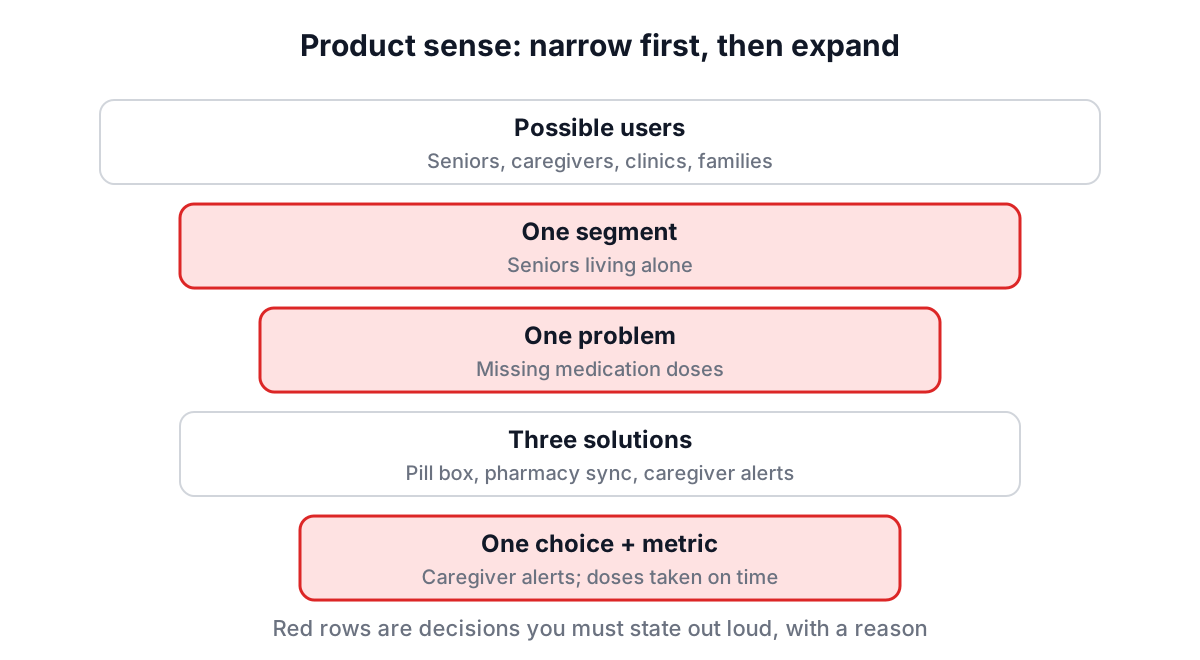
The CIRCLES method from Lewis Lin's book on PM interviews follows a similar order, and the Product Sense Framework in the tool is the same shape. What matters is narrowing before expanding: a narrow segment makes every later step concrete.
Metrics questions: a worked example
Metrics rounds usually start with a symptom. Take the practice prompt: "Daily active users for our mobile app dropped 20% last quarter."
Step 1: Is it real? Before any product theory, check for causes that are not about users at all:
- A tracking or logging change in a recent release
- A change in how "active" is defined
- An outage or app store issue
- Seasonality: compare with the same quarter last year
Step 2: Where is it? Segment the drop.
Platform:   iOS -3%, Android -38%   <- concentrated
Version:    Android 8.4 users -61%, older versions flat
Geography:  roughly even
New vs returning: both down on Android 8.4
In this invented example, the drop sits almost entirely in one Android release. That points to a bug, a crash, or a login problem in that version, not to a change in user taste.
Step 3: Hypothesize and test. Check crash rates and login success for 8.4, compare funnel step conversion with 8.3, and confirm with the engineering team what changed.
Step 4: Recommend. Roll back or hotfix, then add an alert on DAU by app version so the next drop is caught in days rather than a quarter.
The interviewer will often reveal data as you ask for it. Asking the right segmentation questions in the right order is most of the score. Google's HEART framework (Happiness, Engagement, Adoption, Retention, Task success) and the AARRR funnel (Acquisition, Activation, Retention, Referral, Revenue) are useful vocabularies when choosing what to measure, but name one primary metric rather than listing a whole framework.
Estimation: structure beats precision
For "How many smartphones are sold globally each year?", a top-down approach:
World population                         ~8 billion
Share of people with a smartphone        ~60-70%  -> ~5 billion users
Average replacement cycle                ~3 years
Annual sales ≈ 5 billion / 3             ≈ 1.6-1.7 billion
Adjust down: many phones are second-hand or kept longer than 3 years
Answer: roughly 1.2 to 1.5 billion units, central estimate ~1.4 billion
Then sanity check against anything you know. Published industry figures in recent years have been in the low billions per year, which is in the right range. The Market Sizing Calculator and TAM Calculator are useful for practising the top-down and bottom-up arithmetic on real product ideas.
Strategy questions
For "Should company X enter market Y?", work through: why X would want to (goal and capabilities), how attractive Y is (size, growth, margins), who already wins there and why, what X's advantage would be, how X would enter (build, buy, partner), and the main risks. Then answer the question. "It depends" without a recommendation is a common way to lose this round. Pick a side, state the condition that would change your mind, and move on.
Common mistakes
Solving for everyone. Choose a segment. It feels like you are leaving things out, and you are; that is the point.
Listing ideas without choosing. Interviewers want to see prioritization, so make a call and justify it.
Jumping to causes in metrics questions. Rule out data problems and localize the drop first.
Too many metrics. One north star and two or three guardrails is plenty.
Reciting a framework. Frameworks are scaffolding. Walking through every letter of an acronym regardless of the question sounds mechanical.
No technical credibility. You do not need to code, but you should be able to discuss APIs, latency, data pipelines and what makes a feature expensive to build.
A four-week preparation plan
Week 1: Learn the four frameworks in the tool. Read a few product teardowns and write a one-paragraph critique of an app you use daily.
Week 2: Product sense and metrics. One question of each per day, timed to 25 minutes, using Apply Framework to set up an outline and writing your answer under each step.
Week 3: Estimation and strategy, plus behavioral stories. Draft six to eight stories in the STAR answer builder.
Week 4: At least five mock interviews with another PM. Ask for blunt feedback on whether you chose clearly and finished with a recommendation.
If you are moving from engineering into product, spend extra time on metrics and strategy, which engineers practise least. Writing a short spec in the PRD Creator for one of your practice designs is also a good way to test whether your idea holds up beyond the interview answer.