
Projectile Motion Equations: Range, Height, Time and the Best Angle
Split the launch into horizontal and vertical motion and every projectile question becomes two simple equations. Range, peak height, flight time, launching from a height and hitting a target.
· 10 min read
A projectile is anything launched into the air and then left to gravity: a thrown ball, a jet of water, a long jumper, a stone kicked off a cliff. Without air resistance its path is a parabola, and every question about it (how far, how high, how long, at what angle) comes from two simple equations once you split the motion into horizontal and vertical parts. This post derives those equations, works through the common cases, and shows how launching from a height changes the best angle. The Projectile Motion Calculator does all of it with the path plotted.
Two motions at once
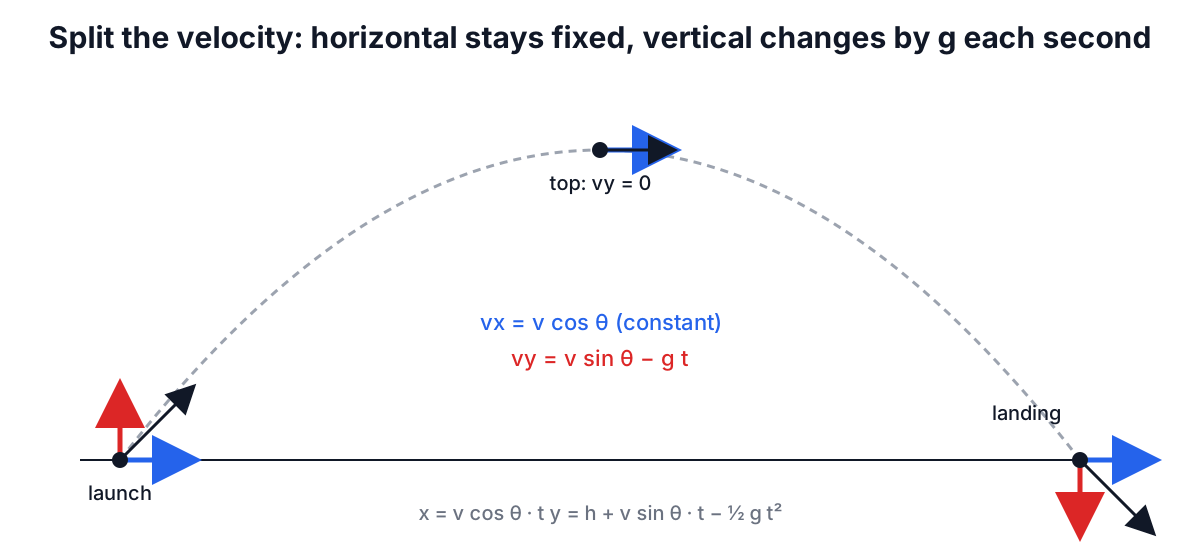
The key idea, set out by Galileo in his Two New Sciences (1638), is that the horizontal and vertical motions of a projectile are independent. Gravity pulls only downwards, so:
- Horizontally there is no force (ignoring air), and the velocity stays constant: vx = v cos θ.
- Vertically there is a constant downward acceleration g, so the velocity changes by g every second: vy = v sin θ − g t.
Here v is the launch speed and θ the launch angle above horizontal. The positions follow by integrating:
x = v cos θ × t
y = h + v sin θ × t − ½ g t²
where h is the launch height above the landing level. Eliminate t and you get the parabola y = h + x tan θ − g x² ÷ (2 v² cos² θ).
The four standard results on level ground
With h = 0 the equations give tidy closed forms. Using g = 9.80665 m/s²:
| Quantity | Formula | 20 m/s at 45° |
|---|---|---|
| Time of flight | T = 2 v sin θ ÷ g | 2.884 s |
| Time to the top | T ÷ 2 = v sin θ ÷ g | 1.442 s |
| Maximum height | H = v² sin² θ ÷ (2g) | 10.20 m |
| Range | R = v² sin 2θ ÷ g | 40.79 m |
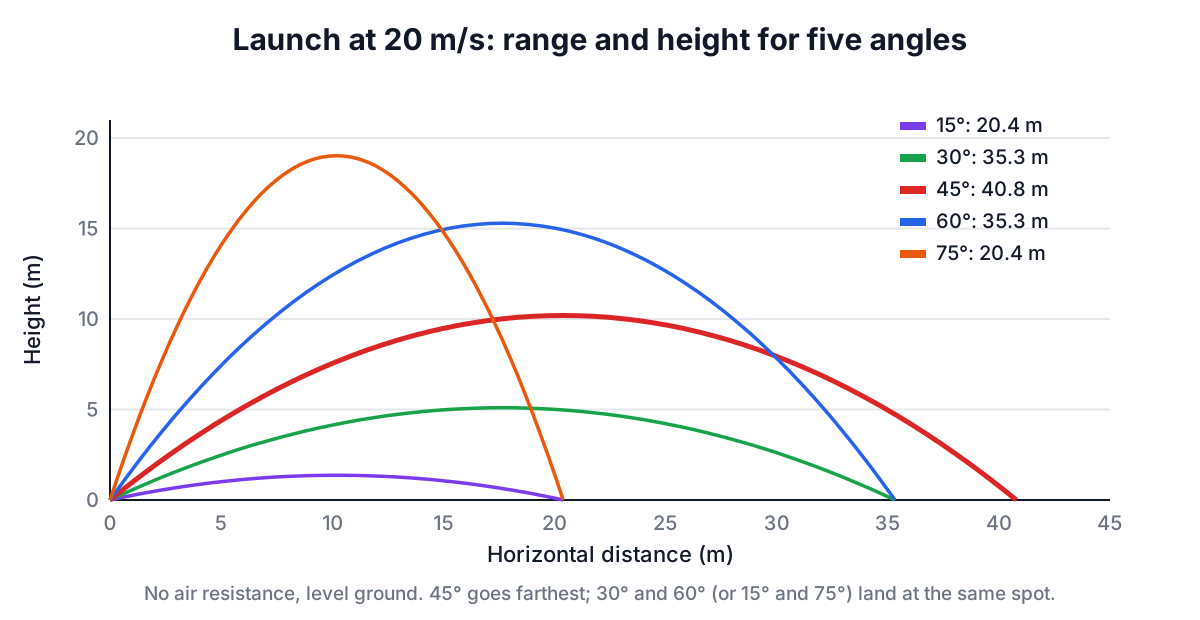
Two features of the range formula are worth noticing. First, R depends on sin 2θ, which peaks at 1 when θ = 45°, so 45° gives the greatest range, v² ÷ g. Second, sin 2θ is the same for θ and 90° − θ, so 30° and 60° land at the same place, as do 15° and 75°. The steep shot goes higher and stays up longer; the shallow one gets there sooner.
| Angle | Range | Max height | Flight time |
|---|---|---|---|
| 15° | 20.39 m | 1.37 m | 1.06 s |
| 30° | 35.32 m | 5.10 m | 2.04 s |
| 45° | 40.79 m | 10.20 m | 2.88 s |
| 60° | 35.32 m | 15.30 m | 3.53 s |
| 75° | 20.39 m | 19.03 m | 3.94 s |
Also note that the projectile lands at the same speed it was launched with, at the same angle below horizontal. On level ground with no drag the path is symmetric.
Launching from a height
Most real launches are not from ground level. A ball is released at shoulder height, a stone is thrown off a cliff, water leaves a nozzle above the lawn. The flight time now comes from solving the vertical equation for y = 0, a quadratic in t:
T = (v sin θ + √(v² sin² θ + 2 g h)) ÷ g
The range is still vx × T, and the maximum height is h + v² sin² θ ÷ (2g) when the launch angle is upward.
Horizontal launch from a ledge
A ball rolls off a 20 m ledge at 10 m/s (θ = 0). The vertical motion is exactly a drop from 20 m, so T = √(2 × 20 ÷ 9.80665) = 2.020 s, and the ball lands 10 × 2.020 = 20.20 m out. It hits the ground at √(10² + (9.80665 × 2.020)²) = 22.19 m/s, steeply, at 63.2° below horizontal. The horizontal speed has no effect on the fall time: a ball dropped straight down from the same ledge lands at the same moment.
The best angle is no longer 45°
When you launch from above the landing level, the projectile gets extra flight time on the way down, and it pays to launch flatter so more of the speed goes into horizontal distance. The optimum satisfies:
tan θ = v ÷ √(v² + 2 g h), giving a maximum range of (v ÷ g) × √(v² + 2 g h)
For the 10 m/s ball on the 20 m ledge, the best angle is 24.3°, which reaches 22.62 m instead of 20.20 m. For a shot put released at 13.7 m/s from 2.1 m, the drag-free optimum is 42.2°. Measured release angles of elite throwers are lower, mostly in the mid to high 30s, partly because the human body can push harder at flatter angles, so the real optimum is lower still; at 37° the formula gives 20.86 m against 21.13 m at the theoretical best, a difference of about 1%.
Hitting a target
The reverse question, what angle lands on a target at distance d and height y above the launch point, also has a closed form. Substituting into the parabola and solving for tan θ:
tan θ = (v² ± √(v⁴ − g(g d² + 2 y v²))) ÷ (g d)
The ± gives two angles, a low direct shot and a high lob. If the expression under the square root is negative, the target is out of range at that speed. For a 20 m/s throw from 1.5 m at a target 30 m away on the ground (y = −1.5 m), the two angles are 20.2° and 67.0°. On level ground with the same speed and distance they would be 23.7° and 66.3°, which add up to 90° as the symmetry predicts.
Artillery tables, basketball shooting models and game engines all use this formula. The calculator's "Hit a target" panel gives both angles or tells you to throw harder.
What air resistance does
Everything above assumes no air. Drag grows with the square of speed and always opposes the motion, so it:
- shortens the range and the maximum height,
- makes the descent steeper than the ascent (the path is no longer symmetric),
- lowers the best launch angle below the drag-free value,
- makes heavier objects of the same size travel farther than lighter ones.
How much depends on the ratio of drag to weight. A 7.26 kg shot put loses only a percent or so of its range. A baseball leaving the bat at about 45 m/s (100 mph) could travel up to v² ÷ g = 206 m in vacuum, but a well-struck fly ball at that speed carries roughly 120 m (about 400 ft), because drag removes a large share of its speed early in the flight. A table tennis ball is dominated by drag and barely follows a parabola at all. So treat drag-free numbers as an upper bound for fast, light objects and a good estimate for slow, dense ones. For a vertical drop with drag modelled exactly, use the Free Fall Calculator.
Other planets
The formulas scale with g. On the Moon (1.62 m/s²) a 20 m/s launch at 45° travels v² ÷ g = 246.9 m and rises to 61.7 m, six times as far and high as on Earth, and stays up 17.5 s. The calculator has presets for the Moon, Mars, Venus, Mercury and Jupiter.
A checklist for projectile problems
- Draw the launch point, the landing level and the angle. Decide which way is positive.
- Split the launch velocity into v cos θ and v sin θ.
- Use the vertical equation to find the time (to the top, to landing, or to a given height).
- Use that time in the horizontal equation for distance.
- Check the answer: does the flight time make sense for the height? Does a steeper angle go higher?
Common errors are using degrees in a calculator set to radians, forgetting the launch height, using 45° as the best angle when the launch is from a height, and mixing km/h with m/s. Convert speeds first: km/h ÷ 3.6, mph × 0.44704.
Try it
The Projectile Motion Calculator takes speed, angle, height and gravity, returns the range, peak height, time, impact speed and angle, the best angle for distance and the angles to hit a target, and draws the path. Related tools: the Kinetic Energy Calculator for the energy at launch and impact, and the Force Calculator for the forces that set the launch speed.
Sources
- Galileo Galilei, Dialogues Concerning Two New Sciences, 1638, Fourth Day (parabolic motion of projectiles).
- CGPM, 3rd General Conference (1901): standard acceleration of gravity, 9.80665 m/s².
- R. A. Serway and J. W. Jewett, Physics for Scientists and Engineers, chapter on motion in two dimensions.
- A. M. Nathan, "The effect of spin on the flight of a baseball", American Journal of Physics 76 (2008), on drag in baseball flight.
- NASA Goddard Space Flight Center, Planetary Fact Sheet, surface gravity values.
Related searches
- projectile motion equations
- range of a projectile formula
- maximum height of a projectile
- time of flight formula
- best launch angle from a height
- angle to hit a target
- horizontal projectile from a cliff
- why 45 degrees maximum range