
Readability Formulas Explained: Flesch, Fog, SMOG and More
Where Flesch Reading Ease, Flesch-Kincaid, Gunning Fog, SMOG, Coleman-Liau and ARI come from, worked calculations, what scores to aim for, and how to rewrite text that scores badly.
· 12 min read
Readability formulas turn a passage of text into a single number: a score from 0 to 100, or a US school grade. They are built into Microsoft Word, required by some regulators and quoted in style guides, yet most people who use them have never seen the formula. This guide shows where the six common formulas came from, works each one through by hand, explains what the numbers mean, and covers the part that matters most: how to change a text that scores badly. The Readability Checker calculates all six and highlights what to fix.
What the formulas measure
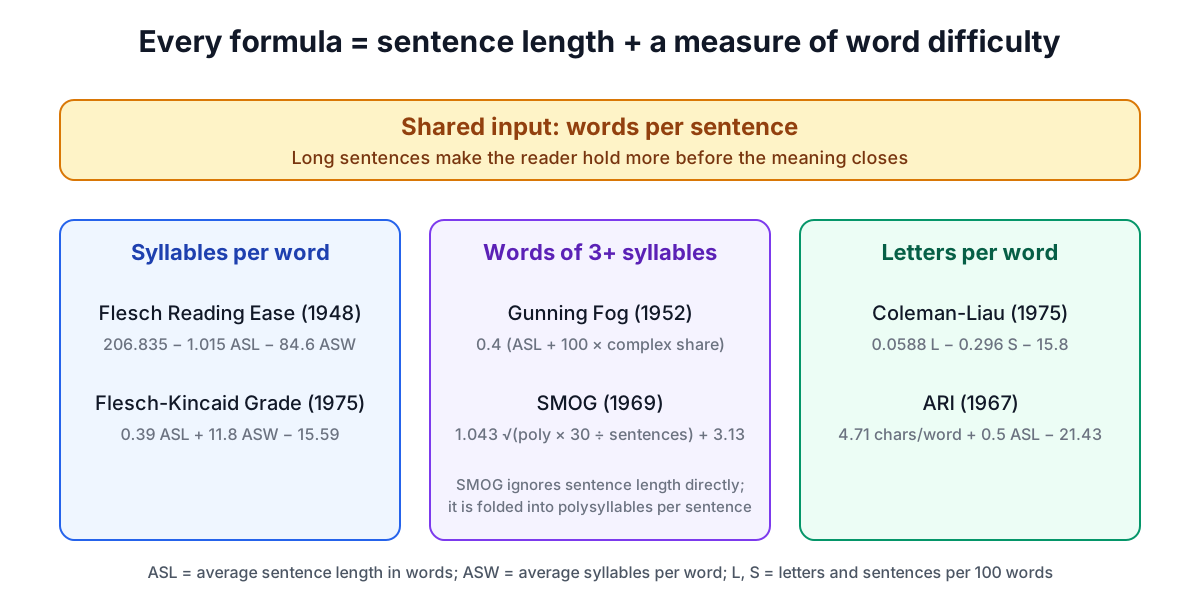
Every classic readability formula is a regression. Researchers gave readers passages, measured how well they understood them (with comprehension questions or cloze tests, where readers fill in deleted words), and then looked for simple text features that predicted the results. Two features kept winning:
- Sentence length, in words. Long sentences ask the reader to hold more in memory before the meaning closes.
- Word difficulty, approximated by length: syllables per word, the share of words with three or more syllables, or letters per word. Long words tend to be rarer and more abstract.
That is all the formulas see. They do not know whether your argument is clear, your terms are defined or your headings help. A formula is a fast check on the two things that make text physically harder to read, and a good way to compare two drafts of the same text.
The six formulas
Flesch Reading Ease (1948)
Rudolf Flesch published his formula in the Journal of Applied Psychology in 1948:
FRE = 206.835 − 1.015 × (words ÷ sentences) − 84.6 × (syllables ÷ words)
Higher is easier. Flesch gave a table for interpreting it:
| Score | Description | Typical reader |
|---|---|---|
| 90 to 100 | Very easy | 5th grade (age 10 to 11) |
| 80 to 90 | Easy | 6th grade |
| 70 to 80 | Fairly easy | 7th grade |
| 60 to 70 | Standard | 8th and 9th grade |
| 50 to 60 | Fairly difficult | 10th to 12th grade |
| 30 to 50 | Difficult | College |
| 0 to 30 | Very difficult | College graduate |
The scale is not capped: a string of one-syllable words in short sentences can exceed 100, and dense academic prose can go below zero.
Flesch-Kincaid Grade Level (1975)
J. Peter Kincaid and colleagues recalculated Flesch's two inputs for US Navy enlisted personnel and expressed the result as a school grade:
FKGL = 0.39 × (words ÷ sentences) + 11.8 × (syllables ÷ words) − 15.59
A score of 8 means a typical US eighth grader (about 13 to 14 years old) should follow it. This is the grade Microsoft Word shows in its readability statistics.
Gunning Fog Index (1952)
Robert Gunning, a newspaper consultant, counted "hard words" instead of syllables per word:
Fog = 0.4 × [(words ÷ sentences) + 100 × (complex words ÷ words)]
A complex word has three or more syllables, but Gunning excluded proper nouns, hyphenated compounds, and words that only reach three syllables because of -es, -ed or -ing ("departing" does not count, because "depart" has two syllables). The Fog index reads as the years of schooling needed; 12 is a high school senior.
SMOG (1969)
G. Harry McLaughlin's "Simple Measure of Gobbledygook" counts polysyllables (three or more syllables) in 30 sentences. The precise regression form is:
SMOG = 1.0430 × √(polysyllables × 30 ÷ sentences) + 3.1291
McLaughlin calibrated it against a strict criterion, full comprehension of test passages, so SMOG usually gives a grade or two higher than Flesch-Kincaid. That conservatism is why it is popular for patient information, where misunderstanding has consequences. It needs 30 sentences; with fewer, the formula extrapolates, and the Readability Checker flags the result.
Coleman-Liau Index (1975)
Meri Coleman and T. L. Liau wanted a formula a machine could compute without counting syllables, so they used letters:
CLI = 0.0588 × L − 0.296 × S − 15.8
where L is letters per 100 words and S is sentences per 100 words.
Automated Readability Index (1967)
E. A. Smith and R. J. Senter developed ARI for the US Air Force, again using characters so that it could be measured mechanically:
ARI = 4.71 × (letters ÷ words) + 0.5 × (words ÷ sentences) − 21.43
A worked example
Take a passage with 100 words, 5 sentences, 130 syllables, 10 complex words and 470 letters. Then words per sentence is 20 and syllables per word is 1.3.
| Formula | Calculation | Result |
|---|---|---|
| Flesch Reading Ease | 206.835 − 1.015 × 20 − 84.6 × 1.3 | 76.6 (fairly easy) |
| Flesch-Kincaid | 0.39 × 20 + 11.8 × 1.3 − 15.59 | 7.6 |
| Gunning Fog | 0.4 × (20 + 100 × 10 ÷ 100) | 12.0 |
| Coleman-Liau | 0.0588 × 470 − 0.296 × 5 − 15.8 | 10.4 |
| ARI | 4.71 × 4.7 + 0.5 × 20 − 21.43 | 10.7 |
The same text gets grades from 7.6 to 12. That spread is normal: the formulas weight word length differently, and Fog's complex-word share jumps quickly with a few technical terms. Pick one formula for a project and track it, or look at the average, rather than chasing every score.
Why scores differ between tools
Two checkers can report different numbers for identical text. The reasons are mundane:
- Syllable counting. English spelling is irregular, so software estimates syllables. "Created" has three, "naked" two, "baked" one. The Readability Checker uses spelling rules plus an exception list and matches dictionary counts for about 95% of common words; other tools use different rules or a pronunciation dictionary.
- Sentence detection. Is "Dr." the end of a sentence? Is a heading without a full stop a sentence? Is a bullet list one sentence or ten? The checker skips titles, initials, abbreviations and decimals, and lets you choose whether line breaks end sentences.
- Numbers and symbols. Flesch's own instructions counted numbers as words and their spoken syllables; tools vary.
A one-point difference between tools is noise. A five-point drop after you edit is real.
What score to aim for
There is no universal target, but several reference points are widely used:
- General web and product copy: Flesch Reading Ease 60 or higher, or grade 8 or lower. Visitors skim, and many read on phones.
- Health and public information: grade 6 to 8. Health literacy guidance from bodies such as the US National Institutes of Health and the American Medical Association recommends patient materials at or below these levels.
- Government writing: the US Plain Writing Act of 2010 requires federal agencies to write clearly for the public. It does not set a score, but the Federal Plain Language Guidelines that support it push the same habits the formulas reward: short sentences, common words and active voice.
- Insurance and consumer contracts: several US states, Florida among them, set a minimum Flesch Reading Ease score for some policy documents.
- Specialist and academic writing: grades 12 to 16 are normal. Experts read technical terms quickly, and replacing a precise term with a vague one helps nobody.
How to lower a score without dumbing it down
The formulas tell you which two levers to pull. In practice:
- Split long sentences. This moves scores the most. A 40-word sentence with three clauses usually becomes two or three sentences with the same content. Look for "and", "which", "while" and semicolons as split points.
- Use the everyday word. "Use" for "utilize", "about" for "approximately", "help" for "facilitate", "before" for "prior to", "to" for "in order to". The checker marks these and suggests the alternative.
- Make the actor the subject. "The form must be completed by the applicant" becomes "Complete the form" or "You must complete the form". Active voice is usually shorter and says who does what. The checker underlines passive constructions such as "was decided" and "is being reviewed".
- Cut adverbs that add nothing. "Really", "very", "basically" and "actually" rarely change the meaning.
- Keep necessary terms, but define them. A term the reader needs should stay; explain it once in plain words.
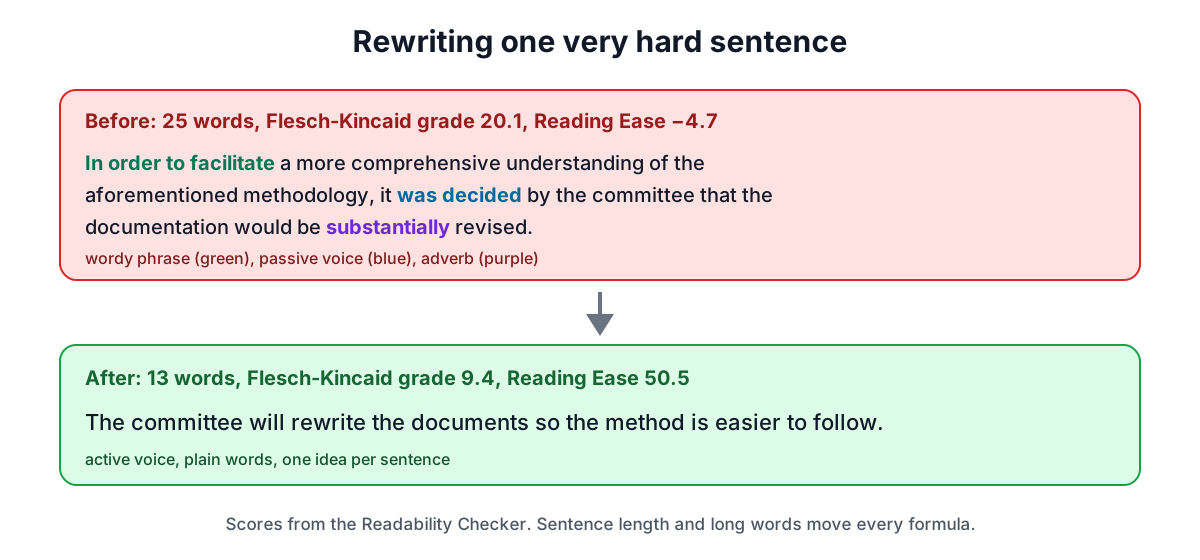
Here is the kind of sentence the checker marks very hard:
In order to facilitate a more comprehensive understanding of the aforementioned methodology, it was decided by the committee that the documentation would be substantially revised.
It has 25 words, many of them long, a wordy opener and a passive verb. A rewrite:
The committee will rewrite the documents so the method is easier to follow.
That is 13 words. The Flesch-Kincaid grade falls from about 20 to about 9, and the reader learns who is acting.
Limits of readability formulas
Formulas have been criticised since the 1950s, and the criticisms are fair:
- They ignore meaning, order and coherence. Shuffle the sentences of a paragraph and the score does not change.
- They reward short words even when the short word is wrong or ambiguous.
- They were calibrated on school readers and military recruits in the mid-twentieth century, in English. Scores for other languages, or for very short texts such as a button label, are not meaningful.
- Writing to the formula can produce choppy text. A grade 4 score on adult technical documentation is not a goal.
Used as a check rather than a target, they still earn their place: they find the sentences that tire readers, and they make it easy to show a colleague that the new draft is clearer than the old one.
Using the Readability Checker
Paste a draft into the Readability Checker, set a target grade, and work through the highlights from red to amber, then the underlined passive verbs and the green wordy phrases. Watch the scores move as you edit. The Word Counter is useful alongside it for length and reading time, and the Online Diff Tool shows exactly what changed between your before and after versions.
Sources
- Flesch, R. (1948). A new readability yardstick. Journal of Applied Psychology, 32(3), 221 to 233.
- Kincaid, J. P., Fishburne, R. P., Rogers, R. L., and Chissom, B. S. (1975). Derivation of new readability formulas for Navy enlisted personnel. Research Branch Report 8-75, Naval Technical Training Command.
- Gunning, R. (1952). The Technique of Clear Writing. McGraw-Hill.
- McLaughlin, G. H. (1969). SMOG grading: a new readability formula. Journal of Reading, 12(8), 639 to 646.
- Coleman, M., and Liau, T. L. (1975). A computer readability formula designed for machine scoring. Journal of Applied Psychology, 60(2), 283 to 284.
- Smith, E. A., and Senter, R. J. (1967). Automated Readability Index. AMRL-TR-66-220, Aerospace Medical Research Laboratories.
- Federal Plain Language Guidelines, plainlanguage.gov.
Related searches
- readability formulas
- flesch reading ease score meaning
- flesch kincaid grade level formula
- gunning fog index example
- smog readability formula
- coleman liau index
- what grade level should i write at
- plain language rewriting tips
- passive voice checker