
401(k), Roth IRA and Annuities: The Maths Behind Retirement Accounts
The 2026 limits, how match formulas really pay, when Roth beats traditional, and how an annuity turns a balance back into income.
· 9 min read

A 401(k), a Roth IRA and an annuity look like three separate products, but they are three stages of the same job. The 401(k) and the IRA are where money goes in and compounds; the annuity is how a balance turns back into a monthly income. This guide works through the arithmetic of each with real numbers from the 401(k) Calculator, the Roth IRA Calculator and the Annuity Calculator, and points out where the judgment calls are. It explains the maths; it is not tax or investment advice.
The 2026 limits and how they are applied
The IRS announced the 2026 figures on 13 November 2025 (news release IR-2025-111, with the technical detail in Notice 2025-67):
| Limit | 2026 |
|---|---|
| 401(k), 403(b), governmental 457 and TSP elective deferrals | $24,500 |
| Catch-up, age 50 and over | $8,000 |
| Catch-up, ages 60 to 63 (SECURE 2.0) | $11,250 |
| Total employee plus employer additions, 415(c) | $72,000 |
| Pay that can be counted for employer contributions | $360,000 |
| IRA contribution (traditional and Roth combined) | $7,500 |
| IRA catch-up, age 50 and over | $1,100 |
Three details trip people up. First, catch-up eligibility depends on the age you reach by 31 December, not on your birthday having passed, so someone turning 50 in November can use the full catch-up that year. Second, the 60 to 63 catch-up replaces the ordinary one rather than adding to it: at 61 your personal ceiling is $24,500 + $11,250 = $35,750, and at 64 it drops back to $32,500. Third, the $24,500 is yours alone. Employer money sits under the separate $72,000 total, which matters for people with generous profit-sharing.
From 2026 there is also a tax-treatment rule: if your FICA wages from the employer were above $150,000 in the previous year, your catch-up contributions must be Roth. The amount is unchanged; the money is simply after-tax.
How employer match formulas really pay
A match formula has two numbers per tier: the rate the employer pays and the slice of your salary it applies to. "50% up to 6%" pays 50 cents per dollar on the first 6% of pay you defer. The chart shows how that compares with the common safe harbor formula of 100% of the first 3% plus 50% of the next 2%.
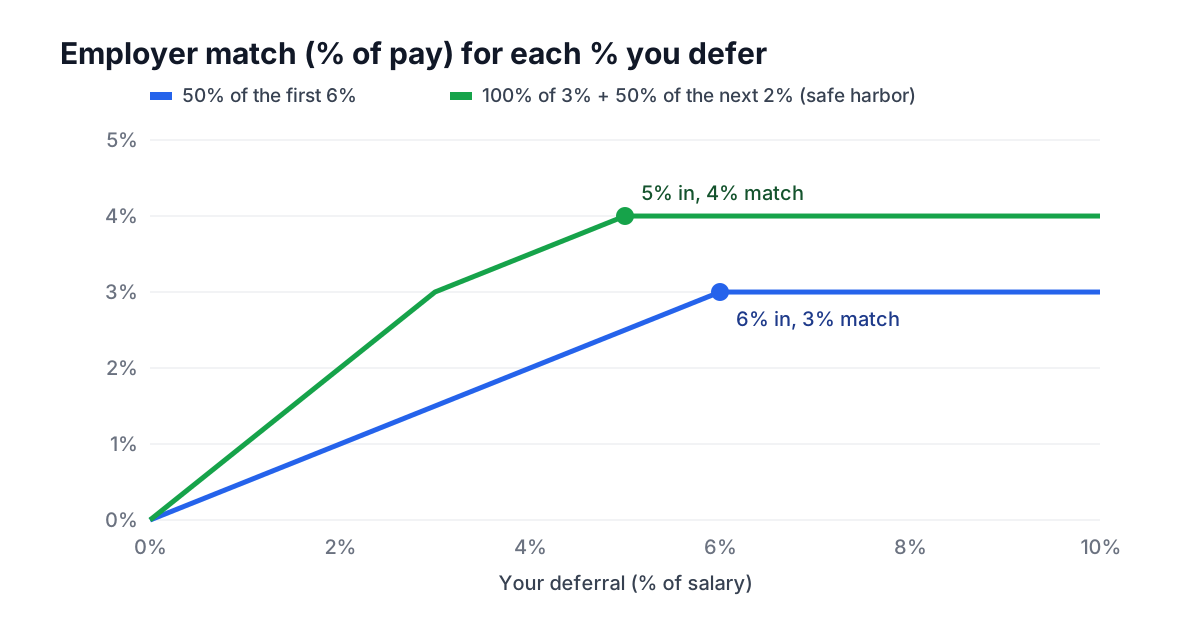
The flat sections are the important part. Above the cap, extra deferral earns no extra match, and below it every percentage point you skip is free money forgone. In the 401(k) Calculator, a 30-year-old on $75,000 with 3% raises, a 7% return and a 50% to 6% match ends with $1,635,798 at 65 when deferring 6%, but only $1,179,503 at 4%. Two percentage points of salary, compounded for 35 years with the match they unlock, is a $456,000 difference.
Two less obvious rules shape the match. Employers calculate it on the deferral you actually made, so if a high earner hits the $24,500 limit in September, deferrals stop and on many plans so does the match, unless the plan does a year-end true-up. And the match is applied to pay only up to the $360,000 compensation limit. The calculator applies both, and you can enter any tiered formula as rate:up-to pairs such as 100:3,50:2.
What a 401(k) projection is really telling you
The default projection (age 30 to 65, $75,000 salary rising 3% a year, $25,000 already saved, 10% deferral, 7% return) comes to $2,244,190. Of that, you contributed $453,466 and your employer $136,040; investment growth supplied $1,629,685. Growth dominates because the first decade's contributions compound for 25 to 35 years.
Two adjustments make the figure honest. Inflation at 2.5% a year turns $2.24 million into about $946,000 of today's spending power, which is the number to compare with what you spend now. And the return is a smooth 7% every year, with no fees, crashes or sequence. Subtract your funds' expense ratio from the return, and run 5% alongside 7% to see the range.
Roth or traditional: the one inequality that matters
A traditional contribution is deducted now and taxed on withdrawal; a Roth contribution is taxed now and withdrawn tax free. Write the traditional result as C × growth × (1 − t_later) and the Roth result as C × (1 − t_now) × growth, and the comparison collapses to a single question: is your tax rate later higher or lower than your tax rate now?
There is a catch in comparing them fairly. A $7,500 traditional contribution only costs $7,500 minus the tax it saves. At 22% that is $1,650 a year, and unless that refund is invested too, you are comparing a $7,500 Roth against a $5,850 traditional. The Roth IRA Calculator invests the refund in a taxable account by default and lets you switch that off.
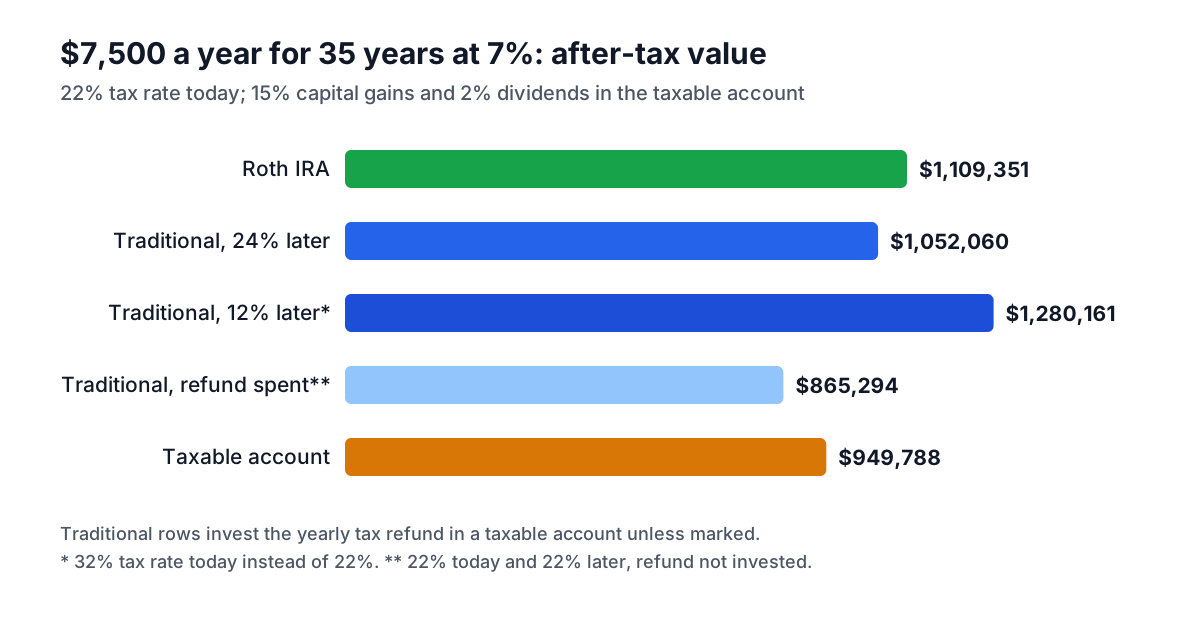
The bars tell the story. With 22% now and 24% later, the Roth leads by about $57,000. Swap to a high earner who pays 32% now and expects 12% in retirement and the traditional IRA wins by $171,000. Spend the refund and the traditional account falls to $865,294, which is why the Roth wins so often in real life. Every option beats the taxable account, where dividends are taxed each year and gains on sale.
The honest answer for most people is that nobody knows their tax rate in 30 years, which is the case for holding both kinds of money. Note also that direct Roth contributions phase out for 2026 between $153,000 and $168,000 of modified AGI for single filers and between $242,000 and $252,000 for joint filers. The calculator lists these ranges and links to the IRS rather than guessing at your modified AGI.
Turning a balance into income with an annuity
At retirement the problem reverses. A payout annuity, whether bought from an insurer or simply a planned drawdown, is a loan in reverse: you hand over a lump sum and receive equal payments that pay off "the loan" plus interest. The payment formula is the same one used for a mortgage:
PMT = PV × i / (1 − (1 + i)^−n)

PV = lump sum, i = rate per period, n = number of payments
A $500,000 balance earning 5% and paid out monthly over 25 years supports $2,922.95 a month. If payments start immediately (an annuity due) each one is smaller by a factor of (1 + i), at $2,910.82. Of the $876,885 paid out, $376,885 is interest earned on the shrinking balance.
Level payments lose buying power. Indexing them by 2.5% a year cuts the first payment to $2,278.99, rising to about $4,100 by year 25. Turn the question around and the cost of indexing is stark: $4,000 a month for 30 years at 5% needs $745,126 as a level annuity and $1,060,004 if payments rise 3% a year. The Annuity Calculator handles rising payments by discounting each one separately, which stays exact even when the growth rate equals the interest rate, a case where the textbook growing-annuity formula divides by zero.
An insurer's life annuity adds something no calculator can: pooling of longevity risk, so it pays for as long as you live. Its price reflects mortality tables and the company's fees and rates, so use the period-certain figure as a benchmark for judging a quote, not as the quote itself.
Putting the three tools together
A useful order of work is: use the retirement calculator to set an income target, the 401(k) and Roth IRA calculators to see whether your contributions reach a balance that supports it, and the annuity calculator to check what that balance pays per month. If you are aiming to stop work early, the FIRE planner covers the long-horizon withdrawal side. Change one assumption at a time, keep a pessimistic run alongside your central case, and revisit the numbers each year when the IRS publishes new limits.