
Required Minimum Distributions: Start Age, Table and Deadlines
How the IRS Uniform Lifetime Table turns a December 31 balance into your RMD, when SECURE 2.0 says you start (73 or 75), the April 1 trap, and the penalty for missing one.
· 10 min read
Traditional IRAs and 401(k)s let money grow without tax for decades, but not forever. From a certain age the IRS requires you to take a minimum amount out each year, and that withdrawal is taxed as ordinary income. The rule is called the required minimum distribution, or RMD. The calculation itself is one division, yet people still get it wrong, mostly on the edges: which balance to use, which age, which table, and which deadline. This guide covers each of those with worked examples you can reproduce in the RMD Calculator. It explains the rules as published by the IRS; it is not personal tax advice.
The formula: one balance, one factor
For an account owner, the RMD for a year is:
RMD = account balance on December 31 of the previous year / distribution period
The distribution period (the IRS calls it the applicable denominator) is a life expectancy factor read from a table, using the age you reach on your birthday in the distribution year. Most owners use Table III, the Uniform Lifetime Table, in Appendix B of IRS Publication 590-B. The current table took effect in 2022, when the IRS updated it for longer life expectancies.
Take an owner born in 1951 whose IRA was worth $500,000 on December 31, 2025. In 2026 they turn 75, the Table III factor for 75 is 24.6, and the RMD for 2026 is:
500,000 / 24.6 = $20,325.20
That is about 4.07% of the balance. The money can come out in one lump or in instalments through the year, as long as the total reaches $20,325.20 by December 31, 2026.
Three details matter here. First, the balance is the prior year-end value, not today's value, so a market drop in the current year does not lower the RMD. Second, the age is your age at your birthday in the distribution year, even if that birthday falls in December. Third, the factor drops every year, so the percentage you must withdraw rises as you get older.
The Uniform Lifetime Table
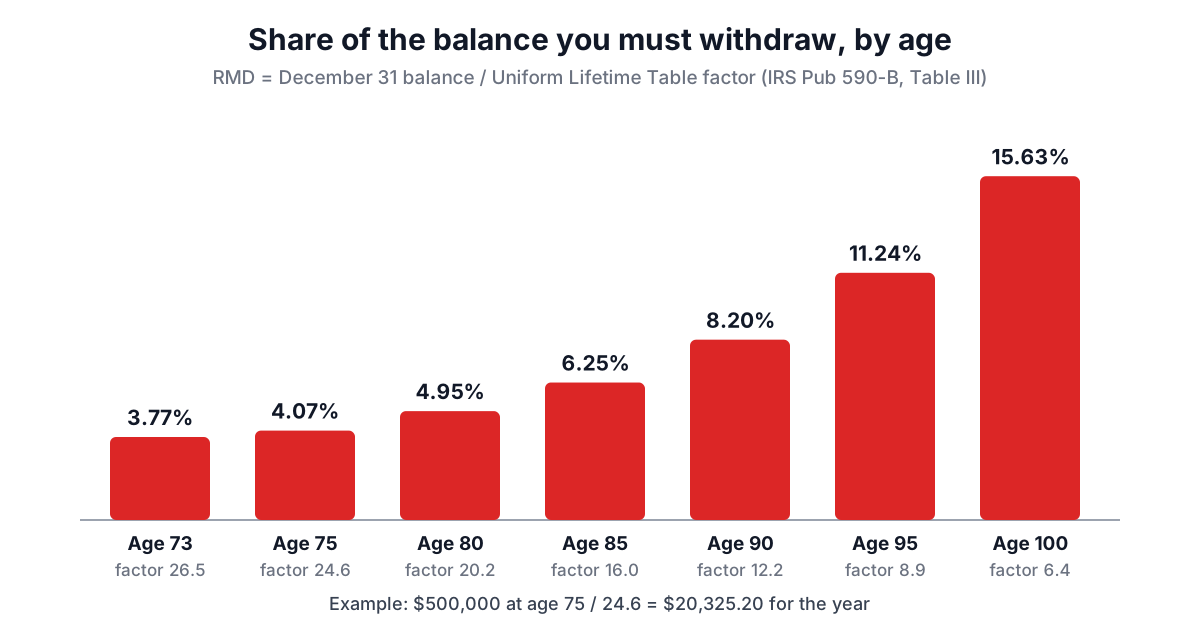
Table III runs from age 72 to "120 and over". Here are selected rows, with the share of the balance each factor implies:
| Age | Factor | Share of balance withdrawn |
|---|---|---|
| 72 | 27.4 | 3.65% |
| 73 | 26.5 | 3.77% |
| 75 | 24.6 | 4.07% |
| 80 | 20.2 | 4.95% |
| 85 | 16.0 | 6.25% |
| 90 | 12.2 | 8.20% |
| 95 | 8.9 | 11.24% |
| 100 | 6.4 | 15.63% |
| 120 and over | 2.0 | 50.00% |
The table is called "uniform" because it already assumes a beneficiary 10 years younger than the owner, whoever the real beneficiary is. That is why it applies whether you are single, married or have named a child as beneficiary.
There is one exception. If your spouse is the sole beneficiary of the account for the whole year and is more than 10 years younger than you, you use Table II, the Joint and Last Survivor table, instead. It is a grid of both ages and gives a longer period, so a smaller RMD. The RMD Calculator only uses Table III; if this case applies, tick the box in the tool and look up your joint factor in Publication 590-B.
When RMDs start: SECURE 2.0 ages
The starting age has moved three times in five years:
| Year of birth | RMD starting age | First RMD year |
|---|---|---|
| Before July 1, 1949 | 70½ | Already started |
| July 1, 1949 to 1950 | 72 | Already started |
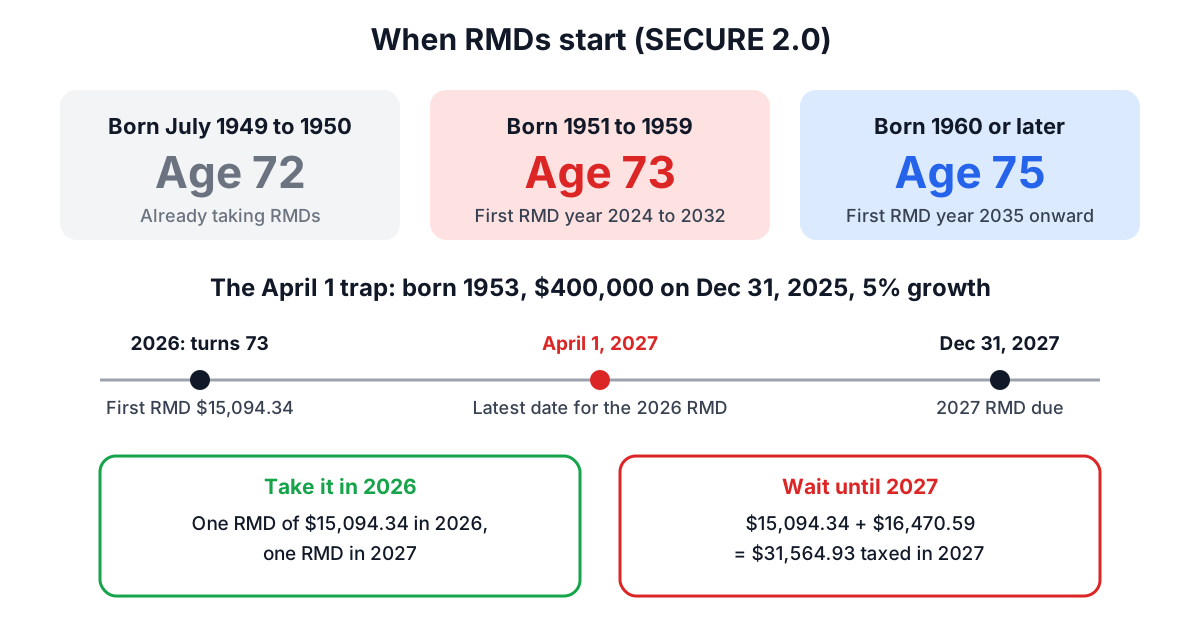
| 1951 to 1959 | 73 | Year you turn 73 (2024 to 2032) |
| 1960 or later | 75 | Year you turn 75 (2035 onward) |
The SECURE Act of 2019 raised the age from 70½ to 72. SECURE 2.0, passed at the end of 2022, raised it to 73 from 2023 and sets 75 for later years. The statute's wording overlapped for people born in 1959, who could have been read as either 73 or 75; the IRS proposed regulations of July 2024 resolve it as 73 for anyone born in 1959 and 75 for anyone born in 1960 or later. The calculator follows that reading.
Someone born in 1961 is 65 in 2026 and owes nothing yet. Their first RMD year is 2036, the year they turn 75. Entering 1961 in the calculator shows "No RMD for 2026" and starts the projection in 2036.
Deadlines and the April 1 trap
Every RMD is due by December 31 of its year, with one exception: the first. For the year you reach your starting age, you may wait until April 1 of the following year. That date is your required beginning date.
Waiting has a cost. The second RMD is still due by December 31 of that same following year, so you take two distributions in one tax year, which can push you into a higher bracket, raise the taxable part of Social Security benefits and lift Medicare premiums through IRMAA.
Here is the arithmetic for someone born in 1953 with $400,000 in an IRA on December 31, 2025, assuming 5% growth:
- 2026 is the first RMD year (age 73). RMD = 400,000 / 26.5 = $15,094.34, due by April 1, 2027.
- If they wait until 2027 to take it, the December 31, 2026 balance includes the money not yet withdrawn: 400,000 x 1.05 = $420,000.
- The 2027 RMD is then 420,000 / 25.5 = $16,470.59.
- Total taxable distributions in 2027: 15,094.34 + 16,470.59 = $31,564.93.
If they take the first RMD during 2026 instead, each year carries one distribution. Delaying only helps if your income in the first year is unusually high and you expect it to drop.
Which accounts, and how many withdrawals
RMDs apply to traditional IRAs, SEP IRAs, SIMPLE IRAs, 401(k)s, 403(b)s, 457(b)s and most other employer plans. They do not apply to Roth IRAs while the original owner is alive. From 2024, SECURE 2.0 also removed lifetime RMDs from Roth accounts inside 401(k) and 403(b) plans.
Where you take the money from depends on the account type:
- IRAs. Work out the RMD for each traditional IRA separately, add them up, and take the total from any one or more of your IRAs.
- 403(b)s. The same aggregation is allowed among your 403(b) accounts.
- 401(k)s and other plans. Each plan's RMD must come out of that plan.
Employer plans also have a "still working" exception: if you are still employed by the company sponsoring the plan and do not own more than 5% of it, the plan can let you delay RMDs from that plan until April 1 after the year you retire. It does not apply to IRAs.
RMD amounts cannot be rolled over or converted to a Roth. If you give to charity and are 70½ or older, a qualified charitable distribution paid directly from an IRA to the charity counts toward your RMD without being taxed, up to an annual limit that is indexed for inflation.
Projecting future RMDs
Because the factor shrinks each year while the account keeps growing, RMDs often rise in dollars for a long time even though they reduce the balance. Continuing the first example with an assumed 5% return, and the RMD taken at the end of each year:
| Year | Age | Start balance | Factor | RMD |
|---|---|---|---|---|
| 2026 | 75 | $500,000.00 | 24.6 | $20,325.20 |
| 2027 | 76 | $504,674.80 | 23.7 | $21,294.30 |
| 2028 | 77 | $508,614.24 | 22.9 | $22,210.23 |
| 2029 | 78 | $511,834.72 | 22.0 | $23,265.21 |
| 2030 | 79 | $514,161.25 | 21.1 | $24,367.83 |
| 2031 | 80 | $515,501.48 | 20.2 | $25,519.88 |
The balance keeps edging up through age 80, when the required share (4.95%) is still just below the 5% return. At 81 the share is 5.15%, and from then on the balance shrinks. The calculator projects up to 50 years with your own growth rate. Returns are never steady, so treat the projection as a planning range, not a schedule. To see how withdrawals fit into wider retirement income, pair it with the Retirement Calculator or, if you are weighing a guaranteed income stream, the Annuity Calculator.
Missing an RMD
If you take less than the required amount, the shortfall is subject to an excise tax of 25%. SECURE 2.0 reduced it from 50%, and it drops to 10% if you take the missed amount and file a corrected return within the correction window. You report it on Form 5329, where you can also ask the IRS to waive the tax for a reasonable error that you have since fixed.
Practical habits that avoid the problem: set up an automatic annual distribution with your custodian, take the RMD early in the year rather than in late December, and keep a note of the December 31 balance of every account, since custodians report it to the IRS on Form 5498.
What the calculator does and does not cover
The RMD Calculator takes the prior year-end balance, your year of birth and the distribution year. It returns your age, the SECURE 2.0 starting age, the Table III factor, the RMD, the deadline (including the April 1 rule in your first year) and a projection with your chosen return.
It does not cover:
- Table II. Owners whose spouse is the sole beneficiary and more than 10 years younger get a smaller RMD than shown.
- Inherited accounts. Beneficiaries use the Single Life Table, the 10-year rule, or both, depending on when the owner died and the beneficiary's relationship to them.
- Tax on the distribution. The RMD is added to your taxable income; use the Paycheck Calculator or your tax software to see the effect of extra ordinary income, and see the Roth IRA Calculator if you are weighing conversions before RMDs begin.
- Annuitised plan payments and defined benefit pensions, which follow their own distribution rules.
Sources
- IRS Publication 590-B, Distributions from Individual Retirement Arrangements, including Appendix B, Table III (Uniform Lifetime) and Table II (Joint and Last Survivor).
- Internal Revenue Code section 401(a)(9), as amended by the SECURE Act of 2019 and section 107 of SECURE 2.0 (Consolidated Appropriations Act, 2023).
- Treasury and IRS proposed regulations on required minimum distributions, July 2024 (applicable age for individuals born in 1959 and later).
- IRS, "Retirement plan and IRA required minimum distributions FAQs".
- Internal Revenue Code section 4974 and IRS Form 5329 instructions (25% and 10% excise tax).
Related searches
- rmd calculator
- uniform lifetime table
- rmd age secure 2.0
- rmd age 73 or 75
- first rmd april 1 deadline
- rmd penalty 25%
- how is rmd calculated
- rmd for 401k still working
- qualified charitable distribution rmd
- do roth iras have rmds