
Salary, Overtime and Raises: The Pay Maths Explained
Hourly to annual and back, what holidays do to the numbers, how federal and California overtime work, and how to tell whether a raise beats inflation.
· 8 min read

A job ad says $50 an hour. Another says $100,000 a year. A manager offers 5%. Each of these is a single number, and each hides a set of assumptions about hours, days off and prices that decides what the money is really worth. This guide works through those assumptions one at a time, using the Salary Calculator, the Overtime Calculator and the Pay Raise Calculator, so you can reproduce every figure. It explains the arithmetic and the rules behind it; it is not tax or legal advice.
Hourly to annual: where 2,080 comes from
A full-time US schedule is 40 hours a week for 52 weeks, which is 2,080 hours. That one number does most of the work in pay conversion:
- Hourly x 2,080 = annual. $25 an hour is $52,000 a year.
- Annual / 2,080 = hourly. $70,000 a year is $33.65 an hour.
The other periods all come from the annual figure. Weekly is annual / 52. Monthly is annual / 12. Quarterly is annual / 4. Two periods cause most of the confusion:
- Bi-weekly means every two weeks: 26 paychecks a year, so annual / 26.
- Semi-monthly means twice a month: 24 paychecks a year, so annual / 24.
On a $60,000 salary that is $2,307.69 bi-weekly against $2,500 semi-monthly. The yearly total is identical; the bi-weekly earner simply gets two extra paychecks a year, usually in the two months that contain three paydays.
A related mistake is treating a month as four weeks. Four weeks a month is only 48 weeks a year. A month really averages 52 / 12 = 4.33 weeks, so $1,000 a week is $4,333.33 a month, not $4,000. Budgets built on "weekly x 4" quietly understate income by about 8%.
What holidays and vacation do to the numbers
The 2,080-hour year assumes you are paid for every one of the 52 weeks. Whether that is true depends on how you are paid, and it changes the answer in opposite directions.
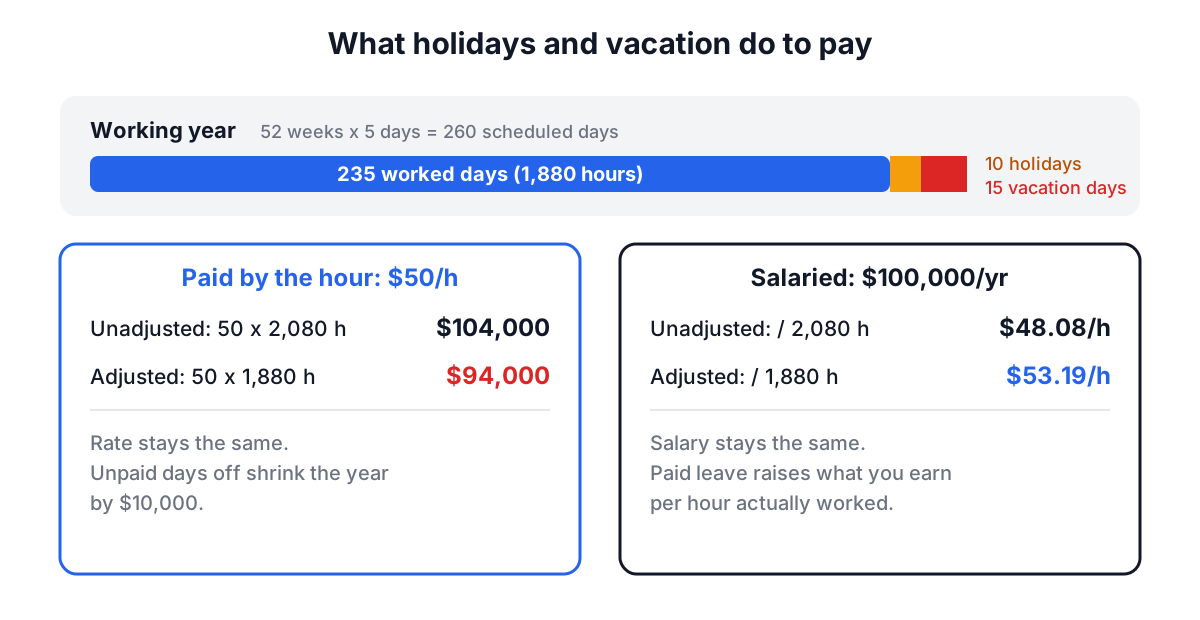
Take a 5-day week, 10 public holidays and 15 vacation days. There are 52 x 5 = 260 scheduled days and 260 - 25 = 235 days actually worked, or 1,880 hours.
If you are paid by the hour and days off are unpaid, the rate stays the same and the year shrinks. $50 an hour is $104,000 on paper but $50 x 1,880 = $94,000 in practice. Those 25 days off are worth $10,000, which is the number to remember when comparing an hourly contract against a salaried job with paid leave.
If you are salaried, the salary stays the same and the hourly rate rises. $100,000 / 2,080 = $48.08 an hour is the usual quote, but you only work 1,880 hours, so you earn $53.19 for each hour actually worked.
The Salary Calculator shows both columns side by side: unadjusted (the straight conversion, as job ads quote it) and adjusted (holidays and vacation removed). Change the hours, days, holidays and vacation fields to match your contract. Part-time schedules work too: 24 hours over 3 days at $20 an hour is $24,960 a year.
Two smaller details are worth knowing. Some payroll systems divide by 2,087 or 2,088 hours rather than 2,080, to average in the extra day of leap years and the odd 53rd payday; the difference is a few cents an hour. And every figure in this section is gross pay, before income tax, Social Security and any retirement or health deductions.
Overtime under federal law
The US Fair Labor Standards Act sets the federal floor. A covered, non-exempt employee must get at least one and a half times the regular rate of pay for hours over 40 in a workweek. The Department of Labor's overtime page fills in the details that matter for calculation:
- A workweek is a fixed, regularly recurring period of 168 hours (seven consecutive 24-hour periods). It does not have to start on Monday.
- Each workweek stands alone. Hours cannot be averaged over two weeks, so 50 hours followed by 30 hours still means 10 hours of overtime in the first week.
- Federal law has no daily overtime and does not require premium pay for weekends or holidays as such.
The calculation is short. At $20 an hour, a 48-hour week is 40 x 20 = $800 of regular pay plus 8 x 30 = $240 of overtime, $1,040 in total. The effective hourly rate for the week is 1,040 / 48 = $21.67.
Two traps catch people out. First, "regular rate" in the law is not always the base wage: non-discretionary bonuses, shift differentials and commissions are folded in, which raises the overtime rate. Second, being paid a salary does not by itself make someone exempt from overtime; exemption depends on salary level and job duties. The calculator uses whatever hourly rate you enter, so add those extras yourself if they apply.
Daily overtime: the California example
States can be more generous than the federal floor, and California is the best-known case. The California Labor Commissioner's overtime FAQ sets out the rules:
- Hours over 8 in a workday, up to and including 12, are paid at 1.5x.
- Hours over 12 in a workday are paid at 2x.
- On the seventh consecutive day of work in a workweek, the first 8 hours are 1.5x and hours beyond 8 are 2x.
- Hours over 40 in the workweek are still overtime.
The difference shows up with long shifts. Four 10-hour days at $20 an hour is exactly 40 hours, so federal law adds nothing and the week pays $800. Under California rules the 2 hours over 8 on each day are overtime: 32 regular hours and 8 overtime hours, $880 in total. A single 13-hour day is 8 regular hours, 4 at time and a half and 1 at double time: $160 + $120 + $40 = $320.
The weekly 40 and the daily rules interact, and the important point is that hours are not paid twice. Hours already paid as daily overtime do not count toward the 40 again. The Overtime Calculator's day-by-day mode counts straight-time hours in order through the week, and once they pass 40 it moves the excess into overtime. Working 8 hours on each of six days and 10 on the seventh at $10 an hour gives 40 regular hours, 16 hours at 1.5x (day 6 plus the first 8 of day 7) and 2 hours at 2x, for $680.
Other states, union agreements and company policies have their own rules, including different thresholds and double time for holidays. Treat the California mode as a worked example of how daily rules combine, and check what applies to your job.
Raises, percentages and inflation
A raise percentage is always measured against the old pay: (new - old) / old x 100. That makes percentages asymmetric. Going from $72,000 to $80,000 is an 11.11% raise; going back from $80,000 to $72,000 is a 10% cut. The same $8,000 is a different share of a different starting point.
Successive raises compound rather than add. A 3% raise followed by a 4% raise multiplies to 1.03 x 1.04 = 1.0712, a 7.12% increase over the two years.
Inflation is the part people skip. What matters is not the number on the paycheck but what it buys, and that is the real raise:
real raise = (1 + raise) / (1 + inflation) - 1
A 5% raise on $60,000 with 3% inflation is 1.05 / 1.03 - 1 = 1.94%. The new salary of $63,000 buys what $61,165.05 would have bought last year. Subtracting (5% - 3% = 2%) is a close shortcut at low rates, but it always overstates the real gain slightly, and the error grows when inflation is high. A raise below inflation is a real pay cut: 2% with 4% inflation is about -1.92%.
For the inflation figure, use the change in your country's consumer price index over the same 12 months as the raise, for example the CPI-U from the US Bureau of Labor Statistics. The Inflation Calculator helps when you want to compare pay across several years rather than one.
The Pay Raise Calculator also turns the raise into amounts you will notice: per month, per bi-weekly paycheck and per hour. A $1.50 hourly raise on $25 sounds small, but at 2,080 hours it is $3,120 a year.
Putting it together
When you compare two jobs or decide whether to take extra shifts, run the numbers in this order:
- Convert both offers to the same period with the Salary Calculator, using the adjusted column if paid leave differs between them.
- Add realistic overtime with the Overtime Calculator, using the rules for your state and the weeks you actually expect to work long hours.
- Check any raise or new offer against inflation with the Pay Raise Calculator.
Then remember what none of these tools include: tax, benefits such as health cover and retirement matching, commuting costs, and the value of your own time. The arithmetic tells you what the pay is; whether it is worth it is a judgment only you can make. For hours tracking across a pay period, the Time Card Calculator feeds the overtime numbers directly.