
Sales Tax, VAT, Discounts and Tips: Percentages at the Till
Why you divide to remove tax, how VAT fractions work, why 20% then 10% off is 28%, and how to tip and split a bill without short-changing anyone.
· 8 min read
Most of the arithmetic at a checkout is percentages: tax on top, discounts off, a tip at the end. Percentages are easy to apply forwards and surprisingly easy to get wrong backwards or in combination. This guide covers the four cases people trip over, using the Sales Tax Calculator, the VAT Calculator, the Discount Calculator and the Tip Calculator, so you can check each number yourself.
Adding tax multiplies, removing tax divides
Adding a tax rate to a price is a multiplication:
total = price x (1 + rate)
$100 at 8.25% is 100 x 1.0825 = $108.25. Removing the tax from a total that already includes it is the reverse operation, which is a division, not a subtraction:
price = total / (1 + rate)
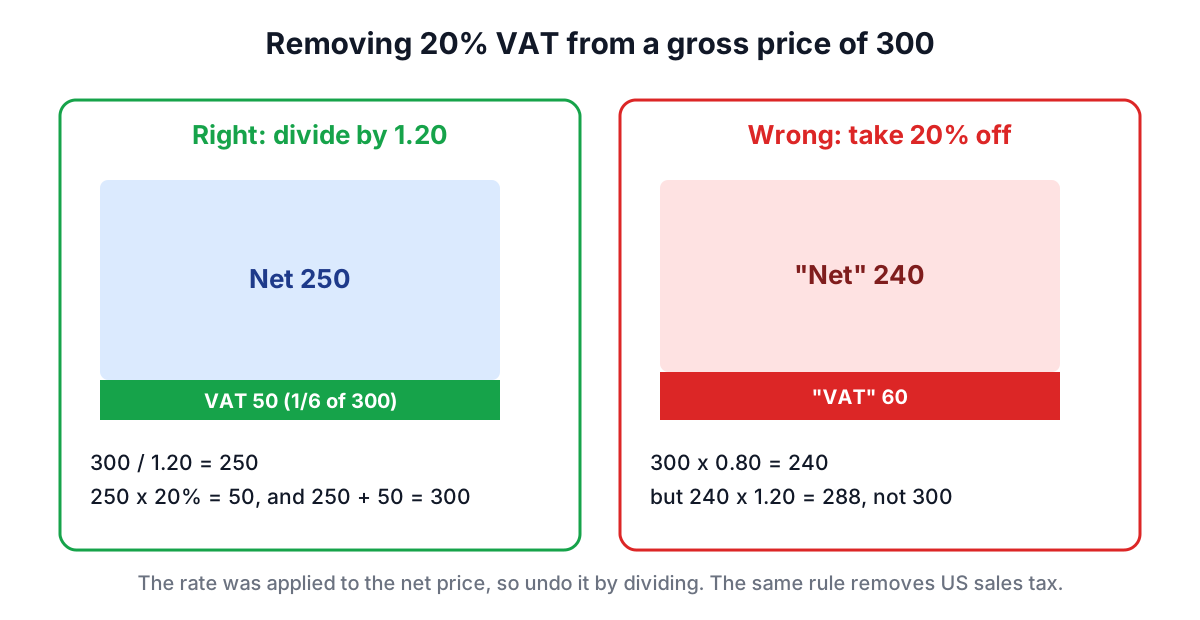
$108.25 / 1.0825 = $100.00. The tempting shortcut, taking 8.25% off the total, gives 108.25 x 0.9175 = $99.32, which is wrong by 68 cents. The reason is that the tax was 8.25% of $100, not of $108.25. Taking the percentage off the bigger number removes too much.
The same logic finds the rate when you know both amounts. If $80 became $86.60 at the till, the tax was $6.60 and the rate was 6.60 / 80 = 8.25%. The Sales Tax Calculator has a mode for each of these three questions.
How US sales tax is built
There is no federal sales tax in the US. Forty-five states and the District of Columbia charge a statewide sales tax; Alaska, Delaware, Montana, New Hampshire and Oregon do not, although Alaska lets local governments charge one. On top of the state rate, counties, cities and special districts can add their own.
Those rates add rather than compound. A 6.25% state rate and 2% of local taxes is an 8.25% combined rate, charged once on the price. That is why the calculator has a state field and a local field and simply sums them.
The combined rate can change from one street to the next, which is why the calculator does not ship a table of rates. Every state revenue department publishes an address lookup; use the rate for the delivery address for online orders, since most states tax where the goods arrive. Some items are exempt or taxed at a reduced rate, commonly groceries and prescription drugs, and shipping is taxable in some states and not others. A receipt that mixes taxed and untaxed items will not match a single rate, and per-line rounding can move a total by a cent.
VAT: net, gross and the VAT fraction
Value added tax works the same way mathematically, but prices are usually shown to consumers with VAT included (gross), while businesses quote and invoice each other net. So the backwards calculation matters more.
At the UK standard rate of 20%, a net £250 becomes 250 x 1.2 = £300 gross. To go back, divide: 300 / 1.2 = £250 net, so the VAT is £50. HMRC calls the share of VAT inside a gross price the VAT fraction, which is rate / (100 + rate). At 20% it is 20/120, exactly one sixth. At the UK reduced rate of 5% it is 5/105, or one twenty-first. At Germany's 19% it is 19/119, about 15.97%, so a €119 price contains €19 of VAT.
Rates differ by country. The EU VAT Directive requires a standard rate of at least 15% and leaves the rest to each member state. According to the European Commission's Your Europe table (last checked 13 July 2026), standard rates run from 17% in Luxembourg to 27% in Hungary, with Germany at 19%, France 20%, Spain and the Netherlands 21%, Ireland 23% and Finland 25.5%. GOV.UK lists the UK rates as 20% standard, 5% reduced and 0% zero-rated; the standard rate has been 20% since 4 January 2011.
Zero-rated and exempt sound alike but are different. Zero-rated goods are taxable at 0%, so the seller can still reclaim VAT on its costs. Exempt goods sit outside VAT, and the related input VAT usually cannot be reclaimed. For a shopper the price looks the same; for a business the difference matters.
The VAT Calculator's presets are standard rates only and are dated, because reduced rates apply to many goods and governments change rates. Type over the rate whenever it does not fit.
Discounts: why stacked percentages add up to less
A single percentage discount multiplies the price by (1 - discount). 25% off $80 is 80 x 0.75 = $60.
When a store offers "an extra 10% off sale prices", the second discount applies to the already reduced price, so the factors multiply:
20% then 10%:  0.80 x 0.90 = 0.72  ->  28% off
50% then 50%:  0.50 x 0.50 = 0.25  ->  75% off
Stacked discounts always total less than their sum. That gives a quick way to compare promotions: 20% off plus an extra 15% is 0.80 x 0.85 = 0.68, or 32% off, which beats a flat 30%. The order of the percentages does not change the result.
Reversing a discount is a division again. A jacket at $60 after 25% off was 60 / 0.75 = $80. Adding 25% to $60 gives $75, which is wrong for the same reason that subtracting tax is wrong: the percentage was taken from the original, bigger price.
Buy-X-get-Y deals depend on basket size. With buy one get one free, items come in pairs and the second of each pair is free, so an even number of identical items is exactly 50% off. Five items at $12 is two free pairs plus one paid item: $36 instead of $60, which is 40% off. A sixth item costs nothing. The Discount Calculator's buy-X-get-Y mode groups items into sets of X + Y, and a part-finished set only earns discounted items once its first X are bought. Stores that discount the cheapest item in a mixed basket need a manual check.
When there is sales tax, a store discount is usually applied first and tax is charged on the reduced price. 25% off $80 with 8% tax is $60 plus $4.80, or $64.80. Manufacturer coupons can be taxed on the pre-coupon price in many states, so a coupon may save less tax than a store markdown of the same size.
Tips: choosing the base and splitting fairly
A tip is the simplest percentage of all, tip = base x rate, and the only real decision is the base. Many etiquette guides suggest tipping on the pre-tax subtotal, since tax is not part of the service. Tipping on the printed total is also common and costs a little more: on a bill with 8% tax, 20% of the total is 21.6% of the food and drink.
Take a bill of $86.40 that includes $6.40 of tax. At 20% on the total the tip is $17.28; on the pre-tax $80.00 it is $16.00. The Tip Calculator's pre-tax switch does this subtraction for you.
Splitting raises the rounding question. At 18%, $86.40 has a tip of $15.55 and a total of $101.95, which is $33.98 each for three people with a cent left over. Rounding each share up to $34.00 makes the total $102.00 and the tip $15.60, an effective 18.06%. Rounding only the total up costs less when many people are splitting, because the extra is at most one unit for the whole table rather than one per person. Either way the calculator rounds up, so the server never gets less than the percentage chosen, and it shows the effective rate after rounding.
Customs vary a great deal. In the US, 15% to 20% at a sit-down restaurant is the commonly cited range; in much of Europe service is included in the price and a small round-up is normal; in Japan tipping is generally not expected. Check the bill for a service charge or an automatic gratuity for large groups before adding a tip on top.
A checklist for checkout maths
- To remove a tax or a discount, divide by (1 + rate) or (1 - discount). Never subtract the percentage from the final number.
- Local rates add to the state rate; look up the combined rate for the address.
- For VAT, check whether a price is net or gross before you start, and use the VAT fraction to find the tax inside a gross price.
- Stacked discounts multiply, so they always total less than their sum.
- Tip on the pre-tax amount if you want the percentage to apply to the service only, and round up rather than down when splitting.
For prices across currencies, convert first with the Currency Converter, then apply the tax or discount. For the reverse problem, setting a selling price from a cost, the Margin and Markup Calculator covers the difference between markup on cost and margin on price, which is another place where the base of a percentage changes the answer.