
How to Calculate Sheet Metal Weight (and Why Gauge Tables Disagree)
Volume times density in metric and inch units, typical densities for steel, stainless, aluminium and copper, why gauge weight tables run 2% heavy, and what changes real weights.
· 9 min read

Weighing a sheet of metal on paper is about as simple as engineering arithmetic gets: volume times density. Yet sheet weights are a steady source of small, expensive mistakes. A crane is booked for the wrong bundle, a freight quote is 15% light, a cost estimate uses aluminium density for a stainless part, or a gauge weight table disagrees with the mill’s packing list. This post goes through the formula in both unit systems, the densities worth remembering, why traditional gauge tables run slightly heavy, and the real-world effects that move actual weights away from theoretical ones. You can check every number in the Sheet Metal Weight Calculator.
The formula in metric and inch units
The mass of a flat sheet is:
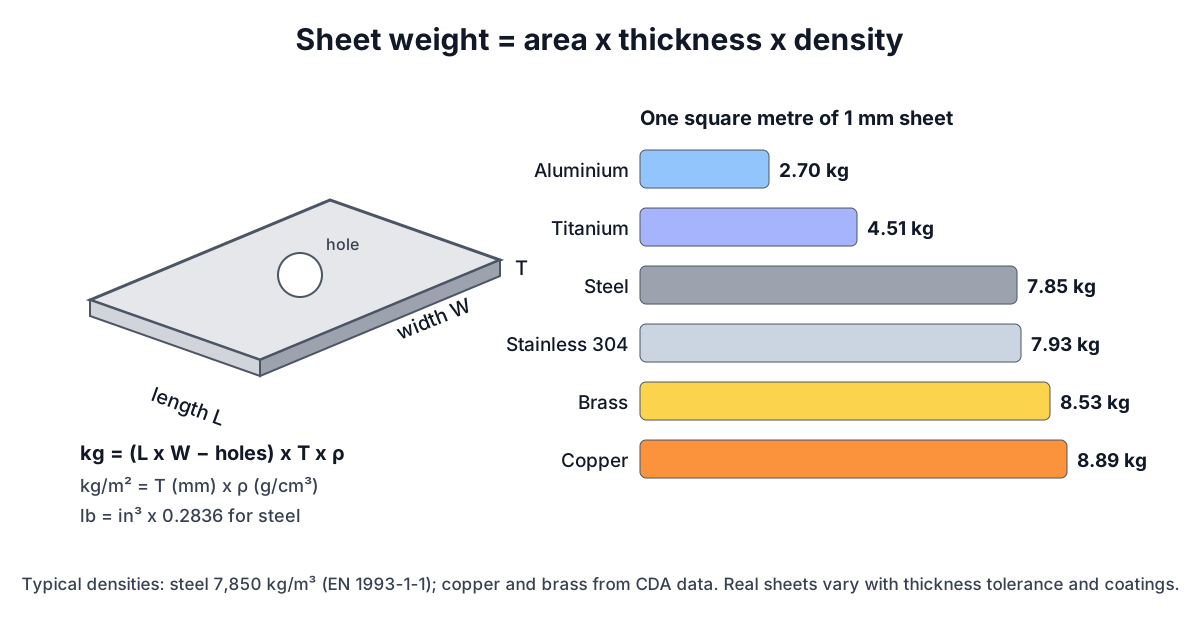
mass = length x width x thickness x density
In SI that means metres and kg/m³, and it helps to rearrange it as an area times a weight per area:
weight per area (kg/m²) = thickness (mm) x density (g/cm³)
mass (kg)               = area (m²) x weight per area
So 1 mm steel weighs 7.85 kg/m², 3 mm aluminium 8.1 kg/m² and 2 mm 304 stainless 15.86 kg/m². A standard 2,440 x 1,220 mm sheet is 2.9768 m², so in 2 mm steel it weighs 2.9768 x 15.7 = 46.74 kg.
In inch units the usual route is cubic inches times pounds per cubic inch:
weight (lb) = L (in) x W (in) x T (in) x density (lb/in³)
Mild steel is 0.2836 lb/in³, so a 96 x 48 in sheet of 0.0598 in steel is 4,608 x 0.0598 x 0.2836 = 78.15 lb. For weight per square foot multiply thickness in inches by 144 and by the density: 0.0598 x 144 x 0.2836 = 2.44 lb/ft².
Densities worth knowing
The calculator’s presets use typical published densities. Exact values move by a percent or so with alloy and temper, which is usually smaller than the thickness tolerance.
| Material | kg/m³ | lb/in³ | kg/m² per mm |
|---|---|---|---|
| Carbon and mild steel | 7,850 | 0.2836 | 7.85 |
| Stainless 304 | 7,930 | 0.286 | 7.93 |
| Stainless 316 | 7,980 | 0.288 | 7.98 |
| Aluminium 5052 | 2,680 | 0.0968 | 2.68 |
| Aluminium 6061 | 2,700 | 0.0975 | 2.70 |
| Aluminium 3003 | 2,730 | 0.0986 | 2.73 |
| Copper C110 | 8,890 | 0.321 | 8.89 |
| Brass C260 | 8,530 | 0.308 | 8.53 |
| Titanium grade 2 | 4,510 | 0.163 | 4.51 |
The steel figure of 7,850 kg/m³ is the value given in EN 1993-1-1 (Eurocode 3) and used by almost every structural steel table. The copper and brass values come from Copper Development Association data sheets. A quick sense check: aluminium is about a third the weight of steel, titanium a little over half, and copper and brass about 10 to 15% heavier than steel.
Why gauge weight tables run about 2% heavy
US steel sheet gauges were defined by weight before they were defined by thickness. The Manufacturers’ Standard Gauge assigns each gauge a nominal weight per square foot and converts it to thickness at 41.82 lb/ft² per inch. That constant corresponds to a density of 41.82 x 12 = 501.8 lb/ft³, or about 8,040 kg/m³, a little above the 7,850 kg/m³ of modern steel tables.
The consequence: a 16 gauge sheet is listed at 2.5 lb/ft² in gauge tables, while 0.0598 in of steel at 7,850 kg/m³ is 2.44 lb/ft². A 4 x 8 sheet comes out at 80 lb in the gauge table and 78.15 lb by density. Neither is wrong; they use different densities. If your purchasing system works from gauge weights, expect the calculator to read about 2.3% lower for steel. The gauge converter explains how the different gauge tables came about.
Holes, cut-outs and the weight of the finished part
A blank with holes weighs less than the sheet it came from, and for perforated panels or parts with large windows the difference is worth counting. The calculator subtracts round holes (π/4 x d² each) and rectangular cut-outs from the gross area before multiplying by thickness and density.
Worked example: ten 304 stainless panels, 2,000 x 1,000 x 3 mm, each with eight 50 mm holes.
gross area        = 2.000 m²
holes             = 8 x π/4 x 0.05² = 0.0157 m²
net area          = 1.9843 m²
weight per area   = 3 x 7.93 = 23.79 kg/m²
each              = 1.9843 x 23.79 = 47.21 kg
batch of ten      = 472.1 kg
The holes remove under 1% of the material here, so for shipping they barely matter. On a part where cut-outs take 40% of the blank, using the gross sheet weight would badly overstate the finished weight, though the gross weight is still what you pay the mill for.
For a bent part, weigh the flat blank, not a box drawn round the outside dimensions. The bend allowance calculator gives the developed length, and the cone flat pattern calculator gives the area of a rolled cone blank.
What makes real sheets heavier or lighter
Thickness tolerance. Sheet is rolled to a tolerance band, set by ASTM A568 for carbon steel sheet and ASTM A480 for stainless and nickel alloys. On thin gauges the band can be several percent of the nominal thickness, and rolls bow slightly so sheets tend to be thicker in the middle than at the edges. Weight scales directly with it.
Coatings. Hot-dip galvanized sheet carries zinc on both faces. Coating designations give the total weight on both sides: G60 is 0.60 oz/ft² (about 183 g/m²) and G90 is 0.90 oz/ft² (about 275 g/m²). On 0.5 mm sheet G90 adds roughly 7% to the weight; on 3 mm sheet barely 1%.
Patterned and expanded products. Tread plate and checker plate carry raised patterns on top of the base thickness, and expanded metal and perforated sheet have most of their area removed. Use the supplier’s published weight per area for these.
Theoretical versus actual weight. Some mills invoice on theoretical weight from nominal dimensions, some on scale weight. When costing by weight, ask which one the price assumes.
A quick method for the shop floor
When there is no calculator to hand, remember one figure per metal: the weight of one square metre of 1 mm sheet, which in kilograms equals the density in g/cm³. Steel 7.85, stainless 7.9, aluminium 2.7, copper 8.9. Multiply by thickness in millimetres and by area in square metres. In inch units, remember that 1/8 in steel plate weighs 5.1 lb/ft² (0.125 x 144 x 0.2836) and scale from there.
Common mistakes
- Mixing gauge tables. 14 gauge aluminium is 0.0641 in while 14 gauge steel is 0.0747 in. Weigh by the decimal thickness of the actual table.
- Unit slips. Thickness in millimetres with length in metres gives a result a thousand times too large if the density is in kg/m³. The weight-per-area form avoids this.
- Forgetting quantity and scrap. Batch weight is per piece times quantity, plus the skeleton left after nesting if you are weighing what comes off the truck.
- Using sheet weight for lifting without margin. Allow for tolerance, coatings, packaging and pallets when choosing slings and forklifts.
For hot-rolled sections and bar rather than sheet, the steel weight calculator covers beams, angles, tubes and round bar with the same densities.