
Sleep Cycles and the 90-Minute Rule: What It Can and Cannot Do
What happens in a sleep cycle, where the 90-minute figure comes from, how much sleep each age needs, and how to use cycle timing without losing hours of sleep.
· 7 min read
The advice to "sleep in multiples of 90 minutes" is everywhere: in apps, on smart alarms and in the bedtime suggestions of the Sleep Calculator. It contains a real piece of sleep science and a convenient simplification. Used well, it helps you pick a bedtime that leaves you less groggy. Used badly, it talks people into six hours of sleep because six is a "clean" multiple.
This guide covers what a sleep cycle is, where the 90-minute number comes from and how much it varies, how much total sleep each age group needs, and how to use cycle timing without losing hours you actually need. It is general information, not medical advice.
What happens in a sleep cycle
Sleep is not one state. Through the night the brain moves through two broad kinds of sleep, recorded in the lab with EEG electrodes, eye-movement sensors and muscle sensors:
- Non-REM sleep, split into three stages. N1 is the brief transition from wakefulness. N2 is light but stable sleep and takes up about half the night in adults. N3, also called slow-wave or deep sleep, is when the EEG shows large, slow waves and it is hardest to wake someone.
- REM sleep, named for rapid eye movements, when brain activity looks close to waking, most vivid dreaming happens and the large muscles are temporarily paralysed.
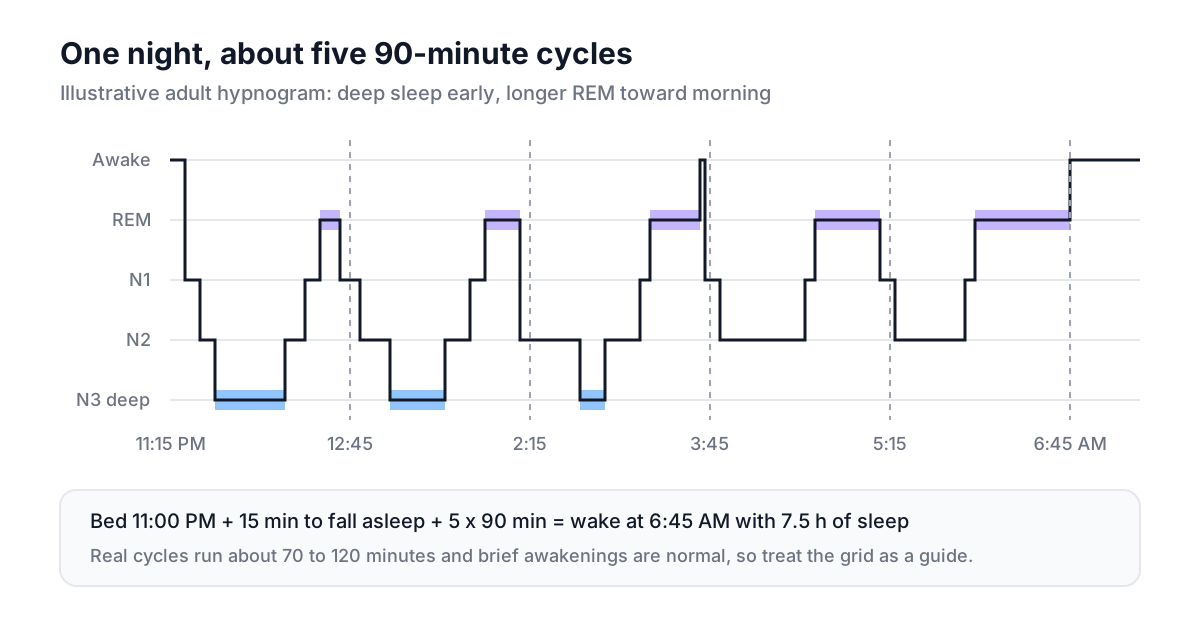
A cycle runs from light sleep down into deep sleep, back up through lighter stages and into a period of REM. Then the next cycle starts. In healthy adults a cycle lasts about 90 minutes on average, and a typical night holds four to six of them.
The cycles are not identical. The first two or three hold most of the deep N3 sleep, which is linked with physical restoration and growth hormone release. Later cycles hold less deep sleep and longer REM periods, so the final 90 minutes of a night are rich in REM. Cutting a night short removes mainly REM.
Where 90 minutes comes from, and how much it varies
The roughly 90-minute rhythm was described in the 1950s and 1960s by Nathaniel Kleitman and his student William Dement at the University of Chicago, in the same research that discovered REM sleep. Kleitman later proposed a "basic rest-activity cycle" of similar length running through the day as well.
Ninety minutes is an average, not a constant. Individual cycles in adults range from roughly 70 to 120 minutes, they can differ from one cycle to the next in the same night, and newborns have much shorter cycles of around 50 to 60 minutes. Alcohol, sleep deprivation, some medicines and sleep disorders all change the structure further. That is why the Sleep Calculator lets you set your own cycle length rather than fixing it at 90.
The arithmetic behind bedtime suggestions
The calculator works backwards from the time you need to get up:
Bedtime = wake-up time - (cycles x cycle length) - time to fall asleep
With a 7:00 AM alarm, 90-minute cycles and 15 minutes to fall asleep:
| Cycles | Sleep | Bedtime |
|---|---|---|
| 6 | 9 h | 9:45 PM |
| 5 | 7 h 30 min | 11:15 PM |
| 4 | 6 h | 12:45 AM |
| 3 | 4 h 30 min | 2:15 AM |
Going forwards from a bedtime works the same way: 11:00 PM plus 15 minutes plus five cycles is 6:45 AM. The 15-minute allowance reflects normal sleep onset for healthy adults, which is usually 10 to 20 minutes. If you reliably take 30 minutes, enter 30; if you fall asleep within a minute or two of your head touching the pillow every night, that can be a sign you are short of sleep.
Why waking at the end of a cycle might help
The grogginess after waking is called sleep inertia. It is strongest when you are woken from deep N3 sleep, and it can blunt reaction time and decision-making for anywhere from a few minutes to half an hour or more. Waking near the end of a cycle, when sleep is lighter, is thought to reduce it.
The evidence for precise cycle timing in everyday life is thinner than the advice suggests. Your real cycle length is unknown, it drifts through the night, and a 15-minute error in the sleep-onset estimate shifts every suggestion. Treat the times as a starting point. If you keep waking a few minutes before your alarm and feeling fine, your rhythm is probably doing the job. If you feel terrible at the alarm, try moving it 15 to 20 minutes either way for a week.
How much sleep you need
Cycle timing never trumps total sleep. The CDC summarises current recommendations from the American Academy of Sleep Medicine (AASM) and the National Sleep Foundation (NSF):
| Age | Hours per 24 hours | Source |
|---|---|---|
| 0 to 3 months | 14 to 17 | NSF |
| 4 to 12 months | 12 to 16, naps included | AASM |
| 1 to 2 years | 11 to 14, naps included | AASM |
| 3 to 5 years | 10 to 13, naps included | AASM |
| 6 to 12 years | 9 to 12 | AASM |
| 13 to 17 years | 8 to 10 | AASM |
| 18 to 60 years | 7 or more | AASM and Sleep Research Society |
| 61 to 64 years | 7 to 9 | NSF |
| 65 and over | 7 to 8 | NSF |
For adults, the AASM and Sleep Research Society consensus (2015) found that regularly sleeping less than seven hours is associated with weight gain, high blood pressure, diabetes, heart disease, depression, impaired immune function and more errors and accidents. Seven and a half hours, five full cycles, is the shortest 90-minute multiple that meets the adult target. Four cycles, six hours, does not, however neat the arithmetic looks. The Sleep Calculator highlights only the options that meet the recommendation for the age you enter.
Naps, shift work and late nights
Cycle thinking is most useful when you cannot get a full night:
- Short naps of 10 to 20 minutes usually end before deep sleep and leave little inertia.
- A 90-minute nap covers a full cycle, including REM, and is a common choice before a night shift.
- Naps of 30 to 60 minutes are the most likely to end in deep sleep, so expect some grogginess.
- After a late night, choosing an alarm at the end of a cycle, for example four cycles instead of four and a half, can make a short night feel slightly less rough. It does not repay the sleep debt.
For shift workers, a consistent anchor period of sleep at the same time every day, a dark and cool room, and caffeine only early in the shift matter more than exact cycle counts. Caffeine's half-life is around five hours in most adults, so a mid-afternoon coffee can still be working at bedtime.
When to talk to a clinician
Some signs suggest a sleep problem rather than a timing problem:
- Loud snoring, pauses in breathing or waking up gasping, which can point to obstructive sleep apnoea.
- Taking more than 30 minutes to fall asleep, or lying awake in the night, on three or more nights a week for three months.
- Feeling very sleepy in the daytime despite seven or more hours in bed.
- An urge to move the legs in the evening that eases with movement.
These are common and treatable, and no bedtime calculation will fix them. For winding down in the meantime, the Breathing Exercises and Relaxation Tool pages have guided techniques that suit the last few minutes before bed.