
The STAR Method for Behavioral Interviews, with Examples
What behavioral interviewers are scoring, how to split a two-minute STAR answer, a before and after example, and how to build a bank of six to eight stories.
· 7 min read
"Tell me about a time you disagreed with your manager." The candidate spent ninety seconds on the company's reorg, the product history and who reported to whom. Then came one sentence of action ("so I talked to him about it") and a result of "it worked out". The interviewer wrote two words in the notes: no signal. The candidate was probably good at the job. The answer just gave the panel nothing to evaluate.
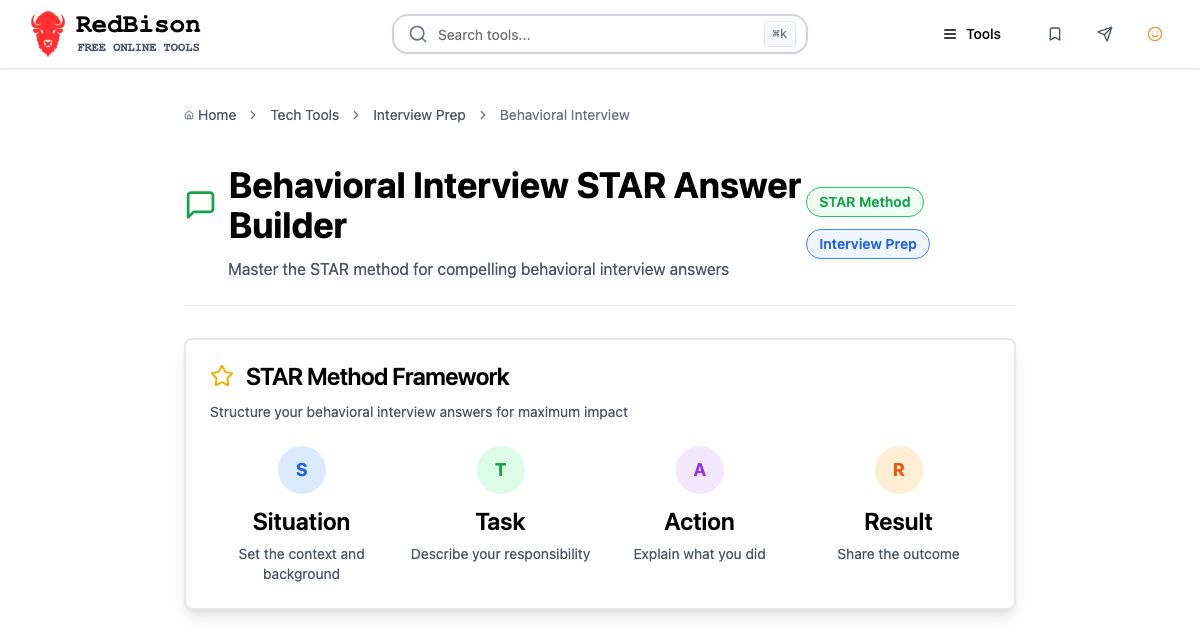
Behavioral rounds are the easiest interviews to prepare for and the most commonly under-prepared. This guide covers what interviewers are listening for, how to build STAR answers that carry real evidence, and a short preparation routine. Draft your stories in the Behavioral Interview STAR Answer Builder as you go.
What the behavioral round is really scoring
The premise of behavioral interviewing is that past behaviour in real situations predicts future behaviour better than answers to hypotheticals. So the interviewer is collecting evidence against a set of competencies, usually some mix of:
- Ownership and accountability
- Collaboration and handling conflict
- Dealing with ambiguity
- Influence without authority
- Delivering results under constraints
- Learning from failure
- For leads and managers: developing people and making hard calls
Each question targets one or two of these. "Tell me about a time you failed" is about ownership and learning. "Tell me about a disagreement" is about collaboration and judgement. The interviewer has to write down what you did, in enough detail to defend a hire or no-hire decision in a debrief. Your job is to make that easy.
The STAR structure, and where the time goes
| Part | Question it answers | Typical length |
|---|---|---|
| Situation | Where were you, what was going on? | 2 to 3 sentences |
| Task | What were you responsible for, what was at stake? | 1 to 2 sentences |
| Action | What did you do, step by step, and why? | The bulk of the answer |
| Result | What happened, ideally measured, and what did you learn? | 2 to 3 sentences |
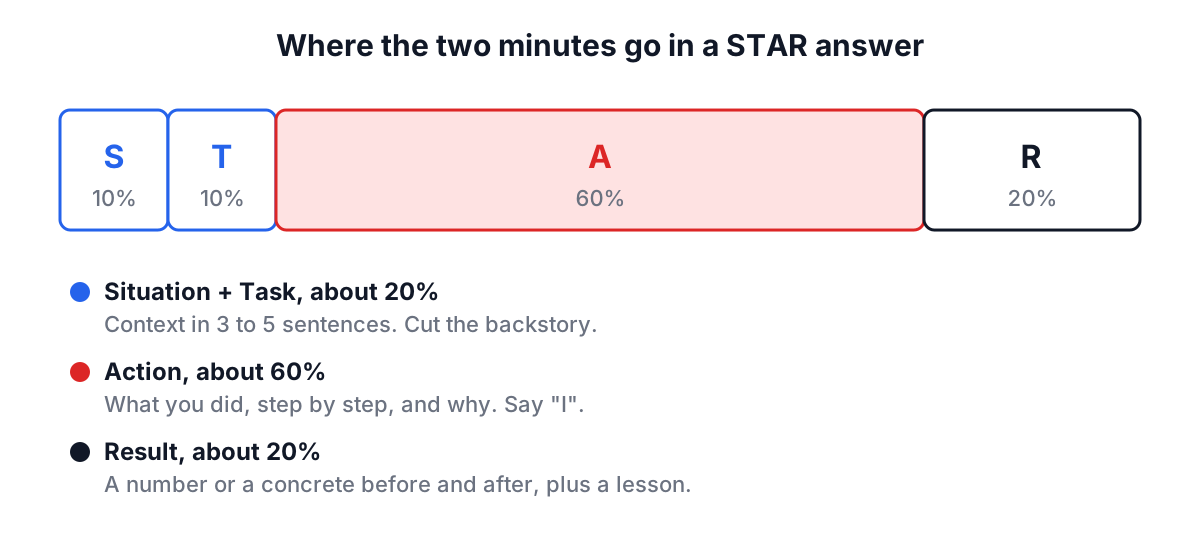
A full answer spoken at a normal pace is about two minutes. Situation and Task together take around 20%, Action about 60%, Result the remaining 20%. Most weak answers invert that: a long setup and a thin middle.
Action is where you are scored. Use "I", name the specific steps, and include your reasoning: what options you considered and why you chose one. "I pulled the error logs, saw the timeouts started after the connection pool change, and proposed rolling it back before the evening peak" is evidence. "We investigated and fixed it" is not.
Result closes the loop. Give a number where one exists (latency, error rate, time saved, revenue, customer count), a concrete before and after where it does not, and one sentence on what you would do differently. A story with no result sounds unfinished, and interviewers will assume it did not go well.
A worked example, before and after
Here is a weak answer to "Tell me about a time you had to work under pressure":
We had a security issue right before a launch. It was really stressful. The whole team worked late and we managed to fix it and launch on time.
And a stronger version, built in the four boxes of the STAR builder:
Situation: Four days before a launch, a pen test found that our password
reset tokens never expired.
Task: I owned the auth service, so the fix and the go or no-go call on
launch were mine to recommend.
Action: I scoped the fix to the token table and expiry check rather than
the full refactor someone proposed, because it could ship in a day with
low risk. I wrote the migration and tests, asked a second engineer to
review only the security logic, and sent the launch lead a short note each
evening with status and the one risk left. On day two I found old tokens
in a cache we had missed, added them to the purge, and re-ran the pen test
case myself.
Result: The fix shipped in two days, the retest passed, and we launched on
schedule. I added token expiry to our security review checklist, and it
caught a similar issue in a new service three months later.
The second answer gives the interviewer five things to write down: scoping judgement, ownership, communication under pressure, thoroughness, and a lasting process change. Use Load Sample in the tool to see more examples, then replace them with your own stories. Interviewers recognise generic sample answers quickly.
Build a story bank, not a script
You do not need a separate story for every possible question. Six to eight rich stories, rehearsed well, cover most loops, because one good story can answer several questions with a different emphasis.
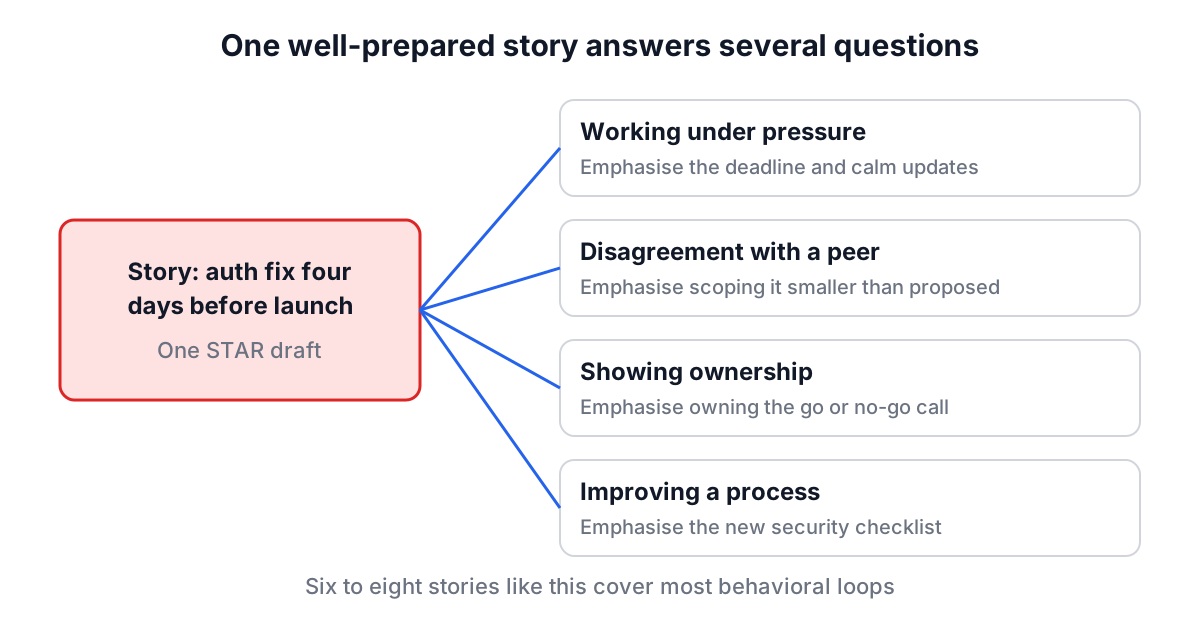
Pick stories that together cover:
- A significant achievement you drove
- A conflict or disagreement, ideally with someone senior
- A real failure or mistake with consequences
- A time you had to decide with incomplete information
- Influencing people who did not report to you
- Helping someone else grow (mentoring, onboarding, feedback)
For each, write the four STAR parts, then list which questions it could answer. Copy each finished answer out of the builder into your notes. Keep stories recent: the last two or three years for most people, because old stories suggest little has happened since.
How interviewers probe, and how to prepare for it
The first telling is rarely the end. Expect follow-ups such as:
- "What would you do differently?"
- "What did the other person think of your approach?"
- "What was the hardest moment?"
- "How did you know it worked?"
- "What would have happened if you had not stepped in?"
Prepare by knowing each story in more depth than you plan to say. If a follow-up reveals that the result was not as clean as the first telling suggested, that is a worse outcome than having said so up front. Honest, specific stories survive probing; polished, vague ones do not.
Common mistakes
"We" instead of "I". Credit the team for shared outcomes, but describe your own actions in the first person. The panel cannot hire your team.
The fake failure. "I care too much" or "I worked too hard" reads as evasion. Pick a real mistake, own it plainly, and spend most of the answer on what you changed.
Hypothetical answers. If you say "I would...", you are not answering the question. If you truly have no example, say so and give the closest real situation.
No result, or a vague one. "It went well" is not a result. Give a measure, a decision that followed, or feedback you received.
Blaming others. In conflict stories, describe the other person's position fairly. Interviewers listen for whether you understood it.
Over-rehearsed delivery. Know the beats, not the words. Recited answers sound recited.
A one-week preparation routine
Day 1: List twelve situations from the last three years, then pick the six to eight strongest. Days 2 and 3: Write each in the STAR builder and copy it to your notes. Day 4: Map stories to the competencies above and fill gaps. Days 5 and 6: Say each story out loud against a two-minute timer, and record yourself once; the Speech to Text tool makes it easy to read back what you actually said. Day 7: Do a mock with a friend who asks follow-ups.
If you are interviewing for a leadership role, add stories about performance problems and hiring decisions, and look at the Engineering Manager Interview Prep scenarios. Product candidates will find behavioral questions mixed into most rounds, so pair this with the Product Manager Interview Prep frameworks.
Most people walk into a behavioral round with good experience and no prepared evidence. A week of writing and rehearsing six stories is usually enough to change that.