
Take-Home Pay in 2026: How a US Paycheck Is Calculated
Gross to net step by step with the 2026 federal brackets, the $16,100 standard deduction, Social Security up to $184,500, Medicare, 401(k) and HSA deductions and state tax.
· 10 min read

A salary offer of $75,000 does not land in your bank account as $2,884.62 every two weeks. Before you see the money, your employer takes out federal income tax, Social Security, Medicare, any state or city tax, and whatever you signed up for at enrolment: a 401(k), a health savings account, health insurance premiums. This guide walks through each of those steps for tax year 2026 so you can see where every dollar goes, using the same rules as the Paycheck Calculator. Every number below can be reproduced by typing the same inputs into the tool. It explains the arithmetic, not your personal tax position, so check anything important with a tax professional or the IRS.
The order of operations: gross to net
A paycheck is calculated in a fixed order, and the order matters because some deductions lower some taxes but not others.
- Gross pay. Annual salary divided by the number of paychecks: 52 for weekly, 26 for bi-weekly, 24 for semi-monthly, 12 for monthly. An hourly rate is converted with hours per week x 52.
- Pre-tax deductions. A traditional 401(k), payroll HSA contributions, and Section 125 cafeteria-plan items such as health, dental and vision premiums or an FSA.
- FICA taxes. Social Security and Medicare, on wages after the Section 125 and HSA deductions but before the 401(k) deduction.
- Federal income tax. On wages after all pre-tax deductions, minus the standard (or itemized) deduction, run through the 2026 brackets, minus credits.
- State and local income tax. Each state has its own rules; the calculator takes a flat percentage.
- After-tax deductions. Roth 401(k) contributions, union dues, some insurance, garnishments.
- Net pay. What is left.
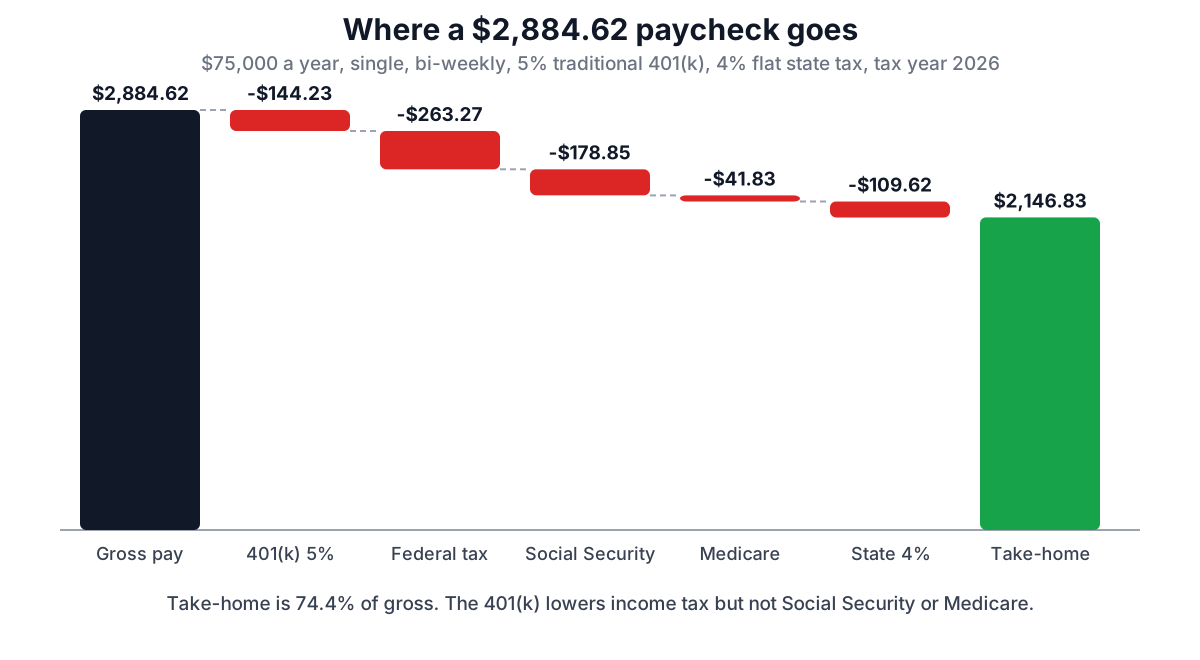
The chart above is a single filer earning $75,000 a year, paid bi-weekly, putting 5% into a traditional 401(k) and living in a state with a flat 4% income tax. Out of a gross check of $2,884.62, $2,146.83 arrives, about 74%. The rest of this guide explains each bar.
FICA: Social Security and Medicare
FICA is the payroll tax that funds Social Security and Medicare. It is the simplest part of the calculation because it is a flat percentage with no deductions or brackets:
- Social Security: 6.2% of wages, up to the yearly wage base. For 2026 the Social Security Administration set that base at $184,500, so the most anyone pays through one employer is 6.2% x 184,500 = $11,439.
- Medicare: 1.45% of all wages, with no cap.
- Additional Medicare tax: a further 0.9% on wages above $200,000 for single and head-of-household filers, $250,000 for joint filers and $125,000 for married filing separately. These thresholds are written into the law and are not indexed for inflation.
On $75,000, Social Security is $4,650 a year ($178.85 per bi-weekly check) and Medicare is $1,087.50 ($41.83).
The detail most people miss is which deductions reduce FICA wages. A traditional 401(k) contribution lowers your income tax but not your FICA tax: the 401(k) money is still Social Security and Medicare wages. Payroll HSA contributions and Section 125 premiums are exempt from both. In the example below, adding $100 of HSA and $150 of health premiums per paycheck cuts FICA wages from $75,000 to $68,500 and Social Security tax from $4,650 to $4,247.
If you earn more than the wage base, Social Security withholding stops partway through the year, so your last few paychecks of the year are bigger. The calculator shows the yearly total spread evenly across all paychecks, which is the right number for a budget but not for any single December stub.
Federal income tax with the 2026 brackets
Federal income tax starts from federal wages: gross pay minus the traditional 401(k), HSA and Section 125 deductions. From that, you subtract the standard deduction or, if larger, your itemized deductions. IRS Revenue Procedure 2025-32 sets the 2026 standard deduction at:
| Filing status | Standard deduction 2026 | 10% bracket ends | 22% bracket starts | 24% bracket starts |
|---|---|---|---|---|
| Single | $16,100 | $12,400 | $50,400 | $105,700 |
| Married filing jointly | $32,200 | $24,800 | $100,800 | $211,400 |
| Married filing separately | $16,100 | $12,400 | $50,400 | $105,700 |
| Head of household | $24,150 | $17,700 | $67,450 | $105,700 |
The full single schedule is 10% up to $12,400, 12% to $50,400, 22% to $105,700, 24% to $201,775, 32% to $256,225, 35% to $640,600 and 37% above that.
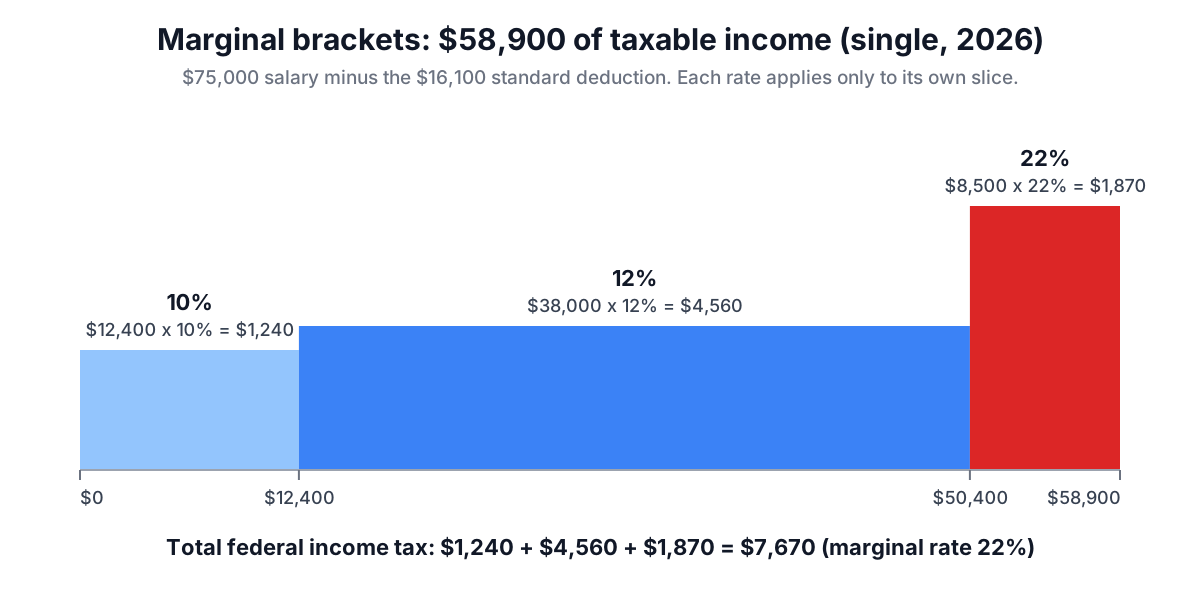
The brackets are marginal: each rate applies only to the slice of income inside its band. For a single filer on $75,000 with no 401(k), taxable income is 75,000 - 16,100 = $58,900, and the tax is:
- 10% of the first $12,400 = $1,240
- 12% of the next $38,000 (12,400 to 50,400) = $4,560
- 22% of the last $8,500 (50,400 to 58,900) = $1,870
Total federal income tax: $7,670, or $295 per bi-weekly check. The marginal rate is 22%, but the tax is only 10.2% of gross pay. The calculator shows this bracket-by-bracket split in its own table.
Now add the 5% traditional 401(k). That takes $3,750 out of federal wages, so taxable income falls to $55,150 and the tax to $6,845. The 401(k) cost you $3,750 of take-home pay, but saved $825 of federal tax (22% of $3,750) and, in a 4% state, another $150. Your net pay fell by only $2,775.
Age 65 and older
People who are 65 or older by the end of the year get an extra standard deduction: $2,050 if unmarried and $1,650 per qualifying spouse if married. For 2025 through 2028 there is also a separate senior deduction of $6,000 per person aged 65+, reduced by 6% of income above $75,000 ($150,000 for joint filers). Married couples filing separately cannot claim it.
A single 66-year-old earning $85,000 gets a standard deduction of 16,100 + 2,050 = $18,150 and a senior deduction of 6,000 - 0.06 x 10,000 = $5,400. Taxable income is $61,450 and federal tax $8,231. The calculator applies both automatically when you enter an age of 65 or more.
Credits
Credits come off the tax itself, not off income. The child tax credit for 2026 is $2,200 per qualifying child under 17, and the credit for other dependents is $500. Both shrink by $50 for every $1,000 (or part of $1,000) of income over $200,000, or $400,000 for joint filers.
A married couple filing jointly on $120,000 with a 6% 401(k) and two children has federal wages of $112,800, taxable income of $80,600 and tax before credits of $9,176. The $4,400 credit brings federal income tax down to $4,776 a year, $199 per semi-monthly check. With a 5% state rate their take-home is $3,883.50 per paycheck.
The calculator only uses credits to reduce tax to zero. If your credit is bigger than your tax, the refundable part (up to $1,700 per child for 2026) comes back when you file your return, not through your paycheck.
The 401(k) limit and the high-earner case
For 2026, IRS Notice 2025-67 sets the employee deferral limit at $24,500. Workers aged 50 or over can add a catch-up of $8,000, and those aged 60 to 63 at year end get a larger catch-up of $11,250. Traditional and Roth 401(k) contributions share the same limit. The calculator caps the two combined and tells you when the cap kicked in.
Here is a single filer on $250,000, bi-weekly, putting 10% into the 401(k):
| Line | Per year | Per paycheck |
|---|---|---|
| Gross pay | $250,000.00 | $9,615.38 |
| Traditional 401(k), capped | $24,500.00 | $942.31 |
| Federal income tax | $43,464.00 | $1,671.69 |
| Social Security | $11,439.00 | $439.96 |
| Medicare (1.45%) | $3,625.00 | $139.42 |
| Additional Medicare (0.9%) | $450.00 | $17.31 |
| Take-home pay | $166,522.00 | $6,404.69 |
Ten percent of $250,000 would be $25,000, so the deferral is capped at $24,500. Social Security stops at the $184,500 wage base, and the extra 0.9% Medicare tax applies to the $50,000 above $200,000. Federal tax is figured on 250,000 - 24,500 - 16,100 = $209,400 of taxable income, which reaches the 32% bracket.
A second rule from SECURE 2.0 starts in 2026: if your FICA wages from the employer were above $150,000 in the prior year, catch-up contributions must go in as Roth. The calculator does not enforce this split, so if it applies to you, move the catch-up amount into the Roth field.
State and local tax: what the calculator assumes
State income tax is where a nationwide calculator has to simplify. Nine states have no tax on wages, several have one flat rate, and the rest have their own brackets, deductions and credits. Some also differ from federal rules on what counts as taxable: Pennsylvania taxes 401(k) contributions, and California and New Jersey tax HSA contributions.
The Paycheck Calculator asks for a single flat state rate and a single flat local rate, applied to federal wages (after pre-tax deductions). That is exact in a flat-tax state if the base matches, and an approximation everywhere else. For a bracket state, the most useful number to enter is your effective state rate: last year's state tax divided by last year's wages. State disability and paid-leave payroll taxes are not included; add them as an after-tax deduction if your state has one.
Liability versus withholding
The calculator estimates your tax liability for the year and spreads it evenly over your paychecks. Your employer does something slightly different: it withholds tax using the percentage method tables in IRS Publication 15-T and the choices on your Form W-4. The two usually land close together for a single job with a W-4 filled in correctly, but they diverge when:
- you have two jobs, or both spouses work, and neither W-4 accounts for the other income;
- you have income without withholding, such as freelance work, interest or dividends;
- you get a bonus, which employers can withhold at a flat 22% supplemental rate;
- your Social Security wage base is reached mid-year, so individual checks change.
Any difference settles when you file your return as a refund or a balance due. If you expect to owe, the "extra federal withholding" field mirrors step 4(c) of the W-4 and shows how much per paycheck closes the gap.
Putting it to use
To estimate your own check, start with the gross figure and frequency from your offer letter or pay stub, pick your filing status, then add the deductions you elected at enrolment. Compare the result with your latest pay stub: if federal tax differs by more than a few dollars a check, look at your W-4. A few practical uses:
- Comparing offers. Run both salaries with the same deductions. Two offers $10,000 apart in gross pay are rarely $10,000 apart in take-home pay; in the 22% bracket with a 4% state rate the gap is closer to $6,600 before benefits.
- Choosing a 401(k) rate. Raise the percentage and watch how little the net falls. The 401(k) Calculator then shows what that contribution grows to.
- Budgeting. Put the per-paycheck net into the Budget Planner rather than the gross.
- Hourly and overtime pay. Convert with the Salary Calculator or Overtime Calculator first, then enter the annual figure here.
What the tool does not model: state brackets and state-specific credits, local taxes with their own bases, the earned income tax credit, self-employment tax, the 2025 to 2028 deductions for tips and overtime pay, and the exact Publication 15-T withholding formula. Treat the result as a careful estimate of where your money goes, not as a payroll run.
Sources
- IRS, Revenue Procedure 2025-32: 2026 tax rate tables, standard deductions, additional standard deduction for age 65 or blind, child tax credit amount and refundable portion.
- IRS newsroom, "IRS releases tax inflation adjustments for tax year 2026, including amendments from the One, Big, Beautiful Bill".
- Social Security Administration, Office of the Chief Actuary, "Contribution and Benefit Base" (2026: $184,500).
- IRS Notice 2025-67: 2026 limits for 401(k) deferrals and catch-up contributions.
- IRS Revenue Procedure 2025-19: 2026 HSA contribution limits.
- Internal Revenue Code section 3101(b)(2): additional Medicare tax thresholds.
- Public Law 119-21 (the One Big Beautiful Bill Act), which added the $6,000 senior deduction for 2025 to 2028 to IRC section 151.
- IRS Publication 15-T, Federal Income Tax Withholding Methods.
Related searches
- take home pay calculator 2026
- gross to net pay
- 2026 tax brackets
- standard deduction 2026
- social security wage base 2026
- fica tax
- does 401k reduce fica
- how much tax comes out of my paycheck
- bi-weekly paycheck after taxes
- additional medicare tax 0.9%