
Torque, Horsepower and RPM: Where 5252 and 9549 Come From
P = T x ω explained from first principles, the origin of the 5252 and 9549 constants, mechanical versus metric horsepower, and how to read motor nameplates and dyno charts without unit errors.
· 9 min read
Every rotating machine, from a cordless drill to a ship's diesel, is described by the same three quantities: how hard it twists (torque), how fast it turns (speed) and how quickly it does work (power). They are not independent. Fix any two and the third is decided by a single line of physics. This post derives that line, shows where the odd-looking constants 5,252 and 9,549 come from, untangles the two kinds of horsepower, and walks through the mistakes that turn up most often on motor sizing sheets. You can check every number here in the Torque and Power Calculator.
From work to P = T x ω
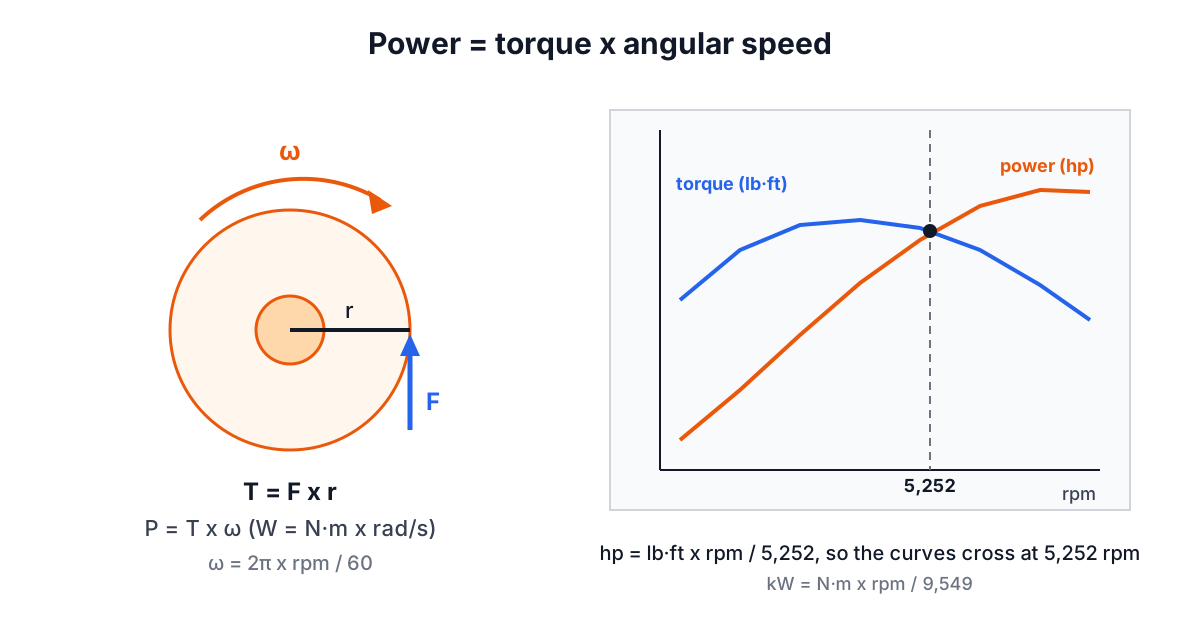
Work is force times distance. When a force F acts at the end of a lever of radius r and the lever turns through a small angle dθ, the force moves a distance r·dθ along its own direction, so the work done is F·r·dθ. The product F·r is the torque T, so the work is simply T·dθ. Divide by the time taken and you get power:
P = T x dθ/dt = T x ω
Here ω is the angular velocity in radians per second. In SI units this needs no constant at all: newton-metres times radians per second gives watts, because a radian is dimensionless and a newton-metre per second is a joule per second.
Nearly every error with this formula comes from putting rpm where rad/s belongs. One revolution is 2π radians and a minute is 60 seconds, so
ω (rad/s) = 2π x rpm / 60 = rpm / 9.5493
Forget that factor and the answer is wrong by almost ten. That is large enough to notice, which is the good news; the bad news is that the mistake often survives because a 10x error in a motor size gets "corrected" by someone picking a standard frame that happens to look reasonable.
Where 9,549 and 5,252 come from
Engineers rarely work in watts and rad/s on a shop floor, so the formula is usually written with the unit conversions folded in.
Metric form. With power in kilowatts and speed in rpm:
P (kW) = T (N·m) x rpm / 9,549.3
The constant is 60 x 1,000 / 2π = 9,549.3: 60 to turn minutes into seconds, 1,000 to turn watts into kilowatts, and 2π to turn revolutions into radians.
US form. James Watt defined one horsepower as 33,000 foot-pounds of work per minute, a figure he arrived at from observing mill horses and then rounded generously. With torque in lb·ft and speed in rpm, the work per minute is T x 2π x rpm foot-pounds, so
hp = T (lb·ft) x 2π x rpm / 33,000 = T x rpm / 5,252.1
That 5,252 has a well known side effect. Plot torque in lb·ft and power in hp against rpm on one chart, and the two curves always cross at 5,252 rpm, whatever the engine. Below that speed the torque number is larger than the horsepower number; above it, smaller. It is a property of the units, not of engines. Plot N·m and kW instead and the crossing moves to 9,549 rpm, which most engines never reach.
Two horsepowers, and other unit traps
There are two horsepowers in everyday use and they are not the same size.
| Unit | Definition | Watts |
|---|---|---|
| Mechanical (imperial) hp | 550 ft·lbf/s | 745.70 |
| Metric hp (PS, CV, pk) | 75 kgf·m/s | 735.50 |
| Electrical hp (US motor ratings) | 746 W by convention | 746 |
The metric horsepower is about 1.4% smaller. That is why a European car rated at 150 PS appears in a US brochure as 148 hp, and why the kilowatt figure (110.3 kW) is the only one that cannot be misread. When in doubt, convert to kilowatts first.
Torque has its own variety: newton-metres, pound-feet, pound-inches and kilogram-force metres. The exact factors follow from the defined pound (0.45359237 kg), the international foot (0.3048 m) and standard gravity (9.80665 m/s²):
- 1 lb·ft = 1.35582 N·m
- 1 lb·in = 0.112985 N·m
- 1 kgf·m = 9.80665 N·m
"Foot-pounds" and "pound-feet" are used interchangeably for torque in casual speech. Strictly, ft·lbf is the energy unit and lb·ft the torque unit, but the numbers are identical.
Worked examples
Shaft torque from a motor nameplate. A 7.5 kW four-pole motor is rated at 1,450 rpm. The full-load torque is
T = 7,500 W / (2π x 1,450 / 60) = 7,500 / 151.84 = 49.39 N·m (36.43 lb·ft)
That is the continuous torque a coupling or gearbox input must carry. The starting torque of a direct-on-line induction motor is commonly two to three times higher, and the breakdown torque higher again, so couplings and keys are usually sized with a service factor on top.
Power from a dyno reading. An engine measures 300 lb·ft at 4,000 rpm:
hp = 300 x 4,000 / 5,252.1 = 228.5 hp = 170.4 kW
If the same engine still made 300 lb·ft at 5,252 rpm, it would be making exactly 300 hp there.
Same power, different speeds. Suppose a process needs 31.4 kW. At 3,000 rpm that is 100 N·m. At 750 rpm it is 400 N·m. Torque, not power, sets the size of shafts, keys, couplings and gear teeth, so a slow drive of the same power is physically much larger. This is the reason a gearbox sits between a fast, compact motor and a slow, heavy load: it trades speed for torque while carrying nearly the same power. The table in the calculator shows this for 750 to 6,000 rpm, and the Gear Ratio Calculator carries the numbers through each stage of a reducer.
Common mistakes and judgment calls
Using peak torque with peak-power rpm. An engine's maximum torque and maximum power occur at different speeds. Multiplying the headline torque by the redline gives a power the engine never makes. Use the torque at the rpm you care about.
Mixing input and output power. A motor nameplate gives mechanical output at the shaft. Electrical input is higher by the efficiency, typically 85 to 96% for industrial motors. For pump and fan drives, the shaft power is in turn higher than the fluid power; the Pump Power Calculator handles that step, and the Three-Phase Power Calculator gets from shaft power back to line current.
Flywheel versus wheel power. Manufacturer figures are usually measured at the crankshaft to SAE J1349 or a similar standard. A chassis dyno reads power at the wheels, lower by the drivetrain losses, often 10 to 20%.
Assuming power is conserved without losses. Through a gearbox or belt drive, torque scales up as speed falls, but each stage loses a little. A three-stage helical reducer at 98% per mesh passes about 94% of its input; a worm reducer may pass far less.
Torque at zero speed. The formula says power is zero when the shaft is stalled, which is true: a motor holding a load still does no mechanical work, though it may be dissipating a lot of heat. That is why the calculator refuses to solve for torque when speed is zero.
When the simple model is not enough
P = T x ω is exact for steady rotation. It describes average power when torque fluctuates, as it does in a single-cylinder engine or a reciprocating compressor, and the peak torque in those machines can be several times the mean. Shaft and coupling design then uses the peak, plus a fatigue check on the fluctuating part. During acceleration some of the torque goes into speeding up the rotating inertia (T = J·α) rather than into the load, which matters when sizing motors for conveyors, hoists and machine tool spindles that start and stop often.
For a quick conversion between any of these units, the Unit Converter covers torque and power, and the Horsepower Calculator works from vehicle performance figures. For transmission design, carry the torque into the Pulley and Belt Calculator or the gear calculator and size the components there.
The calculator results, like the numbers in this post, are for preliminary design. Where a shaft, coupling or lifting device carries a safety-critical load, have the design checked by a qualified engineer against the governing standard and the manufacturer's ratings.