
Unit Conversion Factors: Exact Definitions, Gallons and Temperature Offsets
Why an inch is exactly 2.54 cm, why US and UK gallons differ by 20%, and why temperature cannot be converted with a single multiplication factor.
· 5 min read
A recipe calls for one gallon of stock, a spec sheet lists a tolerance of 0.002 inches, and a weather site in another country says it is 30 degrees. Each needs a conversion, and each hides a trap: which gallon, how many decimal places, which degree. The good news is that most everyday conversions are not approximations at all. Since 1959 the inch, foot, mile and pound have been defined in metric terms, so the factors are exact and you can check any converter against them.
This article explains where those exact factors come from, why volume and temperature behave differently from everything else, and how to avoid the rounding mistakes that creep in. The Unit Converter shows every unit in a category at once, which makes it easy to follow along.
Exact definitions: the 1959 agreement
Before 1959, the US inch and the British inch were slightly different, because each country defined its yard against its own physical standard. Six countries (the US, UK, Canada, Australia, New Zealand and South Africa) agreed on a common international yard and pound in July 1959:
- 1 yard = 0.9144 metres exactly
- 1 pound (avoirdupois) = 0.45359237 kilograms exactly
Everything else follows by arithmetic. Here are the factors the converter uses:
| Unit | Exact value | Derived from |
|---|---|---|
| inch | 2.54 cm | 1 yd ÷ 36 |
| foot | 0.3048 m | 1 yd ÷ 3 |
| mile | 1,609.344 m | 1,760 yd |
| square foot | 0.09290304 m² | 0.3048² |
| acre | 4,046.8564224 m² | 43,560 ft² |
| ounce | 28.349523125 g | 1 lb ÷ 16 |
| stone | 6.35029318 kg | 14 lb |
| US (short) ton | 907.18474 kg | 2,000 lb |
Because these are definitions, a converter that shows 1 acre as 4,046.86 m² is rounding, not measuring. Older tools often hard-code rounded factors such as 0.453592 for the pound. That is close enough for a shopping list, but the error compounds: a factor rounded to six digits can be off in the sixth digit of every result, and squaring or cubing it for area or volume makes the drift worse.
One leftover: the US survey foot, 1200/3937 metres, was kept for land surveying after 1959 because so many maps were built on it. It differs from the international foot by about 2 parts per million, or roughly 3 mm per mile. NIST and NOAA retired it at the end of 2022. If you work with old US land records you may still meet it; this converter uses the international foot.
Volume: two gallons, two pints
Volume is where the US and UK systems went different ways, and the 1959 agreement did not fix it.
- US gallon: defined as 231 cubic inches. With the exact inch, that is 3.785411784 litres.
- Imperial (UK) gallon: defined in 1985 as exactly 4.54609 litres. It is about 20% larger.
The smaller units do not scale the same way either. A US gallon has 128 US fluid ounces; an imperial gallon has 160 imperial fluid ounces. A US pint is 16 US fluid ounces (473 ml) and an imperial pint is 20 imperial fluid ounces (568 ml).
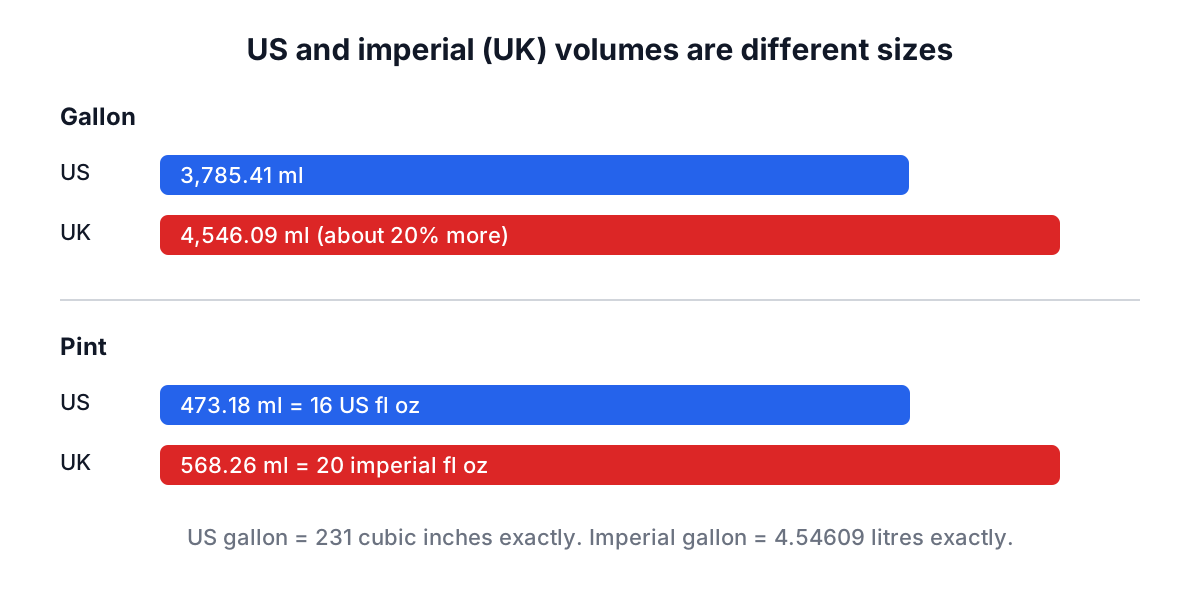
The converter lists US cups, pints, quarts, gallons and fluid ounces, plus the UK gallon labelled separately. Converting 1 Gallon (UK) shows 1.20095 Gallon (US), which is the ratio people half-remember as "about a fifth more".
Practical consequence: fuel economy in miles per gallon from the UK looks about 20% better than the same car's US figure. Recipes from British and American sources need different cup and pint conversions too. A US "cup" in nutrition labelling is 240 ml, while the converter's US cup is the customary 236.588 ml (half a US pint). Those small differences are why baking by weight is more reliable than by volume.
Temperature: offsets as well as factors
Every category above converts with one multiplication. Temperature does not, because the scales put zero in different places.
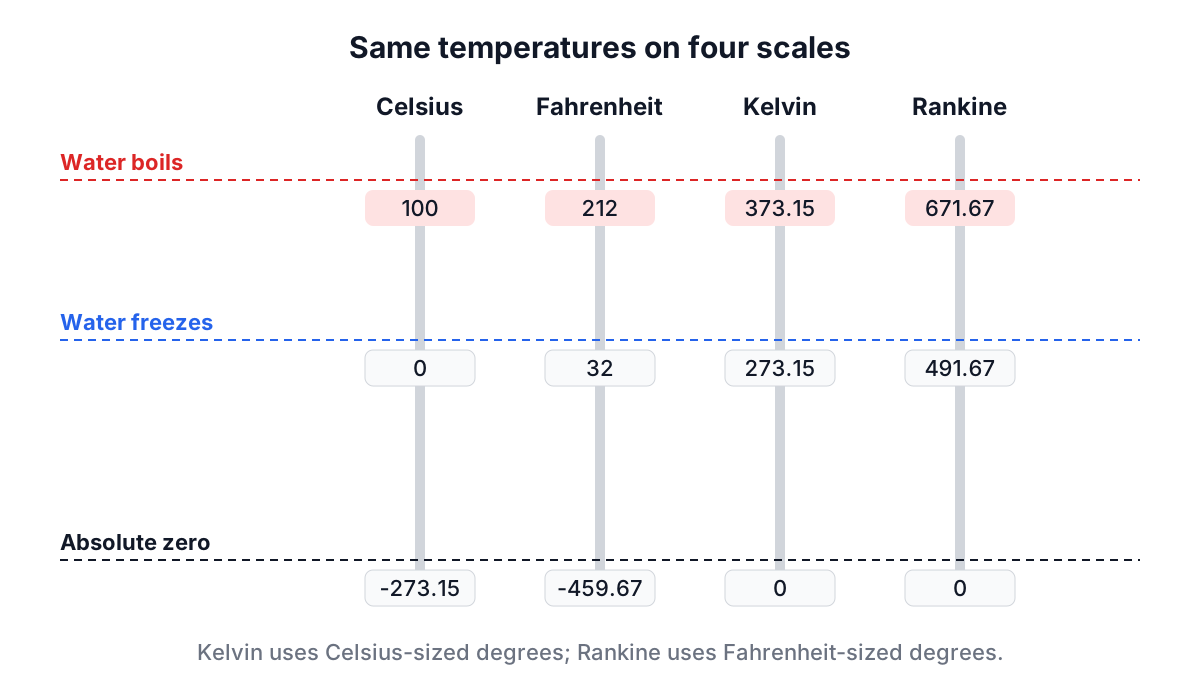
The formulas, all routed through Celsius in the converter:
F = C × 9/5 + 32
C = (F − 32) × 5/9
K = C + 273.15
R = (C + 273.15) × 9/5     (Rankine: Fahrenheit-sized degrees from absolute zero)
A worked example in the tool: choose the Temperature tab, type 100 and pick Celsius. The list shows Fahrenheit 212, Kelvin 373.15 and Rankine 671.67. Change the input to -40 and Fahrenheit also reads -40, the one point where the two scales cross.
Two mistakes come from forgetting the offset:
- Converting a difference as if it were a temperature. A rise of 10 °C is a rise of 18 °F, not 50 °F. For differences, use only the 9/5 factor. The converter converts temperatures, so for a difference convert both ends and subtract.
- Doubling. 20 °C is not "twice as warm" as 10 °C. Ratios only make sense on absolute scales: 293.15 K versus 283.15 K is about 3.5% warmer.
Kelvin has no degree sign and no negative values. Since 2019 it is defined by fixing the Boltzmann constant, but 0 °C is still exactly 273.15 K.
Precision and display
The converter keeps full double precision internally and lets you choose 2, 4, 6, 8 or 10 digits for display. How that setting is applied depends on the size of the number:
- 1 or more: formatted with your locale's thousands separator and up to that many decimal places, such as 4,046.856422.
- Between 0.000001 and 1: that many significant digits, so 12 micrometres shows as 0.000472441 inches.
- Very large or very small: scientific notation, such as a light year in nanometres.
Floating point means some exact conversions print with a tiny tail if you ask for enough digits. 1 inch is 0.0254 m and 1 cm is 0.01 m, but 0.0254 ÷ 0.01 in binary floating point is 2.5399999999999996. At ten digits or fewer the display rounds that back to 2.54. If you need guaranteed exact decimal results, for example in a billing system, do the conversion with integers or a decimal library rather than floats.
Common mistakes
- Mixing US and imperial units. Gallons, pints, fluid ounces and tons all differ. Check the source.
- Confusing mass and weight units. Pounds and kilograms here are mass. A pound-force is a different unit used in engineering.
- Using a rounded factor and then squaring it. Convert lengths to the target unit first, then compute area, or use the area category directly.
- Assuming a "year" is 365 days. The converter's year is the Julian year of 365.25 days (31,557,600 seconds), used in astronomy and for the light year. Calendar arithmetic belongs in a date tool such as Date Arithmetic.
- Pasting localized output into code. Remove the thousands separators first.
For quick sums on the converted values, the Scientific Calculator evaluates full expressions, and the BMI Calculator takes both metric and imperial inputs. Keep the exact factors in the table above somewhere handy; with the inch and the pound memorised, you can sanity-check almost any everyday conversion in your head.